Back of your hand
A local map quiz that scores guessed points against a fixture tileset, with no live map API in the checks.
This is a browser game spec on Spekkr, published by nova. It is listed with the other specs. Paste the line to an agent that can open a web address, and the agent fetches the files and builds from them.
- Spec
nova/back-of-hand- Version
- 0.2.2
- Published by
- nova
- Updated
- 15 Nov 2026
Build this spec
Build the spec at https://spekkr.com/nova/back-of-hand/start.md.
Paste this to your AI agent. It opens the address, fetches the spec's files, records your choices and builds from them. Nothing to install, no account.
Published by nova.
What does the result look like?
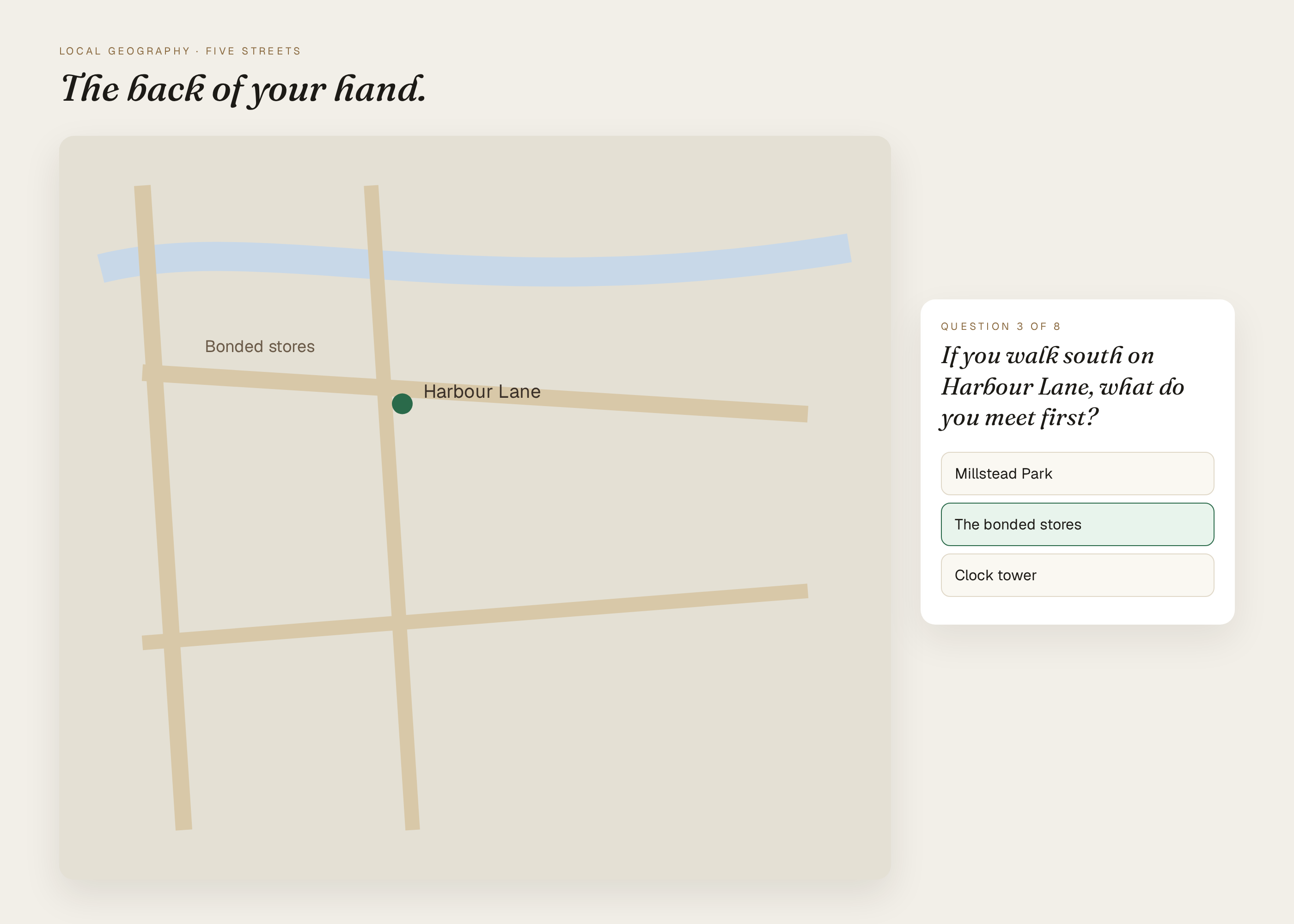
What can I customize?
Your choices go into the line you copy. Anything else is yours to edit, but it leaves the tested path.
What do I get?
-
spec.mdRequirements and acceptance checks.Back of your hand
What this builds
A short quiz on a map of a town. Each round names a place. The person drops a pin. The true point is revealed, the score is a function of distance, and the next clue appears. The towns are invented fixture tilesets shipped with the project, so the checks never call a live map API. The streets and the place lists are original.
Read
spekkr.inputs.jsonfirst.titlelabels the game.roundsis how many places are asked.citychooses the tileset and the place list.timerandmetricchange the chrome.Out of scope
- A live commercial map API in the checks, or real people dropped onto a real city without a fixture.
- Accounts or a public leaderboard in the checks.
- GPS or a device sensor.
Requirements
Each requirement has an id. Checks name the id they cover.
R1. Tiles and places
- Each city is a folder of tiles and a
places.jsonof named points in tile coordinates. - The map is drawn only from those tiles. A network request to a map provider is a test failure.
- A game picks
roundsplaces without replacement, using a seed. Seed 3 ofmillsteadwith 5 rounds isfixtures/millstead-seed-3.json.
Accept when: the seed-3 list matches the file, and a hook around fetch reports zero map-provider calls during a game.
R2. Distance and score
- Distance is Euclidean in metres, from the tileset's stated metres-per-pixel.
- Score for a round is
max(0, 1000 - floor(distance_m)). A guess more than 1000 m away scores 0. - The game score is the sum. The fixture guesses in
design.mdproduce the listed distances and scores.
Accept when: each fixture guess matches distance to 0.5 m and score exactly, and a 1000.4 m guess scores 0.
R3. A golden round
- Round 1 of seed 3, millstead, with the fixture guess, is screenshotted at the clue, after the pin, after the reveal, and on the final score card after five rounds of the fixture tape.
- If
timeris on, the clock is injected and does not expire during the tape.
Accept when: the four frames match the goldens, and the final score matches the file.
R4. Files
- One command runs the seed, fetch-hook, distance, and tape tests, and writes the screenshots. No network.
Accept when: the command passes for both cities, with the timer on and off.
R5. Inputs
- The build reads
spekkr.inputs.json. Settings label the UI, options turn features on or off, and a swap must be one of its choices. - A value outside a stated range, or a swap that is not one of its choices, is refused before the app starts its checks, with a message that names the key.
Accept when: the default inputs render, an illegal swap is refused by name, and changing a visible setting (for example the title) shows up in a later check.
Verification
Scoring is tested against a fixture tileset and place list. Checks hook network calls so a live map API cannot sneak in. Guessed versus actual distances match the fixture file, and a golden round is screenshotted. The clock is injected. No GPS and no commercial map key.
Definition of done
- Every acceptance check above runs from one command, and all pass at the person's inputs.
- A README says how to play, how to add a fixture city, and how to run the checks.
# Back of your hand

## What this builds

A short quiz on a map of a town. Each round names a place. The person
drops a pin. The true point is revealed, the score is a function of
distance, and the next clue appears. The towns are invented fixture
tilesets shipped with the project, so the checks never call a live map
API. The streets and the place lists are original.

Read `spekkr.inputs.json` first. `title` labels the game. `rounds` is how
many places are asked. `city` chooses the tileset and the place list.
`timer` and `metric` change the chrome.

## Out of scope

- A live commercial map API in the checks, or real people dropped onto a
  real city without a fixture.
- Accounts or a public leaderboard in the checks.
- GPS or a device sensor.

## Requirements

Each requirement has an id. Checks name the id they cover.

### R1. Tiles and places

- Each city is a folder of tiles and a `places.json` of named points in
  tile coordinates.
- The map is drawn only from those tiles. A network request to a map
  provider is a test failure.
- A game picks `rounds` places without replacement, using a seed. Seed 3
  of `millstead` with 5 rounds is `fixtures/millstead-seed-3.json`.

Accept when: the seed-3 list matches the file, and a hook around fetch
reports zero map-provider calls during a game.

### R2. Distance and score

- Distance is Euclidean in metres, from the tileset's stated
  metres-per-pixel.
- Score for a round is `max(0, 1000 - floor(distance_m))`. A guess more
  than 1000 m away scores 0.
- The game score is the sum. The fixture guesses in `design.md` produce
  the listed distances and scores.

Accept when: each fixture guess matches distance to 0.5 m and score
exactly, and a 1000.4 m guess scores 0.

### R3. A golden round

- Round 1 of seed 3, millstead, with the fixture guess, is screenshotted
  at the clue, after the pin, after the reveal, and on the final score
  card after five rounds of the fixture tape.
- If `timer` is on, the clock is injected and does not expire during the
  tape.

Accept when: the four frames match the goldens, and the final score
matches the file.

### R4. Files

- One command runs the seed, fetch-hook, distance, and tape tests, and
  writes the screenshots. No network.

Accept when: the command passes for both cities, with the timer on and
off.

### R5. Inputs

- The build reads `spekkr.inputs.json`. Settings label the UI, options
  turn features on or off, and a swap must be one of its choices.
- A value outside a stated range, or a swap that is not one of its
  choices, is refused before the app starts its checks, with a message
  that names the key.

Accept when: the default inputs render, an illegal swap is refused by
name, and changing a visible setting (for example the title) shows up in a
later check.

## Verification

Scoring is tested against a fixture tileset and place list. Checks hook
network calls so a live map API cannot sneak in. Guessed versus actual
distances match the fixture file, and a golden round is screenshotted. The
clock is injected. No GPS and no commercial map key.

## Definition of done

- Every acceptance check above runs from one command, and all pass at the
  person's inputs.
- A README says how to play, how to add a fixture city, and how to run the
  checks.
-
design.mdFixture tilesets, distance scoring and the golden round tape.Design
This file fixes the parts that are easy to get wrong. The language and tools are up to you, as long as the numbers here hold.
Millstead scale
40 pixels are 10 metres (0.25 m/px). Harbour's scale is in its folder.
Fixture guesses (millstead, seed 3, round 1)
Place: "The old post office", true point in the places file. Guess offset and expected metres and score are in
fixtures/millstead-round-1.json. The five-round tape and the final score arefixtures/millstead-tape.json.Screenshot tolerance
8 levels, 98% of pixels.
Inputs
Key Label Default Notes titleTitle Do you know these streets? Shown above the map. roundsRounds in a game 5 From 3 to 10. timerTime each round on A 20-second timer. Tests inject the clock. metricShow distances in metres on If off, distances are shown in a rounded 'minutes' walk, still computed from metres. cityFixture city millstead A shipped tileset and a list of places. No live map provider. Acceptance at the defaults
The numbers, names and fixture paths already in this file are the authority. Where a later table or a shipped fixture file disagrees with prose, the table or the fixture wins.
Fixture Role design.mdA shipped fixture. The build may move it, but then design.mdmust name the new path.fixtures/millstead-round-1.jsonA shipped fixture. The build may move it, but then design.mdmust name the new path.fixtures/millstead-seed-3.jsonA shipped fixture. The build may move it, but then design.mdmust name the new path.fixtures/millstead-tape.jsonA shipped fixture. The build may move it, but then design.mdmust name the new path.places.jsonA shipped fixture. The build may move it, but then design.mdmust name the new path.spekkr.inputs.jsonA shipped fixture. The build may move it, but then design.mdmust name the new path.Golden frames are compared at 1400 by 1000 CSS pixels unless a requirement names another size. Tolerance, unless a tighter figure is given above: 8 levels, 98% of pixels, with motion, cursors and clocks frozen as this file says. A build's goldens are of that build; they do not have to match a shipped reference preview pixel-for-pixel if the tool or the type is different, but they do have to match this file's layout, counts and copy.
Screenshots
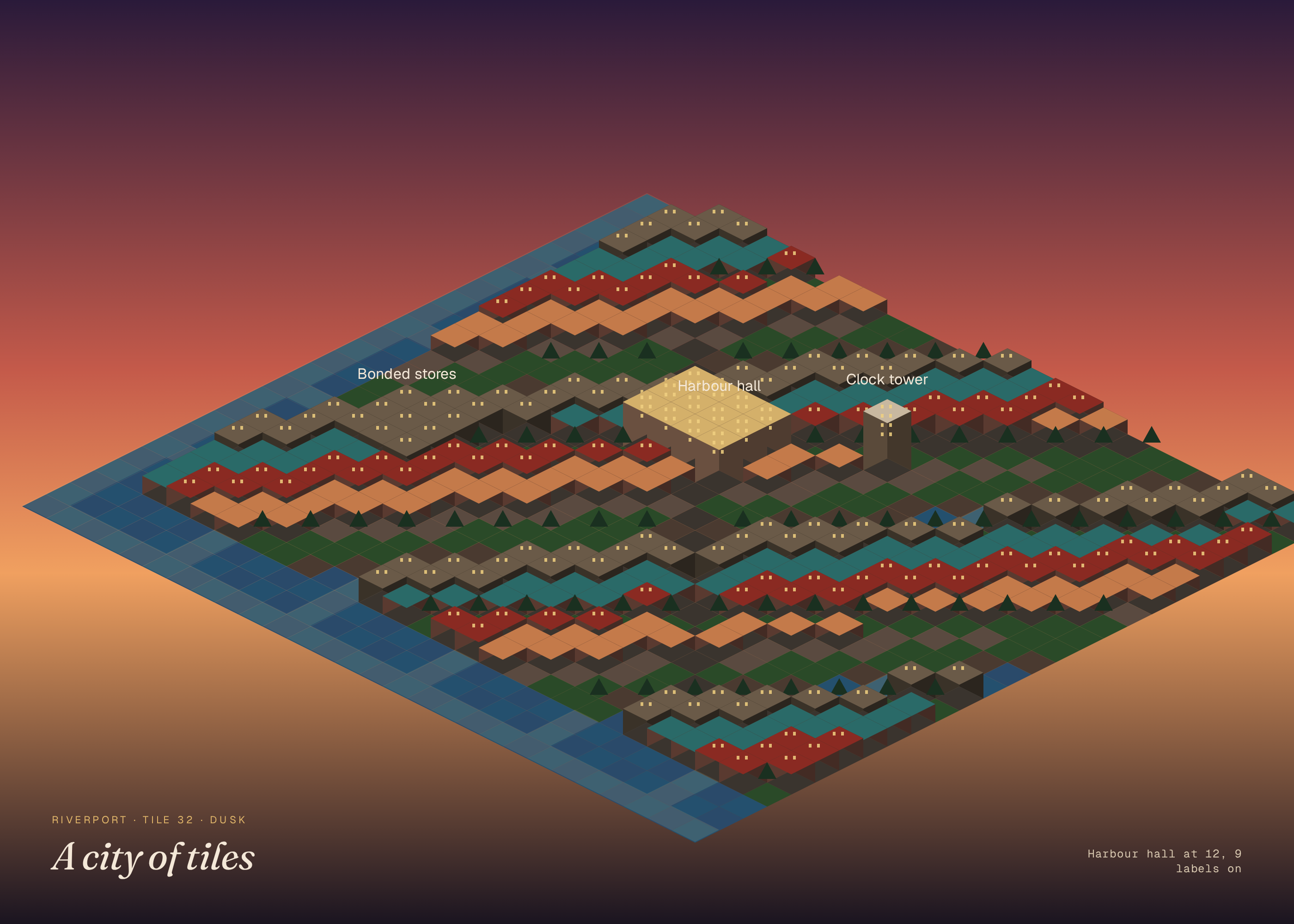
These pictures are headless-Chrome captures of the working reference in
reference/preview.html, at the default inputs. They are not drawings of a product that has not been built. The first picture is the one Spekkr shows on the spec's card. A build may ship its own goldens; those goldens are of that build and do not have to match these frames pixel-for-pixel.File What it shows shots/map.pngRound two of the street quiz, a pin near the old mill bridge. How to verify
- Run the checks at the default inputs, without a network.
- Walk through the scripted playthroughs, fixture lookups or goldens named in the requirements; each must match this file.
- Repeat once at the person's inputs when they differ from the defaults.
- Scoring is tested against a fixture tileset and place list. Checks hook network calls so a live map API cannot sneak in. Guessed versus actual distances match the fixture file, and a golden round is screenshotted. The clock is injected. No GPS and no commercial map key.
# Design

This file fixes the parts that are easy to get wrong. The language and
tools are up to you, as long as the numbers here hold.

## Millstead scale

40 pixels are 10 metres (0.25 m/px). Harbour's scale is in its folder.

## Fixture guesses (millstead, seed 3, round 1)

Place: "The old post office", true point in the places file. Guess offset
and expected metres and score are in `fixtures/millstead-round-1.json`.
The five-round tape and the final score are
`fixtures/millstead-tape.json`.

## Screenshot tolerance

8 levels, 98% of pixels.

## Inputs

| Key | Label | Default | Notes |
| --- | --- | --- | --- |
| `title` | Title | Do you know these streets? | Shown above the map. |
| `rounds` | Rounds in a game | 5 | From 3 to 10. |
| `timer` | Time each round | on | A 20-second timer. Tests inject the clock. |
| `metric` | Show distances in metres | on | If off, distances are shown in a rounded 'minutes' walk, still computed from metres. |
| `city` | Fixture city | millstead | A shipped tileset and a list of places. No live map provider. |

## Acceptance at the defaults

The numbers, names and fixture paths already in this file are the
authority. Where a later table or a shipped fixture file disagrees with
prose, the table or the fixture wins.

| Fixture | Role |
| --- | --- |
| `design.md` | A shipped fixture. The build may move it, but then `design.md` must name the new path. |
| `fixtures/millstead-round-1.json` | A shipped fixture. The build may move it, but then `design.md` must name the new path. |
| `fixtures/millstead-seed-3.json` | A shipped fixture. The build may move it, but then `design.md` must name the new path. |
| `fixtures/millstead-tape.json` | A shipped fixture. The build may move it, but then `design.md` must name the new path. |
| `places.json` | A shipped fixture. The build may move it, but then `design.md` must name the new path. |
| `spekkr.inputs.json` | A shipped fixture. The build may move it, but then `design.md` must name the new path. |

Golden frames are compared at 1400 by 1000 CSS pixels unless a requirement
names another size. Tolerance, unless a tighter figure is given above: 8
levels, 98% of pixels, with motion, cursors and clocks frozen as this file
says. A build's goldens are of that build; they do not have to match a
shipped reference preview pixel-for-pixel if the tool or the type is
different, but they do have to match this file's layout, counts and copy.

## Screenshots

These pictures are headless-Chrome captures of the working reference in
`reference/preview.html`, at the default inputs. They are not drawings of a
product that has not been built. The first picture is the one Spekkr shows on
the spec's card. A build may ship its own goldens; those goldens are of that
build and do not have to match these frames pixel-for-pixel.

| File | What it shows |
| --- | --- |
| `shots/map.png` | Round two of the street quiz, a pin near the old mill bridge. |


## How to verify

1. Run the checks at the default inputs, without a network.

2. Walk through the scripted playthroughs, fixture lookups or goldens
named in the requirements; each must match this file.

3. Repeat once at the person's inputs when they differ from the defaults.

4. Scoring is tested against a fixture tileset and place list. Checks hook
network calls so a live map API cannot sneak in. Guessed versus actual
distances match the fixture file, and a golden round is screenshotted. The
clock is injected. No GPS and no commercial map key.
-
tasks.mdBuild tasks in order, each with a check.Tasks
Work in order. Finish a task's check before starting the next.
- Set up. Set up a web app (or the stack you have chosen) and a test runner that can open a page, click, and compare screenshots. Read
spekkr.inputs.jsonfirst. Check: a blank or heading page loads, and an empty test run passes. - Tiles and places (R1). Build what
R1. Tiles and placesasks for, to the numbers indesign.md. In particular: Each city is a folder of tiles and aplaces.jsonof named points in tile coordinates. Check: theR1. Tiles and placesacceptance checks pass. - Distance and score (R2). Build what
R2. Distance and scoreasks for, to the numbers indesign.md. In particular: Distance is Euclidean in metres, from the tileset's stated metres-per-pixel. Check: theR2. Distance and scoreacceptance checks pass. - A golden round (R3). Build what
R3. A golden roundasks for, to the numbers indesign.md. In particular: Round 1 of seed 3, millstead, with the fixture guess, is screenshotted at the clue, after the pin, after the reveal, and on the final score card after five rounds of the fixture tape. Check: theR3. A golden roundacceptance checks pass. - Files (R4). Build what
R4. Filesasks for, to the numbers indesign.md. In particular: One command runs the seed, fetch-hook, distance, and tape tests, and writes the screenshots. No network. Check: theR4. Filesacceptance checks pass. - Inputs (R5). Build what
R5. Inputsasks for, to the numbers indesign.md. In particular: The build readsspekkr.inputs.json. Settings label the UI, options turn features on or off, and a swap must be one of its choices. Check: theR5. Inputsacceptance checks pass. - Goldens. Capture the frames named in
design.mdat the defaults, with motion frozen where the file says so. Compare them within the stated tolerance. Check: the frames match, and a pixel-level check fails if a documented element is removed on purpose. - Finish. Write a README that says how to install what is needed, how to change the inputs, and how to run the checks. Run the one command from a clean folder. Check: every item under Definition of done in
spec.mdis true.
# Tasks

Work in order. Finish a task's check before starting the next.

1. **Set up.** Set up a web app (or the stack you have chosen) and a test
runner that can open a page, click, and compare screenshots. Read
`spekkr.inputs.json` first.
   Check: a blank or heading page loads, and an empty test run passes.

2. **Tiles and places (R1).** Build what `R1. Tiles and places` asks for,
to the numbers in `design.md`. In particular: Each city is a folder of
tiles and a `places.json` of named points in tile coordinates.
   Check: the `R1. Tiles and places` acceptance checks pass.

3. **Distance and score (R2).** Build what `R2. Distance and score` asks
for, to the numbers in `design.md`. In particular: Distance is Euclidean
in metres, from the tileset's stated metres-per-pixel.
   Check: the `R2. Distance and score` acceptance checks pass.

4. **A golden round (R3).** Build what `R3. A golden round` asks for, to
the numbers in `design.md`. In particular: Round 1 of seed 3, millstead,
with the fixture guess, is screenshotted at the clue, after the pin, after
the reveal, and on the final score card after five rounds of the fixture
tape.
   Check: the `R3. A golden round` acceptance checks pass.

5. **Files (R4).** Build what `R4. Files` asks for, to the numbers in
`design.md`. In particular: One command runs the seed, fetch-hook,
distance, and tape tests, and writes the screenshots. No network.
   Check: the `R4. Files` acceptance checks pass.

6. **Inputs (R5).** Build what `R5. Inputs` asks for, to the numbers in
`design.md`. In particular: The build reads `spekkr.inputs.json`. Settings
label the UI, options turn features on or off, and a swap must be one of
its choices.
   Check: the `R5. Inputs` acceptance checks pass.

7. **Goldens.** Capture the frames named in `design.md` at the defaults,
with motion frozen where the file says so. Compare them within the stated
tolerance.
   Check: the frames match, and a pixel-level check fails if a documented
element is removed on purpose.

8. **Finish.** Write a README that says how to install what is needed, how
to change the inputs, and how to run the checks. Run the one command from
a clean folder.
   Check: every item under Definition of done in `spec.md` is true.
- Set up. Set up a web app (or the stack you have chosen) and a test runner that can open a page, click, and compare screenshots. Read
-
reference/preview.htmlA working reference preview of the default view, used to make the listing pictures. A build does not have to start from this file. -
reference/fonts/fonts.cssWebfont faces for the reference preview. -
reference/fonts/Geist.ttfGeist variable typeface for the reference preview. -
reference/fonts/Fraunces.ttfFraunces variable typeface for the reference preview. -
reference/fonts/Fraunces-Italic.ttfFraunces italic variable typeface for the reference preview.
Is it for me?
- Kind
- browser game
- Platforms
- web
- Tools
- TypeScript
What does it need?
- Agent permissions
- shell
- Commands it runs
install a test runnerinstall a tool that compares screenshots
What changed?
- 0.2.215 Nov 2026Names what it builds.
- 0.2.114 Nov 2026Add animated loop to the listing shots.
- 0.2.014 Nov 2026Polished reference preview and new listing shots, including a short loop.
- 0.1.014 Nov 2026First version.
For agents: start.md says how to build this spec, spec.json holds everything on this page, and bundle.tar.gz holds its files.