Element craft
Drag two elements together to make a third, and chase unlikely recipes from a frozen table you can remix.
This is a browser game spec on Spekkr, published by nova. It is listed with the other specs. Paste the line to an agent that can open a web address, and the agent fetches the files and builds from them.
- Spec
nova/element-craft- Version
- 0.2.2
- Published by
- nova
- Updated
- 15 Nov 2026
Build this spec
Build the spec at https://spekkr.com/nova/element-craft/start.md.
Paste this to your AI agent. It opens the address, fetches the spec's files, records your choices and builds from them. Nothing to install, no account.
Published by nova.
What does the result look like?
What can I customize?
Your choices go into the line you copy. Anything else is yours to edit, but it leaves the tested path.
What do I get?
-
spec.mdRequirements and acceptance checks.Element craft
What this builds
A bench of elements. Drag one onto another and a recipe table decides what, if anything, appears. The table is a frozen file shipped with the project, so a build and its tests never call a live model or an API. The tables in this spec are original. People can later swap in their own table without changing the rules.
Read
spekkr.inputs.jsonfirst.titlelabels the bench.tablechooses the recipe file.starting_packis the opening set, and must be ids that exist in that table's starting list or be refused.discoveriesandduplicateschange the bench.Out of scope
- A live language model or any network call to invent recipes.
- Accounts, clouds, or a public recipe book.
- Chemistry claims. Names are playful, not scientific.
Requirements
Each requirement has an id. Checks name the id they cover.
R1. The bench
- At start, one tile per id in
starting_packis on the bench, with the label from the table. - Tiles can be dragged. Dropping a tile on another is a combine. Dropping it on empty space just moves it.
titleis the heading.
Accept when: a load with the default pack shows four tiles, and a screenshot of the bench matches the
benchgolden within the tolerance indesign.md.R2. The recipe table
- A recipe is an unordered pair of ids and a product id, or a miss (no product).
- The chosen
tableis a JSON file in the repo. Combining A with B is the same as B with A. - The product, if any, is added to the bench as a new tile. If
duplicatesis off and the product is already on the bench, no second tile is added, but the discovery is still recorded if new.
Accept when: every fixture pair in
design.mdreturns the stated product or miss, and a swapped-order call returns the same.R3. Discoveries
- A discovery is a product the person has made at least once. It is recorded even if
discoveriesis off. - If
discoveriesis on, a side list shows each discovery in the order it was first made, with the pair that first made it. - Starting-pack tiles are not discoveries.
Accept when: the first-combo fixture records one discovery, the list shows it only when the option is on, and making it again does not add a second row.
R4. Unknown pairs
- A pair with no recipe is a miss. The two tiles stay where they are. A short miss note appears for one second and then leaves.
- A tile cannot be combined with itself unless the table has a recipe for that pair.
Accept when: the miss fixture leaves both tiles and writes no discovery.
R5. Inputs
- A
starting_packid that is not in the chosen table is refused before the bench loads, with a message that names the id. - An empty pack is refused.
Accept when: the bad id
bogusis refused, and the default pack loads.R6. Files
- One command runs the table tests, the UI combine tests, and writes the four screenshots. No network.
Accept when: the command passes for both tables.
Verification
A frozen recipe table, never a live model, returns the specified product for each fixture pair and a miss for an unknown pair. Order of the two inputs does not matter. UI tests cover drag-combine and take a golden screenshot of a known combo. No network is used in the checks.
Definition of done
- Every acceptance check above runs from one command, and all pass at the person's inputs.
- A README says how to play, how to run the checks, and how to add a recipe.
# Element craft

## What this builds

A bench of elements. Drag one onto another and a recipe table decides
what, if anything, appears. The table is a frozen file shipped with the
project, so a build and its tests never call a live model or an API. The
tables in this spec are original. People can later swap in their own table
without changing the rules.

Read `spekkr.inputs.json` first. `title` labels the bench. `table` chooses
the recipe file. `starting_pack` is the opening set, and must be ids that
exist in that table's starting list or be refused. `discoveries` and
`duplicates` change the bench.

## Out of scope

- A live language model or any network call to invent recipes.
- Accounts, clouds, or a public recipe book.
- Chemistry claims. Names are playful, not scientific.

## Requirements

Each requirement has an id. Checks name the id they cover.

### R1. The bench

- At start, one tile per id in `starting_pack` is on the bench, with the
  label from the table.
- Tiles can be dragged. Dropping a tile on another is a combine. Dropping
  it on empty space just moves it.
- `title` is the heading.

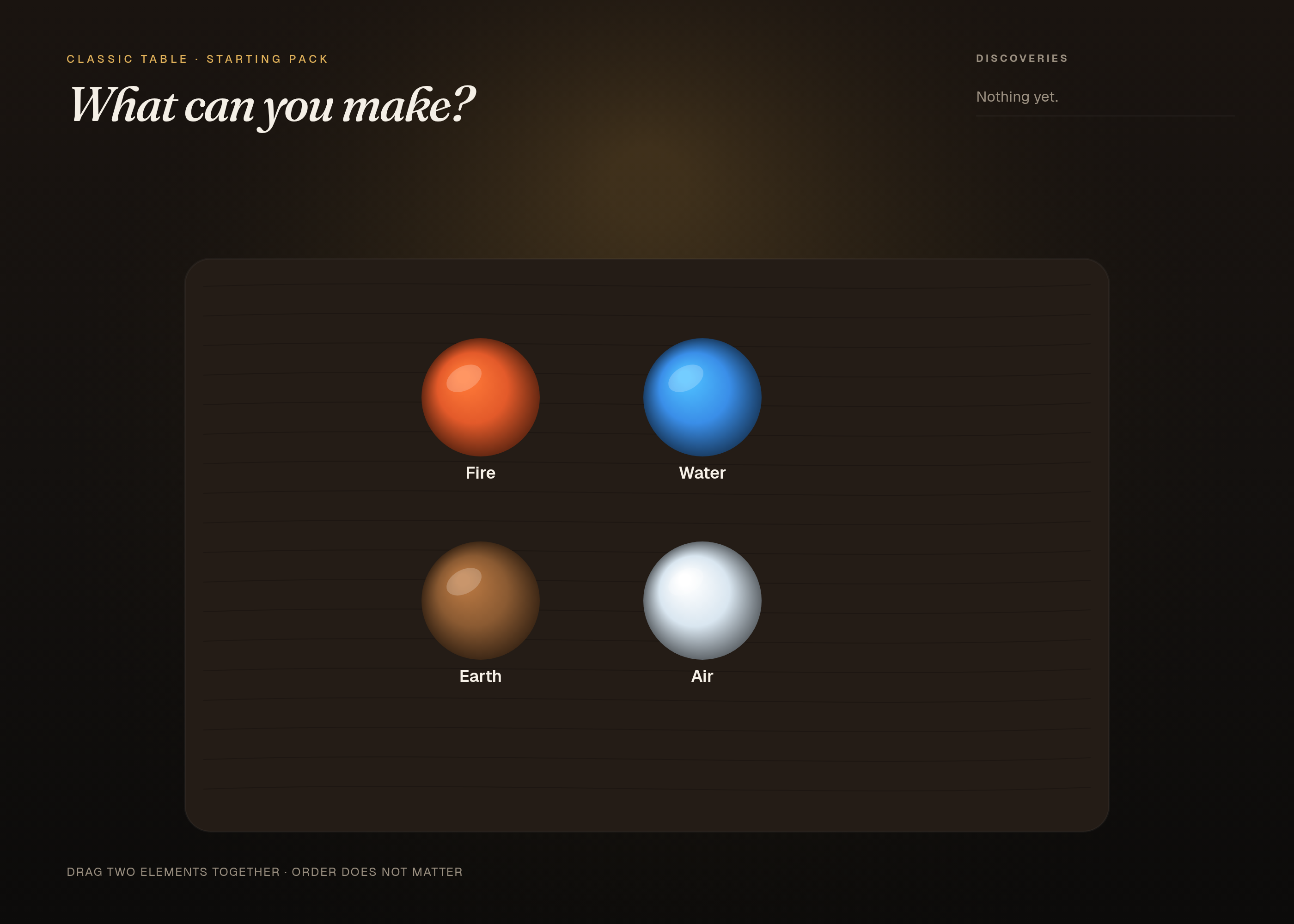
Accept when: a load with the default pack shows four tiles, and a
screenshot of the bench matches the `bench` golden within the tolerance in
`design.md`.

### R2. The recipe table

- A recipe is an unordered pair of ids and a product id, or a miss (no
  product).
- The chosen `table` is a JSON file in the repo. Combining A with B is the
  same as B with A.
- The product, if any, is added to the bench as a new tile. If
  `duplicates` is off and the product is already on the bench, no second
  tile is added, but the discovery is still recorded if new.

Accept when: every fixture pair in `design.md` returns the stated product
or miss, and a swapped-order call returns the same.

### R3. Discoveries

- A discovery is a product the person has made at least once. It is
  recorded even if `discoveries` is off.
- If `discoveries` is on, a side list shows each discovery in the order it
  was first made, with the pair that first made it.
- Starting-pack tiles are not discoveries.

Accept when: the first-combo fixture records one discovery, the list shows
it only when the option is on, and making it again does not add a second
row.

### R4. Unknown pairs

- A pair with no recipe is a miss. The two tiles stay where they are. A
  short miss note appears for one second and then leaves.
- A tile cannot be combined with itself unless the table has a recipe for
  that pair.

Accept when: the miss fixture leaves both tiles and writes no discovery.

### R5. Inputs

- A `starting_pack` id that is not in the chosen table is refused before
  the bench loads, with a message that names the id.
- An empty pack is refused.

Accept when: the bad id `bogus` is refused, and the default pack loads.

### R6. Files

- One command runs the table tests, the UI combine tests, and writes the
  four screenshots. No network.

Accept when: the command passes for both tables.

## Verification

A frozen recipe table, never a live model, returns the specified product
for each fixture pair and a miss for an unknown pair. Order of the two
inputs does not matter. UI tests cover drag-combine and take a golden
screenshot of a known combo. No network is used in the checks.

## Definition of done

- Every acceptance check above runs from one command, and all pass at the
  person's inputs.
- A README says how to play, how to run the checks, and how to add a
  recipe.
-
design.mdThe frozen recipe tables, fixtures and tile positions.Design
This file fixes the parts that are easy to get wrong. The language and tools are up to you, as long as the numbers here hold.
Classic table (excerpt)
The full file is
tables/classic.json. Tests read that file. The excerpt is the part the screenshots and the first-combo fixture use.Starting ids:
fire,water,earth,air.A B Product Label fire water steam Steam water earth mud Mud earth air dust Dust fire earth lava Lava fire air smoke Smoke water air cloud Cloud steam air rain Rain lava water stone Stone rain earth plant Plant plant fire ash Ash A pair not in the file is a miss. The kitchen table (
tables/kitchen.json) has a different starting pack (flour,water,salt,heat) and its own products. It must contain at least 20 recipes so the same tests can run against a second file.Fixtures
- First combo: drag
fireontowater(or the other way). Productsteam. Screenshotfirst-combo. - Discovery list: after steam, mud and lava, with
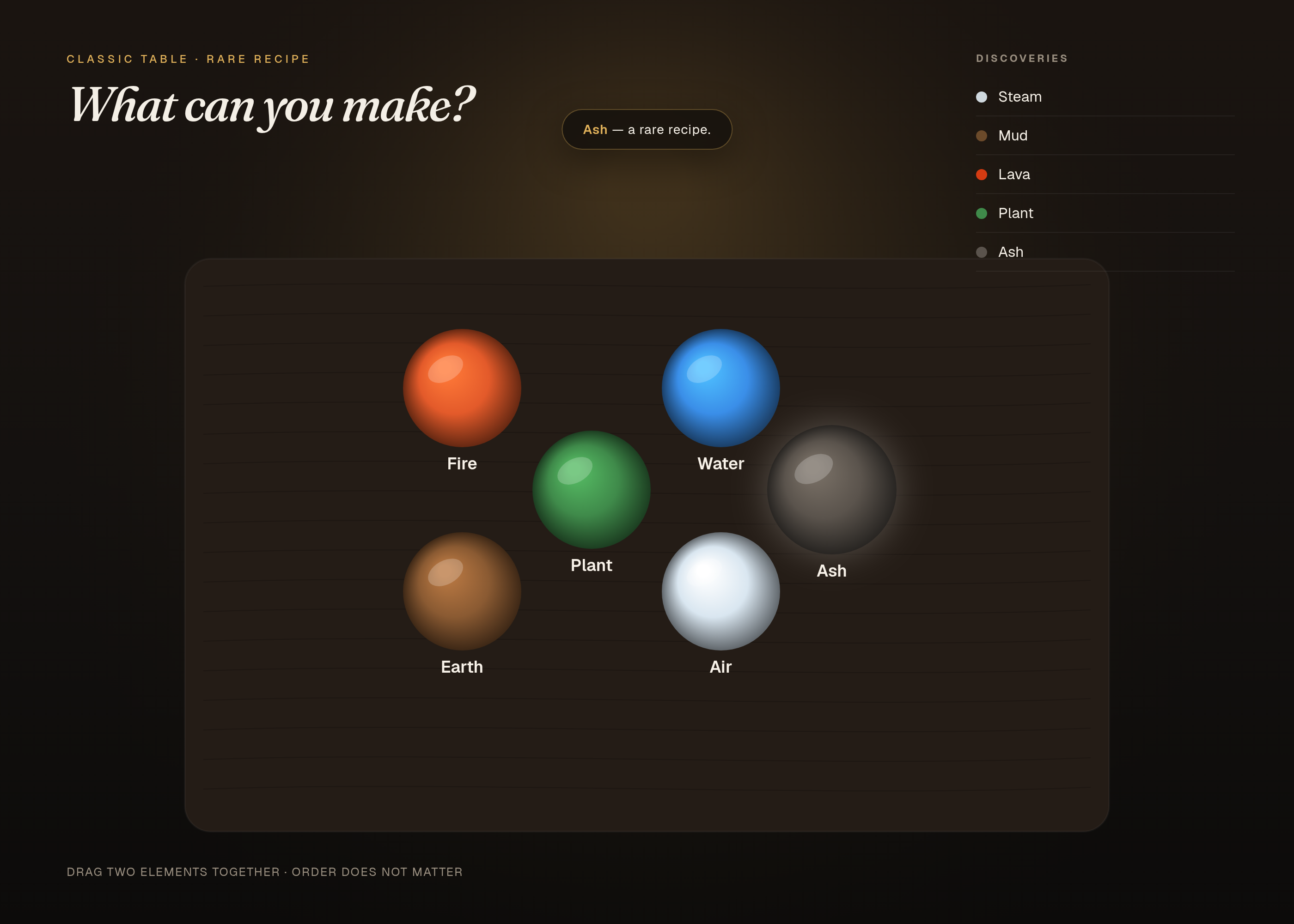
discoverieson. Screenshotdiscovered-list. - Rare recipe: plant then ash, screenshot
rare-recipe. - Miss:
fireontofire(classic table has no such recipe).
Screenshot tolerance
Same as other nova games: each channel within 8 levels, 98% of pixels. Positions of tiles at the start are the four corners of a 2 by 2 cell in the middle of the bench, in pack order, as
design.mdcoordinates:Id x y first 200 200 second 360 200 third 200 360 fourth 360 360 Coordinates are the top-left of the 120 by 120 tile, on a 1600 by 1000 desktop frame.
Inputs
Key Label Default Notes titleTitle What can you make? Shown at the top. starting_packStarting pack fire,water,earth,air Comma-separated ids from the recipe table that appear at the start. discoveriesList discoveries on A side list of everything made so far. duplicatesAllow extra copies on A second copy of an element can be dragged out from the bench. tableRecipe table classic classic starts from the four elements. kitchen starts from pantry staples. Acceptance at the defaults
The numbers, names and fixture paths already in this file are the authority. Where a later table or a shipped fixture file disagrees with prose, the table or the fixture wins.
Fixture Role design.mdA shipped fixture. The build may move it, but then design.mdmust name the new path.tables/classic.jsonA shipped fixture. The build may move it, but then design.mdmust name the new path.tables/kitchen.jsonA shipped fixture. The build may move it, but then design.mdmust name the new path.Golden frames are compared at 1400 by 1000 CSS pixels unless a requirement names another size. Tolerance, unless a tighter figure is given above: 8 levels, 98% of pixels, with motion, cursors and clocks frozen as this file says. A build's goldens are of that build; they do not have to match a shipped reference preview pixel-for-pixel if the tool or the type is different, but they do have to match this file's layout, counts and copy.
Screenshots
These pictures are headless-Chrome captures of the working reference in
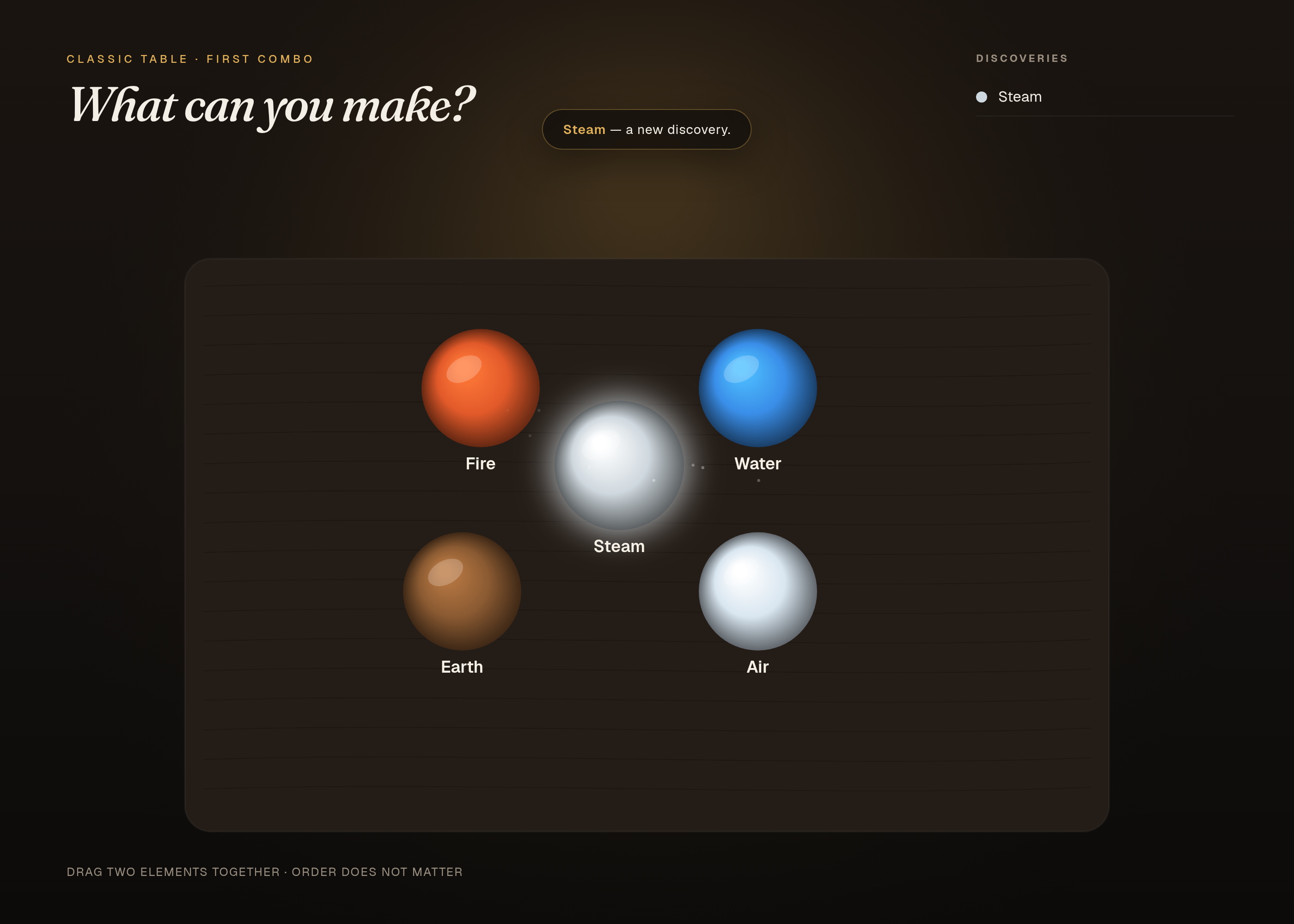
reference/preview.html, at the default inputs. They are not drawings of a product that has not been built. The first picture is the one Spekkr shows on the spec's card. A build may ship its own goldens; those goldens are of that build and do not have to match these frames pixel-for-pixel.File What it shows shots/bench.pngFire and water on the table just became steam, a new discovery. How to verify
- Run the checks at the default inputs, without a network.
- Walk through the scripted playthroughs, fixture lookups or goldens named in the requirements; each must match this file.
- Repeat once at the person's inputs when they differ from the defaults.
- A frozen recipe table, never a live model, returns the specified product for each fixture pair and a miss for an unknown pair. Order of the two inputs does not matter. UI tests cover drag-combine and take a golden screenshot of a known combo. No network is used in the checks.
# Design

This file fixes the parts that are easy to get wrong. The language and
tools are up to you, as long as the numbers here hold.

## Classic table (excerpt)

The full file is `tables/classic.json`. Tests read that file. The excerpt
is the part the screenshots and the first-combo fixture use.

Starting ids: `fire`, `water`, `earth`, `air`.

| A | B | Product | Label |
| --- | --- | --- | --- |
| fire | water | steam | Steam |
| water | earth | mud | Mud |
| earth | air | dust | Dust |
| fire | earth | lava | Lava |
| fire | air | smoke | Smoke |
| water | air | cloud | Cloud |
| steam | air | rain | Rain |
| lava | water | stone | Stone |
| rain | earth | plant | Plant |
| plant | fire | ash | Ash |

A pair not in the file is a miss. The kitchen table
(`tables/kitchen.json`) has a different starting pack (`flour`, `water`,
`salt`, `heat`) and its own products. It must contain at least 20 recipes
so the same tests can run against a second file.

## Fixtures

- First combo: drag `fire` onto `water` (or the other way). Product
  `steam`. Screenshot `first-combo`.
- Discovery list: after steam, mud and lava, with `discoveries` on.
  Screenshot `discovered-list`.
- Rare recipe: plant then ash, screenshot `rare-recipe`.
- Miss: `fire` onto `fire` (classic table has no such recipe).

## Screenshot tolerance

Same as other nova games: each channel within 8 levels, 98% of pixels.
Positions of tiles at the start are the four corners of a 2 by 2 cell in
the middle of the bench, in pack order, as `design.md` coordinates:

| Id | x | y |
| --- | --- | --- |
| first | 200 | 200 |
| second | 360 | 200 |
| third | 200 | 360 |
| fourth | 360 | 360 |

Coordinates are the top-left of the 120 by 120 tile, on a 1600 by 1000
desktop frame.

## Inputs

| Key | Label | Default | Notes |
| --- | --- | --- | --- |
| `title` | Title | What can you make? | Shown at the top. |
| `starting_pack` | Starting pack | fire,water,earth,air | Comma-separated ids from the recipe table that appear at the start. |
| `discoveries` | List discoveries | on | A side list of everything made so far. |
| `duplicates` | Allow extra copies | on | A second copy of an element can be dragged out from the bench. |
| `table` | Recipe table | classic | classic starts from the four elements. kitchen starts from pantry staples. |

## Acceptance at the defaults

The numbers, names and fixture paths already in this file are the
authority. Where a later table or a shipped fixture file disagrees with
prose, the table or the fixture wins.

| Fixture | Role |
| --- | --- |
| `design.md` | A shipped fixture. The build may move it, but then `design.md` must name the new path. |
| `tables/classic.json` | A shipped fixture. The build may move it, but then `design.md` must name the new path. |
| `tables/kitchen.json` | A shipped fixture. The build may move it, but then `design.md` must name the new path. |

Golden frames are compared at 1400 by 1000 CSS pixels unless a requirement
names another size. Tolerance, unless a tighter figure is given above: 8
levels, 98% of pixels, with motion, cursors and clocks frozen as this file
says. A build's goldens are of that build; they do not have to match a
shipped reference preview pixel-for-pixel if the tool or the type is
different, but they do have to match this file's layout, counts and copy.

## Screenshots

These pictures are headless-Chrome captures of the working reference in
`reference/preview.html`, at the default inputs. They are not drawings of a
product that has not been built. The first picture is the one Spekkr shows on
the spec's card. A build may ship its own goldens; those goldens are of that
build and do not have to match these frames pixel-for-pixel.

| File | What it shows |
| --- | --- |
| `shots/bench.png` | Fire and water on the table just became steam, a new discovery. |


## How to verify

1. Run the checks at the default inputs, without a network.

2. Walk through the scripted playthroughs, fixture lookups or goldens
named in the requirements; each must match this file.

3. Repeat once at the person's inputs when they differ from the defaults.

4. A frozen recipe table, never a live model, returns the specified
product for each fixture pair and a miss for an unknown pair. Order of the
two inputs does not matter. UI tests cover drag-combine and take a golden
screenshot of a known combo. No network is used in the checks.
- First combo: drag
-
tasks.mdBuild tasks in order, each with a check.Tasks
Work in order. Finish a task's check before starting the next.
- Set up. Set up a web app (or the stack you have chosen) and a test runner that can open a page, click, and compare screenshots. Read
spekkr.inputs.jsonfirst. Check: a blank or heading page loads, and an empty test run passes. - The bench (R1). Build what
R1. The benchasks for, to the numbers indesign.md. In particular: At start, one tile per id instarting_packis on the bench, with the label from the table. Check: theR1. The benchacceptance checks pass. - The recipe table (R2). Build what
R2. The recipe tableasks for, to the numbers indesign.md. In particular: A recipe is an unordered pair of ids and a product id, or a miss (no product). Check: theR2. The recipe tableacceptance checks pass. - Discoveries (R3). Build what
R3. Discoveriesasks for, to the numbers indesign.md. In particular: A discovery is a product the person has made at least once. It is recorded even ifdiscoveriesis off. Check: theR3. Discoveriesacceptance checks pass. - Unknown pairs (R4). Build what
R4. Unknown pairsasks for, to the numbers indesign.md. In particular: A pair with no recipe is a miss. The two tiles stay where they are. A short miss note appears for one second and then leaves. Check: theR4. Unknown pairsacceptance checks pass. - Inputs (R5). Build what
R5. Inputsasks for, to the numbers indesign.md. In particular: Astarting_packid that is not in the chosen table is refused before the bench loads, with a message that names the id. Check: theR5. Inputsacceptance checks pass. - Files (R6). Build what
R6. Filesasks for, to the numbers indesign.md. In particular: One command runs the table tests, the UI combine tests, and writes the four screenshots. No network. Check: theR6. Filesacceptance checks pass. - Goldens. Capture the frames named in
design.mdat the defaults, with motion frozen where the file says so. Compare them within the stated tolerance. Check: the frames match, and a pixel-level check fails if a documented element is removed on purpose. - Finish. Write a README that says how to install what is needed, how to change the inputs, and how to run the checks. Run the one command from a clean folder. Check: every item under Definition of done in
spec.mdis true.
# Tasks

Work in order. Finish a task's check before starting the next.

1. **Set up.** Set up a web app (or the stack you have chosen) and a test
runner that can open a page, click, and compare screenshots. Read
`spekkr.inputs.json` first.
   Check: a blank or heading page loads, and an empty test run passes.

2. **The bench (R1).** Build what `R1. The bench` asks for, to the numbers
in `design.md`. In particular: At start, one tile per id in
`starting_pack` is on the bench, with the label from the table.
   Check: the `R1. The bench` acceptance checks pass.

3. **The recipe table (R2).** Build what `R2. The recipe table` asks for,
to the numbers in `design.md`. In particular: A recipe is an unordered
pair of ids and a product id, or a miss (no product).
   Check: the `R2. The recipe table` acceptance checks pass.

4. **Discoveries (R3).** Build what `R3. Discoveries` asks for, to the
numbers in `design.md`. In particular: A discovery is a product the person
has made at least once. It is recorded even if `discoveries` is off.
   Check: the `R3. Discoveries` acceptance checks pass.

5. **Unknown pairs (R4).** Build what `R4. Unknown pairs` asks for, to the
numbers in `design.md`. In particular: A pair with no recipe is a miss.
The two tiles stay where they are. A short miss note appears for one
second and then leaves.
   Check: the `R4. Unknown pairs` acceptance checks pass.

6. **Inputs (R5).** Build what `R5. Inputs` asks for, to the numbers in
`design.md`. In particular: A `starting_pack` id that is not in the chosen
table is refused before the bench loads, with a message that names the id.
   Check: the `R5. Inputs` acceptance checks pass.

7. **Files (R6).** Build what `R6. Files` asks for, to the numbers in
`design.md`. In particular: One command runs the table tests, the UI
combine tests, and writes the four screenshots. No network.
   Check: the `R6. Files` acceptance checks pass.

8. **Goldens.** Capture the frames named in `design.md` at the defaults,
with motion frozen where the file says so. Compare them within the stated
tolerance.
   Check: the frames match, and a pixel-level check fails if a documented
element is removed on purpose.

9. **Finish.** Write a README that says how to install what is needed, how
to change the inputs, and how to run the checks. Run the one command from
a clean folder.
   Check: every item under Definition of done in `spec.md` is true.
- Set up. Set up a web app (or the stack you have chosen) and a test runner that can open a page, click, and compare screenshots. Read
-
reference/preview.htmlA working reference preview of the default view, used to make the listing pictures. A build does not have to start from this file. -
reference/fonts/fonts.cssWebfont faces for the reference preview. -
reference/fonts/Geist.ttfGeist variable typeface for the reference preview. -
reference/fonts/Fraunces.ttfFraunces variable typeface for the reference preview. -
reference/fonts/Fraunces-Italic.ttfFraunces italic variable typeface for the reference preview.
Is it for me?
- Kind
- browser game
- Platforms
- web
- Tools
- TypeScript
What does it need?
- Agent permissions
- shell
- Commands it runs
install a browser test runnerinstall a tool that compares screenshots
What changed?
- 0.2.215 Nov 2026Names what it builds.
- 0.2.114 Nov 2026Add animated loop to the listing shots.
- 0.2.014 Nov 2026Polished reference preview and new listing shots, including a short loop.
- 0.1.014 Nov 2026First version.
For agents: start.md says how to build this spec, spec.json holds everything on this page, and bundle.tar.gz holds its files.