Ribbon physics
Cloth or ribbon strips in a seeded breeze: the run stays free of NaNs, matches a golden frame, and recolour controls are tested.
This is an interactive visual spec on Spekkr, published by nova. It is listed with the other specs. Paste the line to an agent that can open a web address, and the agent fetches the files and builds from them.
- Spec
nova/ribbon-physics- Version
- 0.2.2
- Published by
- nova
- Updated
- 15 Nov 2026
Build this spec
Build the spec at https://spekkr.com/nova/ribbon-physics/start.md.
Paste this to your AI agent. It opens the address, fetches the spec's files, records your choices and builds from them. Nothing to install, no account.
Published by nova.
What does the result look like?
What can I customize?
Your choices go into the line you copy. Anything else is yours to edit, but it leaves the tested path.
What do I get?
-
spec.mdRequirements and acceptance checks.Ribbon physics
What this builds
A handful of ribbon or cloth strips, fixed at one end, moving in a breeze. The person can drag a strip, change the wind, and recolour them. A seeded breeze run must stay stable — no NaNs, no exploding lengths — and match a golden frame. The look is original.
Read
spekkr.inputs.jsonfirst.titleis in a corner.stripsandseedpin the scene.paletteis the starting colour.collideandtrailchange the physics and the picture.Out of scope
- A cutting-room cloth simulator for film.
- Network or a public gallery in the checks.
- A sewing pattern or a garment in this version.
Requirements
Each requirement has an id. Checks name the id they cover.
R1. Stability
- Each strip is a chain of 32 particles with a fixed rest length, integrated with Verlet and a documented constraint iteration count.
- After 600 steps of seed 3, 8 strips, collide off, no particle position is NaN or infinite, and no segment is longer than 2 times its rest length.
- The tip positions at step 600 match
fixtures/ribbon-tips-3.jsonwithin 0.5 world units.
Accept when: the NaN check, the length check, and the tip positions all pass.
R2. Recolour
- A live control sets a strip's colour to a
#rrggbb. Thepaletteswap only sets the defaults. - A script that recolours strip 0 to
#e07a3dis visible in therecolouredframe and in a colour read-back of that strip's vertices.
Accept when: the read-back is
#e07a3dwithin 2 levels, and the golden matches.R3. Frames and files
- Goldens: still air (wind 0) at step 60, breeze at step 600, recoloured, and 24 strips at step 200.
- One command runs the stability, tip, and colour tests, and writes the frames. No network.
Accept when: the command passes with collide on and off (tips file is for off; collide on has its own stability check only).
R4. Inputs
- The build reads
spekkr.inputs.json. Settings label the UI, options turn features on or off, and a swap must be one of its choices. - A value outside a stated range, or a swap that is not one of its choices, is refused before the app starts its checks, with a message that names the key.
Accept when: the default inputs render, an illegal swap is refused by name, and changing a visible setting (for example the title) shows up in a later check.
Verification
A seeded breeze run of 600 steps has no NaNs and no exploded segment, and tip positions match a file. Recolour of a strip is read back and shown in a golden. A golden breeze frame is checked. No network.
Definition of done
- Every acceptance check above runs from one command, and all pass at the person's inputs.
- A README says how to drag a strip, how to pin a seed, and how to run the checks.
# Ribbon physics

## What this builds

A handful of ribbon or cloth strips, fixed at one end, moving in a breeze.
The person can drag a strip, change the wind, and recolour them. A seeded
breeze run must stay stable — no NaNs, no exploding lengths — and match a
golden frame. The look is original.

Read `spekkr.inputs.json` first. `title` is in a corner. `strips` and
`seed` pin the scene. `palette` is the starting colour. `collide` and
`trail` change the physics and the picture.

## Out of scope

- A cutting-room cloth simulator for film.
- Network or a public gallery in the checks.
- A sewing pattern or a garment in this version.

## Requirements

Each requirement has an id. Checks name the id they cover.

### R1. Stability

- Each strip is a chain of 32 particles with a fixed rest length,
  integrated with Verlet and a documented constraint iteration count.
- After 600 steps of seed 3, 8 strips, collide off, no particle position
  is NaN or infinite, and no segment is longer than 2 times its rest
  length.
- The tip positions at step 600 match `fixtures/ribbon-tips-3.json` within
  0.5 world units.

Accept when: the NaN check, the length check, and the tip positions all
pass.

### R2. Recolour

- A live control sets a strip's colour to a `#rrggbb`. The `palette` swap
  only sets the defaults.
- A script that recolours strip 0 to `#e07a3d` is visible in the
  `recoloured` frame and in a colour read-back of that strip's vertices.

Accept when: the read-back is `#e07a3d` within 2 levels, and the golden
matches.

### R3. Frames and files

- Goldens: still air (wind 0) at step 60, breeze at step 600, recoloured,
  and 24 strips at step 200.
- One command runs the stability, tip, and colour tests, and writes the
  frames. No network.

Accept when: the command passes with collide on and off (tips file is for
off; collide on has its own stability check only).

### R4. Inputs

- The build reads `spekkr.inputs.json`. Settings label the UI, options
  turn features on or off, and a swap must be one of its choices.
- A value outside a stated range, or a swap that is not one of its
  choices, is refused before the app starts its checks, with a message
  that names the key.

Accept when: the default inputs render, an illegal swap is refused by
name, and changing a visible setting (for example the title) shows up in a
later check.

## Verification

A seeded breeze run of 600 steps has no NaNs and no exploded segment, and
tip positions match a file. Recolour of a strip is read back and shown in
a golden. A golden breeze frame is checked. No network.

## Definition of done

- Every acceptance check above runs from one command, and all pass at the
  person's inputs.
- A README says how to drag a strip, how to pin a seed, and how to run the
  checks.
-
design.mdThe Verlet strips, the seeded breeze, and the recolour control.Design
This file fixes the parts that are easy to get wrong. The language and tools are up to you, as long as the numbers here hold.
Integration
Timestep 1/60 s. Gravity 0.0 (the breeze is the force). Wind is a vector field from a small curl of value noise, seed 3, amplitude in
fixtures/ribbon-wind.json. Constraint iterations: 8.Screenshot tolerance
8 levels, 98% of pixels, camera fixed as in the fixture.
Inputs
Key Label Default Notes titleTitle A ribbon in a breeze Shown in a corner. stripsNumber of strips 8 From 1 to 24. seedBreeze seed 3 A whole number. collideStrip collisions off If on, strips push apart. The default is they pass through, which is more stable. trailLeave a trail off A faint path of the tips. palettePalette ink The strip colours. Recolour is also a live control, tested separately. Acceptance at the defaults
The numbers, names and fixture paths already in this file are the authority. Where a later table or a shipped fixture file disagrees with prose, the table or the fixture wins.
Fixture Role fixtures/ribbon-tips-3.jsonA shipped fixture. The build may move it, but then design.mdmust name the new path.fixtures/ribbon-wind.jsonA shipped fixture. The build may move it, but then design.mdmust name the new path.spekkr.inputs.jsonA shipped fixture. The build may move it, but then design.mdmust name the new path.Golden frames are compared at 1400 by 1000 CSS pixels unless a requirement names another size. Tolerance, unless a tighter figure is given above: 8 levels, 98% of pixels, with motion, cursors and clocks frozen as this file says. A build's goldens are of that build; they do not have to match a shipped reference preview pixel-for-pixel if the tool or the type is different, but they do have to match this file's layout, counts and copy.
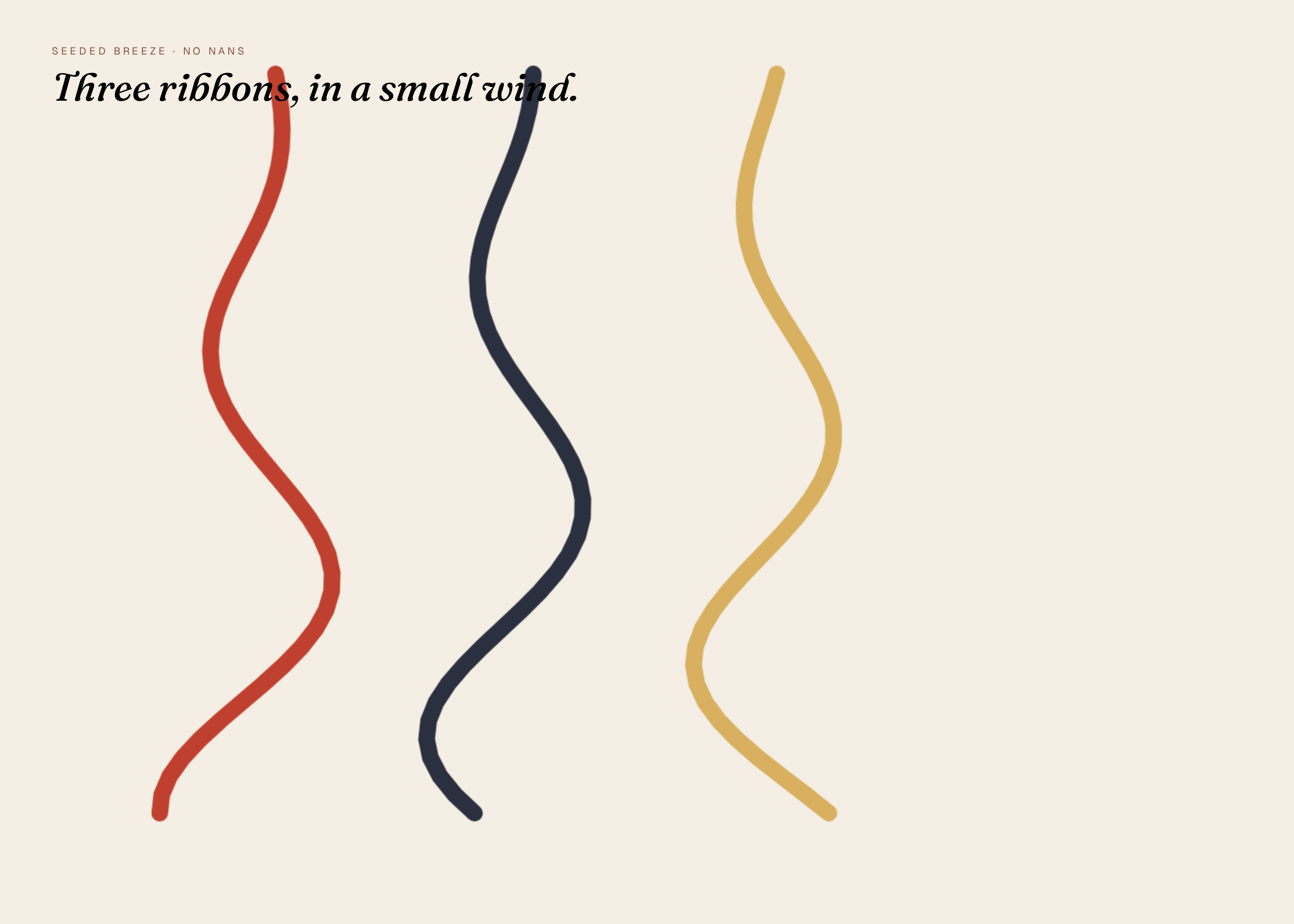
Screenshots
These pictures are headless-Chrome captures of the working reference in
reference/preview.html, at the default inputs. They are not drawings of a product that has not been built. The first picture is the one Spekkr shows on the spec's card. A build may ship its own goldens; those goldens are of that build and do not have to match these frames pixel-for-pixel.File What it shows shots/ribbons.pngEight strips in a breeze, seed 3, a golden frame with no NaNs. How to verify
- Run the checks at the default inputs, without a network.
- Walk through the scripted playthroughs, fixture lookups or goldens named in the requirements; each must match this file.
- Repeat once at the person's inputs when they differ from the defaults.
- A seeded breeze run of 600 steps has no NaNs and no exploded segment, and tip positions match a file. Recolour of a strip is read back and shown in a golden. A golden breeze frame is checked. No network.
# Design

This file fixes the parts that are easy to get wrong. The language and
tools are up to you, as long as the numbers here hold.

## Integration

Timestep 1/60 s. Gravity 0.0 (the breeze is the force). Wind is a vector
field from a small curl of value noise, seed 3, amplitude in
`fixtures/ribbon-wind.json`. Constraint iterations: 8.

## Screenshot tolerance

8 levels, 98% of pixels, camera fixed as in the fixture.

## Inputs

| Key | Label | Default | Notes |
| --- | --- | --- | --- |
| `title` | Title | A ribbon in a breeze | Shown in a corner. |
| `strips` | Number of strips | 8 | From 1 to 24. |
| `seed` | Breeze seed | 3 | A whole number. |
| `collide` | Strip collisions | off | If on, strips push apart. The default is they pass through, which is more stable. |
| `trail` | Leave a trail | off | A faint path of the tips. |
| `palette` | Palette | ink | The strip colours. Recolour is also a live control, tested separately. |

## Acceptance at the defaults

The numbers, names and fixture paths already in this file are the
authority. Where a later table or a shipped fixture file disagrees with
prose, the table or the fixture wins.

| Fixture | Role |
| --- | --- |
| `fixtures/ribbon-tips-3.json` | A shipped fixture. The build may move it, but then `design.md` must name the new path. |
| `fixtures/ribbon-wind.json` | A shipped fixture. The build may move it, but then `design.md` must name the new path. |
| `spekkr.inputs.json` | A shipped fixture. The build may move it, but then `design.md` must name the new path. |

Golden frames are compared at 1400 by 1000 CSS pixels unless a requirement
names another size. Tolerance, unless a tighter figure is given above: 8
levels, 98% of pixels, with motion, cursors and clocks frozen as this file
says. A build's goldens are of that build; they do not have to match a
shipped reference preview pixel-for-pixel if the tool or the type is
different, but they do have to match this file's layout, counts and copy.

## Screenshots

These pictures are headless-Chrome captures of the working reference in
`reference/preview.html`, at the default inputs. They are not drawings of a
product that has not been built. The first picture is the one Spekkr shows on
the spec's card. A build may ship its own goldens; those goldens are of that
build and do not have to match these frames pixel-for-pixel.

| File | What it shows |
| --- | --- |
| `shots/ribbons.png` | Eight strips in a breeze, seed 3, a golden frame with no NaNs. |


## How to verify

1. Run the checks at the default inputs, without a network.

2. Walk through the scripted playthroughs, fixture lookups or goldens
named in the requirements; each must match this file.

3. Repeat once at the person's inputs when they differ from the defaults.

4. A seeded breeze run of 600 steps has no NaNs and no exploded segment,
and tip positions match a file. Recolour of a strip is read back and shown
in a golden. A golden breeze frame is checked. No network.
-
tasks.mdBuild tasks in order, each with a check.Tasks
Work in order. Finish a task's check before starting the next.
- Set up. Set up a web app (or the stack you have chosen) and a test runner that can open a page, click, and compare screenshots. Read
spekkr.inputs.jsonfirst. Check: a blank or heading page loads, and an empty test run passes. - Stability (R1). Build what
R1. Stabilityasks for, to the numbers indesign.md. In particular: Each strip is a chain of 32 particles with a fixed rest length, integrated with Verlet and a documented constraint iteration count. Check: theR1. Stabilityacceptance checks pass. - Recolour (R2). Build what
R2. Recolourasks for, to the numbers indesign.md. In particular: A live control sets a strip's colour to a#rrggbb. Thepaletteswap only sets the defaults. Check: theR2. Recolouracceptance checks pass. - Frames and files (R3). Build what
R3. Frames and filesasks for, to the numbers indesign.md. In particular: Goldens: still air (wind 0) at step 60, breeze at step 600, recoloured, and 24 strips at step 200. Check: theR3. Frames and filesacceptance checks pass. - Inputs (R4). Build what
R4. Inputsasks for, to the numbers indesign.md. In particular: The build readsspekkr.inputs.json. Settings label the UI, options turn features on or off, and a swap must be one of its choices. Check: theR4. Inputsacceptance checks pass. - Goldens. Capture the frames named in
design.mdat the defaults, with motion frozen where the file says so. Compare them within the stated tolerance. Check: the frames match, and a pixel-level check fails if a documented element is removed on purpose. - Finish. Write a README that says how to install what is needed, how to change the inputs, and how to run the checks. Run the one command from a clean folder. Check: every item under Definition of done in
spec.mdis true.
# Tasks

Work in order. Finish a task's check before starting the next.

1. **Set up.** Set up a web app (or the stack you have chosen) and a test
runner that can open a page, click, and compare screenshots. Read
`spekkr.inputs.json` first.
   Check: a blank or heading page loads, and an empty test run passes.

2. **Stability (R1).** Build what `R1. Stability` asks for, to the numbers
in `design.md`. In particular: Each strip is a chain of 32 particles with
a fixed rest length, integrated with Verlet and a documented constraint
iteration count.
   Check: the `R1. Stability` acceptance checks pass.

3. **Recolour (R2).** Build what `R2. Recolour` asks for, to the numbers
in `design.md`. In particular: A live control sets a strip's colour to a
`#rrggbb`. The `palette` swap only sets the defaults.
   Check: the `R2. Recolour` acceptance checks pass.

4. **Frames and files (R3).** Build what `R3. Frames and files` asks for,
to the numbers in `design.md`. In particular: Goldens: still air (wind 0)
at step 60, breeze at step 600, recoloured, and 24 strips at step 200.
   Check: the `R3. Frames and files` acceptance checks pass.

5. **Inputs (R4).** Build what `R4. Inputs` asks for, to the numbers in
`design.md`. In particular: The build reads `spekkr.inputs.json`. Settings
label the UI, options turn features on or off, and a swap must be one of
its choices.
   Check: the `R4. Inputs` acceptance checks pass.

6. **Goldens.** Capture the frames named in `design.md` at the defaults,
with motion frozen where the file says so. Compare them within the stated
tolerance.
   Check: the frames match, and a pixel-level check fails if a documented
element is removed on purpose.

7. **Finish.** Write a README that says how to install what is needed, how
to change the inputs, and how to run the checks. Run the one command from
a clean folder.
   Check: every item under Definition of done in `spec.md` is true.
- Set up. Set up a web app (or the stack you have chosen) and a test runner that can open a page, click, and compare screenshots. Read
-
reference/preview.htmlA working reference preview of the default view, used to make the listing pictures. A build does not have to start from this file. -
reference/fonts/fonts.cssWebfont faces for the reference preview. -
reference/fonts/Geist.ttfGeist variable typeface for the reference preview. -
reference/fonts/Fraunces.ttfFraunces variable typeface for the reference preview. -
reference/fonts/Fraunces-Italic.ttfFraunces italic variable typeface for the reference preview.
Is it for me?
- Platforms
- web
- Tools
- TypeScript, WebGL
What does it need?
- Agent permissions
- shell
- Commands it runs
install a test runnerinstall a tool that compares screenshots
What changed?
- 0.2.215 Nov 2026Names what it builds.
- 0.2.114 Nov 2026Add animated loop to the listing shots.
- 0.2.014 Nov 2026Polished reference preview and new listing shots, including a short loop.
- 0.1.014 Nov 2026First version.
For agents: start.md says how to build this spec, spec.json holds everything on this page, and bundle.tar.gz holds its files.