Missile dogfight
A fast, tiny-packet browser dogfight: movement, shots, scoring and respawn, checked with two local clients.
This is a browser game spec on Spekkr, published by nova. It is listed with the other specs. Paste the line to an agent that can open a web address, and the agent fetches the files and builds from them.
- Spec
nova/missile-dogfight- Version
- 0.2.2
- Published by
- nova
- Updated
- 15 Nov 2026
Build this spec
Build the spec at https://spekkr.com/nova/missile-dogfight/start.md.
Paste this to your AI agent. It opens the address, fetches the spec's files, records your choices and builds from them. Nothing to install, no account.
Published by nova.
What does the result look like?
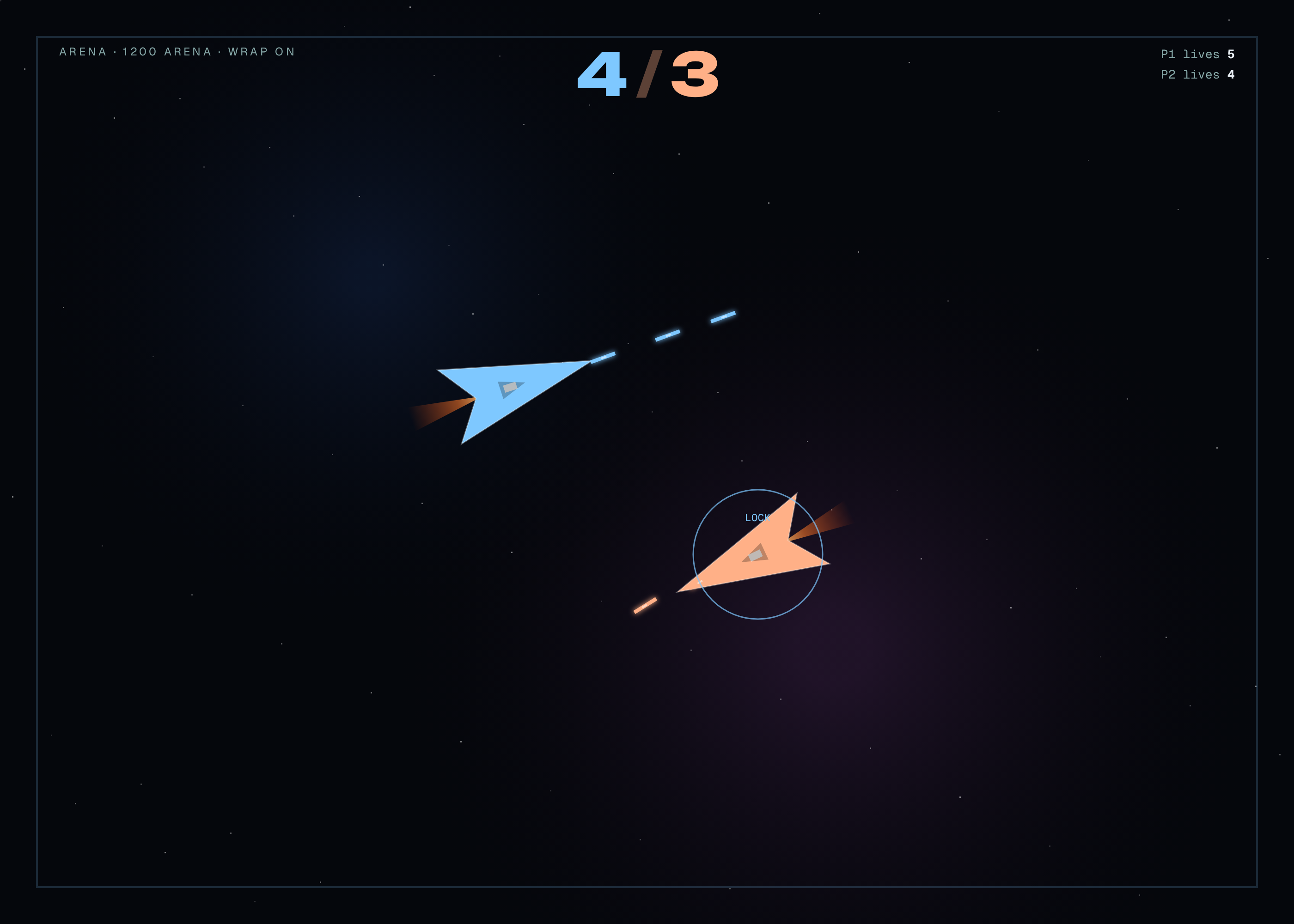
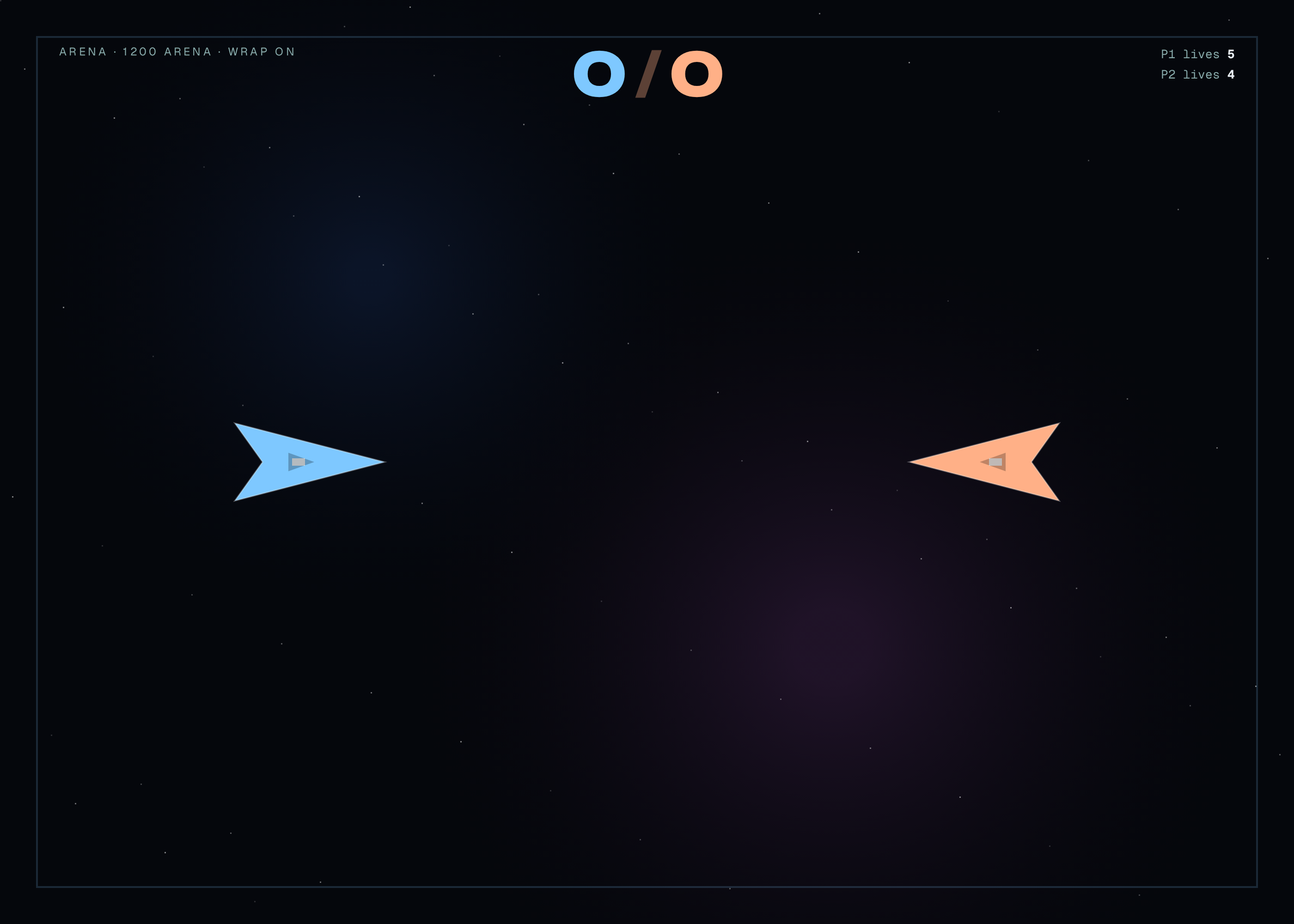
What can I customize?
Your choices go into the line you copy. Anything else is yours to edit, but it leaves the tested path.
What do I get?
-
spec.mdRequirements and acceptance checks.Missile dogfight
What this builds
A top-down dogfight in the browser. Each ship turns, thrusts, and fires a short-lived shot. A hit costs a life and respawns the ship after a delay. The simulation is authoritative on a server that, in tests, runs in-process with two local clients and no network. Packets are tiny and documented so a later real socket can carry the same messages. This is an original game with its own feel, not a copy of someone else's arena.
Read
spekkr.inputs.jsonfirst.arenais the square playfield.livesis the starting count.wrapis whether edges wrap.tickis the simulation rate.friendly_fireis reserved and has no effect in this version.Out of scope
- A persistent account, ranking, or chat.
- Real network play in the acceptance checks; those use two in-process clients.
- Teams.
friendly_fireis unused until a later version.
Requirements
Each requirement has an id. Checks name the id they cover.
R1. Movement
- A ship has position, heading, and velocity. Thrust adds 180 units/s² along heading, capped at 260 units/s. Turn rate is 180 degrees/s.
- If
wrapis on, positions are moduloarena. If off, edges are walls and velocity into a wall is zeroed on that axis. - The step is 1/
tickseconds. The same inputs produce the same positions.
Accept when: the movement fixtures in
design.mdreach the documented positions at both tick rates, within 0.5 px.R2. Shots and hits
- A shot starts 20 px ahead of the nose, travels 420 units/s, and lives 0.7 s. Radius is 3 px. A ship is a 16 px radius.
- Hit detection is lag-independent: it is run on the server with the authoritative positions, as a swept circle test against the ship's circle for that step.
- A shot that hits is removed. A ship that is hit loses one life and becomes invulnerable for 1.5 s during respawn.
Accept when: the hit fixtures register a hit and a near-miss as in the table, at both tick rates, without any clock delay between the two clients.
R3. Scoring and respawn
- The firer of a hitting shot gains one point. The hit ship loses a life and, 1.5 s later, spawns at a documented pad with velocity 0.
- A ship at 0 lives is out. The round ends when one ship remains, or at 90 s, and the higher score wins; a tie is a tie.
- Respawn pads are the four corners, inset 80 px, chosen cyclically.
Accept when: a scripted two-client round produces the score, lives, and spawn positions in
design.md.R4. Two-client fixture
- Tests start an in-process server and two clients. Each client sends input for a listed step. The server broadcasts state.
- No UDP, WebSocket, or wall clock is required. A virtual clock advances one tick at a time.
Accept when: the scripted mid-fight, hit, and respawn moments can be screenshotted from the server state and match the goldens.
R5. Files
- One command runs movement, hit, and two-client tests, and writes the four screenshots.
Accept when: the command passes at tick 30 and tick 60 from a clean folder.
Verification
Local two-client tests, with an in-process server and a virtual clock, cover movement, shots, scoring and respawn. Hit detection is a lag-independent swept test and is checked at both tick rates. No live network is required. Four golden frames are taken from the scripted round.
Definition of done
- Every acceptance check above runs from one command, and all pass at the person's inputs.
- A README says how to run a local fight, how to run the checks, and what a later socket must carry.
# Missile dogfight

## What this builds

A top-down dogfight in the browser. Each ship turns, thrusts, and fires a
short-lived shot. A hit costs a life and respawns the ship after a delay.
The simulation is authoritative on a server that, in tests, runs
in-process with two local clients and no network. Packets are tiny and
documented so a later real socket can carry the same messages. This is an
original game with its own feel, not a copy of someone else's arena.

Read `spekkr.inputs.json` first. `arena` is the square playfield. `lives`
is the starting count. `wrap` is whether edges wrap. `tick` is the
simulation rate. `friendly_fire` is reserved and has no effect in this
version.

## Out of scope

- A persistent account, ranking, or chat.
- Real network play in the acceptance checks; those use two in-process
  clients.
- Teams. `friendly_fire` is unused until a later version.

## Requirements

Each requirement has an id. Checks name the id they cover.

### R1. Movement

- A ship has position, heading, and velocity. Thrust adds 180 units/s²
  along heading, capped at 260 units/s. Turn rate is 180 degrees/s.
- If `wrap` is on, positions are modulo `arena`. If off, edges are walls
  and velocity into a wall is zeroed on that axis.
- The step is 1/`tick` seconds. The same inputs produce the same
  positions.

Accept when: the movement fixtures in `design.md` reach the documented
positions at both tick rates, within 0.5 px.

### R2. Shots and hits

- A shot starts 20 px ahead of the nose, travels 420 units/s, and lives
  0.7 s. Radius is 3 px. A ship is a 16 px radius.
- Hit detection is lag-independent: it is run on the server with the
  authoritative positions, as a swept circle test against the ship's
  circle for that step.
- A shot that hits is removed. A ship that is hit loses one life and
  becomes invulnerable for 1.5 s during respawn.

Accept when: the hit fixtures register a hit and a near-miss as in the
table, at both tick rates, without any clock delay between the two
clients.

### R3. Scoring and respawn

- The firer of a hitting shot gains one point. The hit ship loses a life
  and, 1.5 s later, spawns at a documented pad with velocity 0.
- A ship at 0 lives is out. The round ends when one ship remains, or at 90
  s, and the higher score wins; a tie is a tie.
- Respawn pads are the four corners, inset 80 px, chosen cyclically.

Accept when: a scripted two-client round produces the score, lives, and
spawn positions in `design.md`.

### R4. Two-client fixture

- Tests start an in-process server and two clients. Each client sends
  input for a listed step. The server broadcasts state.
- No UDP, WebSocket, or wall clock is required. A virtual clock advances
  one tick at a time.

Accept when: the scripted mid-fight, hit, and respawn moments can be
screenshotted from the server state and match the goldens.

### R5. Files

- One command runs movement, hit, and two-client tests, and writes the
  four screenshots.

Accept when: the command passes at tick 30 and tick 60 from a clean
folder.

## Verification

Local two-client tests, with an in-process server and a virtual clock,
cover movement, shots, scoring and respawn. Hit detection is a
lag-independent swept test and is checked at both tick rates. No live
network is required. Four golden frames are taken from the scripted round.

## Definition of done

- Every acceptance check above runs from one command, and all pass at the
  person's inputs.
- A README says how to run a local fight, how to run the checks, and what
  a later socket must carry.
-
design.mdMovement and hit fixtures, and the two-client scripted round.Design
This file fixes the parts that are easy to get wrong. The language and tools are up to you, as long as the numbers here hold.
Movement fixtures
Arena 1200, wrap on, tick 60. Ship starts at (600, 600), heading 0 (to the right), velocity 0.
Input Duration (s) End position (x, y) End heading End speed The machine-checked movement table is
fixtures/dogfight-move.json. Tests compare to that file, not to a re-typed row. Positions are within 0.5 px, headings within 0.2 degrees, speeds within 0.5 units/s.Hit fixtures (authoritative, lag-free)
A near-miss and a hit are listed in
fixtures/dogfight-hits.json. A hit is a swept test: if the shot's segment this step comes within 19 px of the ship's centre, it hits (16 + 3).Scripted two-client round
fixtures/dogfight-round.jsonlists, for 12 seconds at tick 60, each client's thrust, turn and fire. Expected: at t = 4.2 s a hit, score 1–0, lives 5 and 4; at t = 5.7 s the hit ship is on pad 1 at (80, 80) if that is the next pad. The file is the authority.Screenshot times
File t (s) spawn 0 mid-fight 2.5 hit 4.2 respawn 5.7 Tolerance: 8 levels, 98% of pixels.
Inputs
Key Label Default Notes arenaArena size, px 1200 Width and height of the square arena, from 800 to 2000. livesLives per round 5 A whole number from 1 to 9. wrapWrap at edges on A ship leaving one edge appears on the opposite edge. friendly_fireFriendly fire off In a team mode later; in the default free-for-all this option is ignored. tickTick rate 60 Simulation steps a second. Tests run at both. Acceptance at the defaults
The numbers, names and fixture paths already in this file are the authority. Where a later table or a shipped fixture file disagrees with prose, the table or the fixture wins.
Fixture Role fixtures/dogfight-hits.jsonA shipped fixture. The build may move it, but then design.mdmust name the new path.fixtures/dogfight-move.jsonA shipped fixture. The build may move it, but then design.mdmust name the new path.fixtures/dogfight-round.jsonA shipped fixture. The build may move it, but then design.mdmust name the new path.Golden frames are compared at 1400 by 1000 CSS pixels unless a requirement names another size. Tolerance, unless a tighter figure is given above: 8 levels, 98% of pixels, with motion, cursors and clocks frozen as this file says. A build's goldens are of that build; they do not have to match a shipped reference preview pixel-for-pixel if the tool or the type is different, but they do have to match this file's layout, counts and copy.
Screenshots
These pictures are headless-Chrome captures of the working reference in
reference/preview.html, at the default inputs. They are not drawings of a product that has not been built. The first picture is the one Spekkr shows on the spec's card. A build may ship its own goldens; those goldens are of that build and do not have to match these frames pixel-for-pixel.File What it shows shots/arena.pngTwo ships exchanging missiles in the 1200 arena, score 4–3. How to verify
- Run the checks at the default inputs, without a network.
- Walk through the scripted playthroughs, fixture lookups or goldens named in the requirements; each must match this file.
- Repeat once at the person's inputs when they differ from the defaults.
- Local two-client tests, with an in-process server and a virtual clock, cover movement, shots, scoring and respawn. Hit detection is a lag-independent swept test and is checked at both tick rates. No live network is required. Four golden frames are taken from the scripted round.
# Design

This file fixes the parts that are easy to get wrong. The language and
tools are up to you, as long as the numbers here hold.

## Movement fixtures

Arena 1200, wrap on, tick 60. Ship starts at (600, 600), heading 0 (to the
right), velocity 0.

| Input | Duration (s) | End position (x, y) | End heading | End speed |
| --- | --- | --- | --- | --- |
The machine-checked movement table is `fixtures/dogfight-move.json`. Tests
compare to that file, not to a re-typed row. Positions are within 0.5 px,
headings within 0.2 degrees, speeds within 0.5 units/s.

## Hit fixtures (authoritative, lag-free)

A near-miss and a hit are listed in `fixtures/dogfight-hits.json`. A hit
is a swept test: if the shot's segment this step comes within 19 px of the
ship's centre, it hits (16 + 3).

## Scripted two-client round

`fixtures/dogfight-round.json` lists, for 12 seconds at tick 60, each
client's thrust, turn and fire. Expected: at t = 4.2 s a hit, score 1–0,
lives 5 and 4; at t = 5.7 s the hit ship is on pad 1 at (80, 80) if that
is the next pad. The file is the authority.

## Screenshot times

| File | t (s) |
| --- | --- |
| spawn | 0 |
| mid-fight | 2.5 |
| hit | 4.2 |
| respawn | 5.7 |

Tolerance: 8 levels, 98% of pixels.

## Inputs

| Key | Label | Default | Notes |
| --- | --- | --- | --- |
| `arena` | Arena size, px | 1200 | Width and height of the square arena, from 800 to 2000. |
| `lives` | Lives per round | 5 | A whole number from 1 to 9. |
| `wrap` | Wrap at edges | on | A ship leaving one edge appears on the opposite edge. |
| `friendly_fire` | Friendly fire | off | In a team mode later; in the default free-for-all this option is ignored. |
| `tick` | Tick rate | 60 | Simulation steps a second. Tests run at both. |

## Acceptance at the defaults

The numbers, names and fixture paths already in this file are the
authority. Where a later table or a shipped fixture file disagrees with
prose, the table or the fixture wins.

| Fixture | Role |
| --- | --- |
| `fixtures/dogfight-hits.json` | A shipped fixture. The build may move it, but then `design.md` must name the new path. |
| `fixtures/dogfight-move.json` | A shipped fixture. The build may move it, but then `design.md` must name the new path. |
| `fixtures/dogfight-round.json` | A shipped fixture. The build may move it, but then `design.md` must name the new path. |

Golden frames are compared at 1400 by 1000 CSS pixels unless a requirement
names another size. Tolerance, unless a tighter figure is given above: 8
levels, 98% of pixels, with motion, cursors and clocks frozen as this file
says. A build's goldens are of that build; they do not have to match a
shipped reference preview pixel-for-pixel if the tool or the type is
different, but they do have to match this file's layout, counts and copy.

## Screenshots

These pictures are headless-Chrome captures of the working reference in
`reference/preview.html`, at the default inputs. They are not drawings of a
product that has not been built. The first picture is the one Spekkr shows on
the spec's card. A build may ship its own goldens; those goldens are of that
build and do not have to match these frames pixel-for-pixel.

| File | What it shows |
| --- | --- |
| `shots/arena.png` | Two ships exchanging missiles in the 1200 arena, score 4–3. |


## How to verify

1. Run the checks at the default inputs, without a network.

2. Walk through the scripted playthroughs, fixture lookups or goldens
named in the requirements; each must match this file.

3. Repeat once at the person's inputs when they differ from the defaults.

4. Local two-client tests, with an in-process server and a virtual clock,
cover movement, shots, scoring and respawn. Hit detection is a
lag-independent swept test and is checked at both tick rates. No live
network is required. Four golden frames are taken from the scripted round.
-
tasks.mdBuild tasks in order, each with a check.Tasks
Work in order. Finish a task's check before starting the next.
- Set up. Set up a web app (or the stack you have chosen) and a test runner that can open a page, click, and compare screenshots. Read
spekkr.inputs.jsonfirst. Check: a blank or heading page loads, and an empty test run passes. - Movement (R1). Build what
R1. Movementasks for, to the numbers indesign.md. In particular: A ship has position, heading, and velocity. Thrust adds 180 units/s² along heading, capped at 260 units/s. Turn rate is 180 degrees/s. Check: theR1. Movementacceptance checks pass. - Shots and hits (R2). Build what
R2. Shots and hitsasks for, to the numbers indesign.md. In particular: A shot starts 20 px ahead of the nose, travels 420 units/s, and lives 0.7 s. Radius is 3 px. A ship is a 16 px radius. Check: theR2. Shots and hitsacceptance checks pass. - Scoring and respawn (R3). Build what
R3. Scoring and respawnasks for, to the numbers indesign.md. In particular: The firer of a hitting shot gains one point. The hit ship loses a life and, 1.5 s later, spawns at a documented pad with velocity 0. Check: theR3. Scoring and respawnacceptance checks pass. - Two-client fixture (R4). Build what
R4. Two-client fixtureasks for, to the numbers indesign.md. In particular: Tests start an in-process server and two clients. Each client sends input for a listed step. The server broadcasts state. Check: theR4. Two-client fixtureacceptance checks pass. - Files (R5). Build what
R5. Filesasks for, to the numbers indesign.md. In particular: One command runs movement, hit, and two-client tests, and writes the four screenshots. Check: theR5. Filesacceptance checks pass. - Goldens. Capture the frames named in
design.mdat the defaults, with motion frozen where the file says so. Compare them within the stated tolerance. Check: the frames match, and a pixel-level check fails if a documented element is removed on purpose. - Finish. Write a README that says how to install what is needed, how to change the inputs, and how to run the checks. Run the one command from a clean folder. Check: every item under Definition of done in
spec.mdis true.
# Tasks

Work in order. Finish a task's check before starting the next.

1. **Set up.** Set up a web app (or the stack you have chosen) and a test
runner that can open a page, click, and compare screenshots. Read
`spekkr.inputs.json` first.
   Check: a blank or heading page loads, and an empty test run passes.

2. **Movement (R1).** Build what `R1. Movement` asks for, to the numbers
in `design.md`. In particular: A ship has position, heading, and velocity.
Thrust adds 180 units/s² along heading, capped at 260 units/s. Turn rate
is 180 degrees/s.
   Check: the `R1. Movement` acceptance checks pass.

3. **Shots and hits (R2).** Build what `R2. Shots and hits` asks for, to
the numbers in `design.md`. In particular: A shot starts 20 px ahead of
the nose, travels 420 units/s, and lives 0.7 s. Radius is 3 px. A ship is
a 16 px radius.
   Check: the `R2. Shots and hits` acceptance checks pass.

4. **Scoring and respawn (R3).** Build what `R3. Scoring and respawn` asks
for, to the numbers in `design.md`. In particular: The firer of a hitting
shot gains one point. The hit ship loses a life and, 1.5 s later, spawns
at a documented pad with velocity 0.
   Check: the `R3. Scoring and respawn` acceptance checks pass.

5. **Two-client fixture (R4).** Build what `R4. Two-client fixture` asks
for, to the numbers in `design.md`. In particular: Tests start an
in-process server and two clients. Each client sends input for a listed
step. The server broadcasts state.
   Check: the `R4. Two-client fixture` acceptance checks pass.

6. **Files (R5).** Build what `R5. Files` asks for, to the numbers in
`design.md`. In particular: One command runs movement, hit, and two-client
tests, and writes the four screenshots.
   Check: the `R5. Files` acceptance checks pass.

7. **Goldens.** Capture the frames named in `design.md` at the defaults,
with motion frozen where the file says so. Compare them within the stated
tolerance.
   Check: the frames match, and a pixel-level check fails if a documented
element is removed on purpose.

8. **Finish.** Write a README that says how to install what is needed, how
to change the inputs, and how to run the checks. Run the one command from
a clean folder.
   Check: every item under Definition of done in `spec.md` is true.
- Set up. Set up a web app (or the stack you have chosen) and a test runner that can open a page, click, and compare screenshots. Read
-
reference/preview.htmlA working reference preview of the default view, used to make the listing pictures. A build does not have to start from this file. -
reference/fonts/fonts.cssWebfont faces for the reference preview. -
reference/fonts/Geist.ttfGeist variable typeface for the reference preview. -
reference/fonts/GeistMono.ttfGeist Mono variable typeface for the reference preview. -
reference/fonts/Unbounded.ttfUnbounded variable typeface for the reference preview.
Is it for me?
- Kind
- browser game
- Platforms
- web
- Tools
- TypeScript
What does it need?
- Agent permissions
- shell
- Commands it runs
install a test runnerinstall a local two-client fixture
What changed?
- 0.2.215 Nov 2026Names what it builds.
- 0.2.115 Nov 2026Scale up the ships, add exhaust and more fire, tighten the crop, and add an animated loop.
- 0.2.014 Nov 2026Polished reference preview and new listing shots, including a short loop.
- 0.1.014 Nov 2026First version.
For agents: start.md says how to build this spec, spec.json holds everything on this page, and bundle.tar.gz holds its files.