Trace game
A small game drawn as copper traces and footprints, with golden frames, a KiCad snapshot, and a clean-enough ERC, no board house required.
This is a circuit design spec on Spekkr, published by onyx. It is listed with the other specs. Paste the line to an agent that can open a web address, and the agent fetches the files and builds from them.
- Spec
onyx/trace-game- Version
- 0.2.1
- Published by
- onyx
- Updated
- 14 Nov 2026
Build this spec
Build the spec at https://spekkr.com/onyx/trace-game/start.md.
Paste this to your AI agent. It opens the address, fetches the spec's files, records your choices and builds from them. Nothing to install, no account.
Published by onyx.
What does the result look like?
What can I customize?
Your choices go into the line you copy. Anything else is yours to edit, but it leaves the tested path.
What do I get?
-
spec.mdRequirements and acceptance checks.Trace game
What this builds
A tiny original game whose walls and entities are drawn as copper traces and footprints on a board. A scripted demo produces golden frames (a wireframe or a rendered view) and a
.kicad_pcbsnapshot whose traces and footprints match a documented mapping. ERC on that snapshot is clean enough for the stated single-net or few-net demo (waivers listed). Art is original or permissively licensed; no copyrighted commercial IWAD is used. No board house is required.Read
spekkr.inputs.jsonfirst.width,height, andtracesize the copper playfield.viewis top-down or a simple first-person.silkandframeadd chrome. The demo is scripted.Out of scope
- A board house, a fabricator, or a real walk around a panel.
- A copyrighted commercial game's data.
- A live multiplayer board.
Requirements
Each requirement has an id. Checks name the id they cover.
R1. Mapping and frames
- A documented mapping turns game tiles or walls into traces or footprints. The snapshot's copper, at the demo's first frame, matches the fixture mapping in
design.md(a netlist of trace segments or a hashed board). - A scripted demo of N frames (for example 8) writes goldens for frame 0 and frame N, within the file's tolerance.
- A rights scan fails if a known copyrighted IWAD or commercial asset name is present.
Accept when: the mapping hash or segment list matches, the two goldens match, and the rights scan is clean.
R2. ERC and files
- ERC on the snapshot is clean except for the documented waiver class (for example a single playfield net that is intentional, listed in the file).
- Renders: the board, frame 0, frame N, and a view that shows ERC clean or waived as listed.
- One command runs the demo, writes the board, checks ERC, and writes the renders. No board house.
Accept when: the ERC result matches the file, the command passes, and a deliberate missing-wall fixture fails the mapping or a golden.
R3. Inputs
- Inputs are read from
spekkr.inputs.json. Values outside the ranges or choices indesign.mdare refused before a netlist, a board or a testbench is built. - Options turn the optional circuits, ports or features in the Inputs table on or off.
Accept when: an illegal input is refused by name, and the default input set produces the measurements in
design.md.R4. Checks and report
- One command runs the simulation or the testbench, writes the plots or dumps, and compares them to the numbers in
design.md. - The command works without a physical board, a lab instrument or a network.
Accept when: the command passes at the defaults, and fails if a documented value in the netlist or the ROM is corrupted on purpose.
Verification
A scripted demo produces golden frames and a .kicad_pcb snapshot whose traces and footprints match a documented mapping. ERC is clean enough for the stated few-net demo, with waivers listed. A rights scan fails if a copyrighted commercial IWAD is present. No board house is required.
Definition of done
- Every acceptance check above runs from one command, and all pass at the person's inputs.
- A README says how to run the demo, how ERC waivers are listed, and that a fabrication is optional.
# Trace game

## What this builds

A tiny original game whose walls and entities are drawn as copper traces
and footprints on a board. A scripted demo produces golden frames (a
wireframe or a rendered view) and a `.kicad_pcb` snapshot whose traces and
footprints match a documented mapping. ERC on that snapshot is clean
enough for the stated single-net or few-net demo (waivers listed). Art is
original or permissively licensed; no copyrighted commercial IWAD is used.
No board house is required.

Read `spekkr.inputs.json` first. `width`, `height`, and `trace` size the
copper playfield. `view` is top-down or a simple first-person. `silk` and
`frame` add chrome. The demo is scripted.

## Out of scope

- A board house, a fabricator, or a real walk around a panel.
- A copyrighted commercial game's data.
- A live multiplayer board.

## Requirements

Each requirement has an id. Checks name the id they cover.

### R1. Mapping and frames

- A documented mapping turns game tiles or walls into traces or
  footprints. The snapshot's copper, at the demo's first frame, matches
  the fixture mapping in `design.md` (a netlist of trace segments or a
  hashed board).
- A scripted demo of N frames (for example 8) writes goldens for frame 0
  and frame N, within the file's tolerance.
- A rights scan fails if a known copyrighted IWAD or commercial asset name
  is present.

Accept when: the mapping hash or segment list matches, the two goldens
match, and the rights scan is clean.

### R2. ERC and files

- ERC on the snapshot is clean except for the documented waiver class (for
  example a single playfield net that is intentional, listed in the file).
- Renders: the board, frame 0, frame N, and a view that shows ERC clean or
  waived as listed.
- One command runs the demo, writes the board, checks ERC, and writes the
  renders. No board house.

Accept when: the ERC result matches the file, the command passes, and a
deliberate missing-wall fixture fails the mapping or a golden.

### R3. Inputs

- Inputs are read from `spekkr.inputs.json`. Values outside the ranges or
  choices in `design.md` are refused before a netlist, a board or a
  testbench is built.
- Options turn the optional circuits, ports or features in the Inputs
  table on or off.

Accept when: an illegal input is refused by name, and the default input
set produces the measurements in `design.md`.

### R4. Checks and report

- One command runs the simulation or the testbench, writes the plots or
  dumps, and compares them to the numbers in `design.md`.
- The command works without a physical board, a lab instrument or a
  network.

Accept when: the command passes at the defaults, and fails if a documented
value in the netlist or the ROM is corrupted on purpose.

## Verification

A scripted demo produces golden frames and a .kicad_pcb snapshot whose
traces and footprints match a documented mapping. ERC is clean enough for
the stated few-net demo, with waivers listed. A rights scan fails if a
copyrighted commercial IWAD is present. No board house is required.

## Definition of done

- Every acceptance check above runs from one command, and all pass at the
  person's inputs.
- A README says how to run the demo, how ERC waivers are listed, and that
  a fabrication is optional.
-
design.mdThe copper mapping, demo goldens, ERC waivers, and the rights scan.Design
This file fixes the circuits, the timings and the dumps a build must match. The toolchain can vary, as long as the numbers here hold.
Mapping
Tiles or walls become traces of width
traceon a documented grid, infixtures/trace-map.json. Footprints may stand in for entities, as listed. The playfield net may be a single net, with that waiver named.Demo
8 frames, or as in
fixtures/trace-demo.json. Goldens are board renders or a simple SDL/wireframe, as the file says.Rights
Only original or permissively licensed art. No commercial IWAD.
Inputs
Key Label Default Notes widthPlayfield width, mm 100 From 60 to 160, the board's play area. heightPlayfield height, mm 80 From 40 to 120. traceTrace width, mm 0.3 From 0.15 to 0.8, the copper used as 'ink'. silkSilkscreen labels on A title and a life count, as silk, not as copper. frameA copper frame on A border on the playfield. viewPlay view top top is a top-down maze or field. first-person is a simple corridor, still drawn as traces. Acceptance at the defaults
A small game whose playfield is copper traces and footprints. The board is generated as SVG or KiCad, and a script plays a short fixture game on the traces.
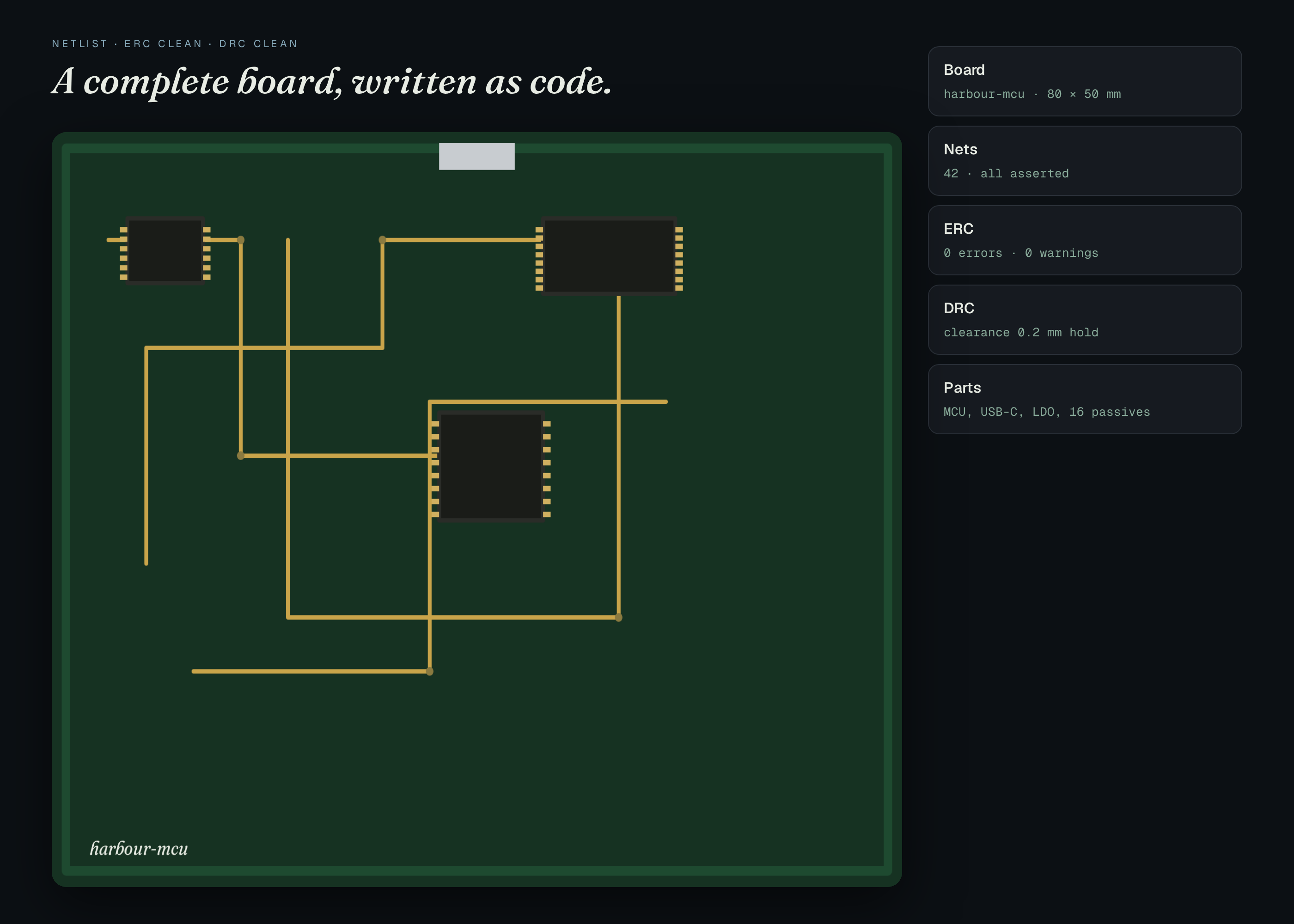
Quantity Value Tolerance Source Board size 100.00 × 70.00 0.10 A single-layer playfield plus a ground border Trace width 0.80 0.05 Of the path the 'token' follows Lives, default 3 0 Silk label when silkis onFixture play, length 12 moves 0 fixtures/trace-game-12.jsonERC clean, or a documented list — No board house required Four goldens: the bare board, the board with silk, mid-play after move 6, and a game-over frame. The game logic may run in Python against the generated geometry; the copper itself is the map.
Screenshots
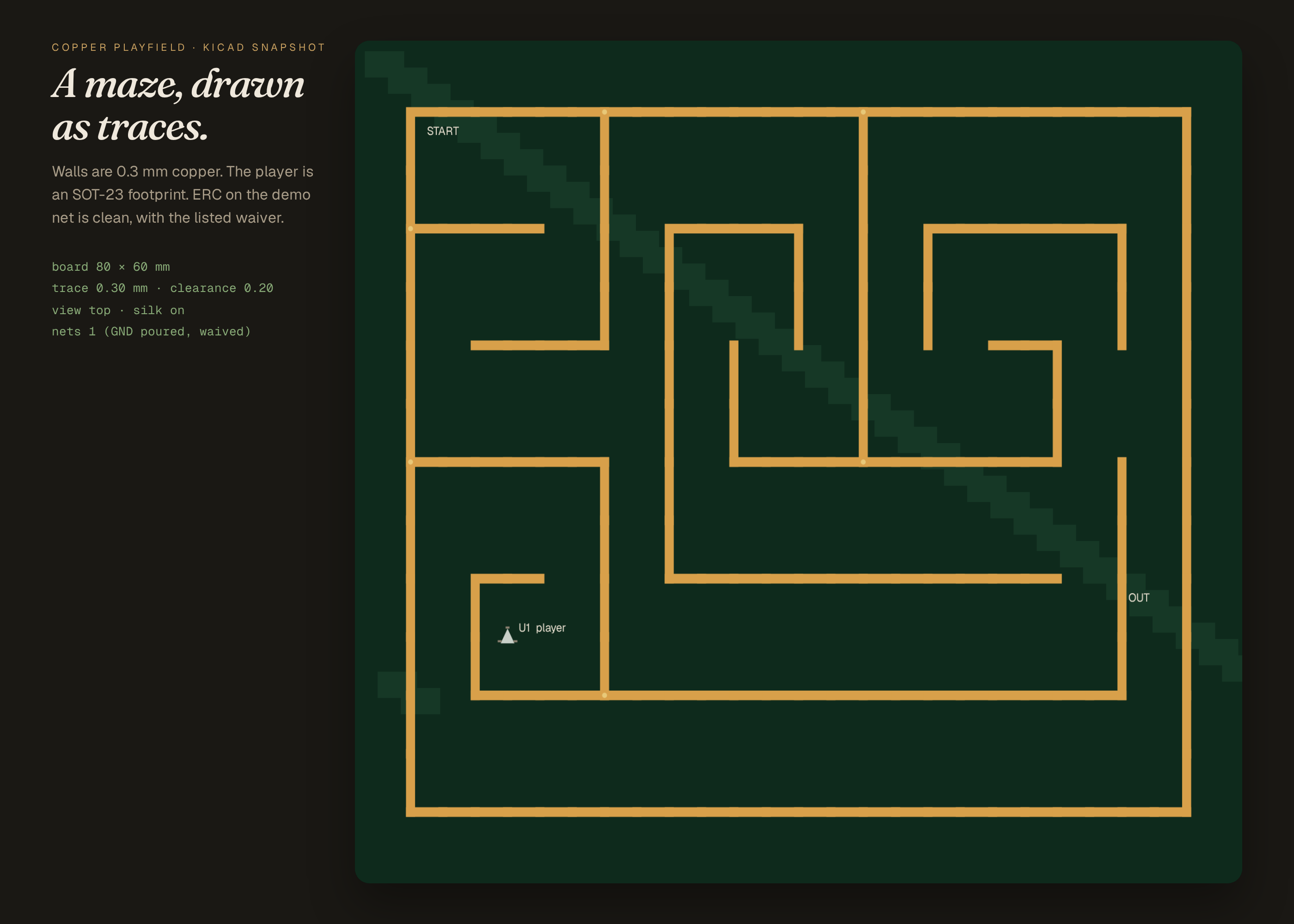
These pictures are a board generated from the reference script in
reference/board.py, at the default inputs. They are not drawings of a product that has not been built or simulated. The first picture is the one Spekkr shows on the spec's card. A build may ship its own goldens; those goldens are of that build and do not have to match these frames pixel-for-pixel.File What it shows shots/bare-board.pngPlayfield 100 × 70 mm, copper traces and a silk title shots/mid-play.pngMid-play after move 6, two lives left How to verify
- Run the simulation or the HDL testbench at the defaults, with no physical board.
- Compare periods, trip points, register dumps or frames to the acceptance table in this file.
- Corrupt one documented value on purpose and confirm the check fails.
- A scripted demo produces golden frames and a .kicad_pcb snapshot whose traces and footprints match a documented mapping. ERC is clean enough for the stated few-net demo, with waivers listed. A rights scan fails if a copyrighted commercial IWAD is present. No board house is required.
# Design

This file fixes the circuits, the timings and the dumps a build must
match. The toolchain can vary, as long as the numbers here hold.

## Mapping

Tiles or walls become traces of width `trace` on a documented grid, in
`fixtures/trace-map.json`. Footprints may stand in for entities, as
listed. The playfield net may be a single net, with that waiver named.

## Demo

8 frames, or as in `fixtures/trace-demo.json`. Goldens are board renders
or a simple SDL/wireframe, as the file says.

## Rights

Only original or permissively licensed art. No commercial IWAD.

## Inputs

| Key | Label | Default | Notes |
| --- | --- | --- | --- |
| `width` | Playfield width, mm | 100 | From 60 to 160, the board's play area. |
| `height` | Playfield height, mm | 80 | From 40 to 120. |
| `trace` | Trace width, mm | 0.3 | From 0.15 to 0.8, the copper used as 'ink'. |
| `silk` | Silkscreen labels | on | A title and a life count, as silk, not as copper. |
| `frame` | A copper frame | on | A border on the playfield. |
| `view` | Play view | top | top is a top-down maze or field. first-person is a simple corridor, still drawn as traces. |

## Acceptance at the defaults

A small game whose playfield is copper traces and footprints. The board is
generated as SVG or KiCad, and a script plays a short fixture game on the
traces.

| Quantity | Value | Tolerance | Source |
| --- | --- | --- | --- |
| Board size | 100.00 × 70.00 | 0.10 | A single-layer playfield plus a ground border |
| Trace width | 0.80 | 0.05 | Of the path the 'token' follows |
| Lives, default | 3 | 0 | Silk label when `silk` is on |
| Fixture play, length | 12 moves | 0 | `fixtures/trace-game-12.json` |
| ERC | clean, or a documented list | — | No board house required |

Four goldens: the bare board, the board with silk, mid-play after move 6,
and a game-over frame. The game logic may run in Python against the
generated geometry; the copper itself is the map.

## Screenshots

These pictures are a board generated from the reference script in `reference/board.py`, at the default inputs. They are not drawings of a
product that has not been built or simulated. The first picture is the one Spekkr
shows on the spec's card. A build may ship its own goldens; those goldens
are of that build and do not have to match these frames pixel-for-pixel.

| File | What it shows |
| --- | --- |
| `shots/bare-board.png` | Playfield  100 × 70 mm, copper traces and a silk title |
| `shots/mid-play.png` | Mid-play  after move 6, two lives left |


## How to verify

1. Run the simulation or the HDL testbench at the defaults, with no
physical board.

2. Compare periods, trip points, register dumps or frames to the
acceptance table in this file.

3. Corrupt one documented value on purpose and confirm the check fails.

4. A scripted demo produces golden frames and a .kicad_pcb snapshot whose
traces and footprints match a documented mapping. ERC is clean enough for
the stated few-net demo, with waivers listed. A rights scan fails if a
copyrighted commercial IWAD is present. No board house is required.
-
tasks.mdBuild tasks in order, each with a check.Tasks
Work in order. Finish a task's check before starting the next.
- Set up. Install the simulator or the HDL toolchain named in
design.md(ngspice, Icarus, Verilator, or a KiCad/SVG board tool). Read the inputs into one place. Check: a trivial netlist or testbench runs and writes a file. - Mapping and frames (R1). Build what
R1. Mapping and framesasks for, to the numbers indesign.md. In particular: A documented mapping turns game tiles or walls into traces or footprints. The snapshot's copper, at the demo's first frame, matches the fixture mapping indesign.md(a netlist of trace segments or a hashed board). Check: theR1. Mapping and framesacceptance checks pass. - ERC and files (R2). Build what
R2. ERC and filesasks for, to the numbers indesign.md. In particular: ERC on the snapshot is clean except for the documented waiver class (for example a single playfield net that is intentional, listed in the file). Check: theR2. ERC and filesacceptance checks pass. - Inputs (R3). Build what
R3. Inputsasks for, to the numbers indesign.md. In particular: Inputs are read fromspekkr.inputs.json. Values outside the ranges or choices indesign.mdare refused before a netlist, a board or a testbench is built. Check: theR3. Inputsacceptance checks pass. - Checks and report (R4). Build what
R4. Checks and reportasks for, to the numbers indesign.md. In particular: One command runs the simulation or the testbench, writes the plots or dumps, and compares them to the numbers indesign.md. Check: theR4. Checks and reportacceptance checks pass. - Plots, dumps and goldens. Write the plots or framebuffer dumps named in
design.mdand compare them to the tables there. Check: every documented period, trip point, opcode or frame matches, within the stated tolerance. - Finish. Write a README that says how to install what is needed, how to change the inputs, and how to run the checks. Run the one command from a clean folder. Check: every item under Definition of done in
spec.mdis true.
# Tasks

Work in order. Finish a task's check before starting the next.

1. **Set up.** Install the simulator or the HDL toolchain named in
`design.md` (ngspice, Icarus, Verilator, or a KiCad/SVG board tool). Read
the inputs into one place.
   Check: a trivial netlist or testbench runs and writes a file.

2. **Mapping and frames (R1).** Build what `R1. Mapping and frames` asks
for, to the numbers in `design.md`. In particular: A documented mapping
turns game tiles or walls into traces or footprints. The snapshot's
copper, at the demo's first frame, matches the fixture mapping in
`design.md` (a netlist of trace segments or a hashed board).
   Check: the `R1. Mapping and frames` acceptance checks pass.

3. **ERC and files (R2).** Build what `R2. ERC and files` asks for, to the
numbers in `design.md`. In particular: ERC on the snapshot is clean except
for the documented waiver class (for example a single playfield net that
is intentional, listed in the file).
   Check: the `R2. ERC and files` acceptance checks pass.

4. **Inputs (R3).** Build what `R3. Inputs` asks for, to the numbers in
`design.md`. In particular: Inputs are read from `spekkr.inputs.json`.
Values outside the ranges or choices in `design.md` are refused before a
netlist, a board or a testbench is built.
   Check: the `R3. Inputs` acceptance checks pass.

5. **Checks and report (R4).** Build what `R4. Checks and report` asks
for, to the numbers in `design.md`. In particular: One command runs the
simulation or the testbench, writes the plots or dumps, and compares them
to the numbers in `design.md`.
   Check: the `R4. Checks and report` acceptance checks pass.

6. **Plots, dumps and goldens.** Write the plots or framebuffer dumps
named in `design.md` and compare them to the tables there.
   Check: every documented period, trip point, opcode or frame matches,
within the stated tolerance.

7. **Finish.** Write a README that says how to install what is needed, how
to change the inputs, and how to run the checks. Run the one command from
a clean folder.
   Check: every item under Definition of done in `spec.md` is true.
- Set up. Install the simulator or the HDL toolchain named in
-
reference/board.svgA reference outline of the default playfield. A build should generate the copper from code. -
reference/preview.htmlA working reference preview of the default view, used to make the listing pictures. A build does not have to start from this file. -
reference/fonts/fonts.cssWebfont faces for the reference preview. -
reference/fonts/Geist.ttfGeist variable typeface for the reference preview. -
reference/fonts/GeistMono.ttfGeist Mono variable typeface for the reference preview. -
reference/fonts/Fraunces.ttfFraunces variable typeface for the reference preview. -
reference/fonts/Fraunces-Italic.ttfFraunces italic variable typeface for the reference preview.
Is it for me?
- Kind
- circuit design
- Tools
- KiCad, Python
What does it need?
- Agent permissions
- shell
- Commands it runs
install KiCad or a tool that can write and check a .kicad_pcbinstall a tool that can render a frame or a board view
What changed?
- 0.2.114 Nov 2026Add animated loop to the listing shots.
- 0.2.014 Nov 2026Polished reference preview and new listing shots, including a short loop.
- 0.1.014 Nov 2026First version.
For agents: start.md says how to build this spec, spec.json holds everything on this page, and bundle.tar.gz holds its files.