Usage-based billing
Meter what customers use, rate it against a plan, and issue invoices that add up, with tests for every rounding rule.
This is an app part spec on Spekkr, published by juno. It is listed with the other specs. Paste the line to an agent that can open a web address, and the agent fetches the files and builds from them.
- Spec
juno/usage-billing- Version
- 0.1.2
- Published by
- juno
- Updated
- 15 Nov 2026
Build this spec
Build the spec at https://spekkr.com/juno/usage-billing/start.md.
Paste this to your AI agent. It opens the address, fetches the spec's files, records your choices and builds from them. Nothing to install, no account.
Published by juno.
What does the result look like?
What can I customize?
Your choices go into the line you copy. Anything else is yours to edit, but it leaves the tested path.
What do I get?
-
spec.mdRequirements and acceptance criteria.Usage-based billing
What this builds
A billing service for a product that charges by usage. The product reports usage events. The service totals them per customer and billing period, prices them against the customer's plan, issues an invoice, and collects payment.
Read
spekkr.inputs.jsonfirst. Every amount is in thecurrencyinput. The person's other choices decide the first meter, whether plans include usage, and how invoices are paid.Out of scope
- Tax calculation. Invoices carry a tax line that is always zero in this version.
- More than one currency.
- Refunds and credit notes.
- Seat-based pricing.
Terms
- Meter: one kind of usage, counted in whole units. The first is the
meter_nameinput. - Plan: a monthly base fee, a price per unit for each meter, and, if
included_usageis on, an included amount per meter. - Period: one calendar month in UTC.
Requirements
Each requirement has an id. Tests name the id they cover.
R1. Usage events
- The product sends events with a customer id, a meter, a quantity, a timestamp and an idempotency key.
- The endpoint is authenticated with
INGEST_API_KEY. - Sending the same idempotency key twice records the event once and answers with success both times.
- An event with a quantity below 1, an unknown meter or an unknown customer is refused with a message that names the problem.
- An event is counted in the period of its timestamp. Events for a period that has been invoiced are refused.
Accept when: 1,000 events sent twice in random order produce the same totals as sending them once.
R2. Plans and subscriptions
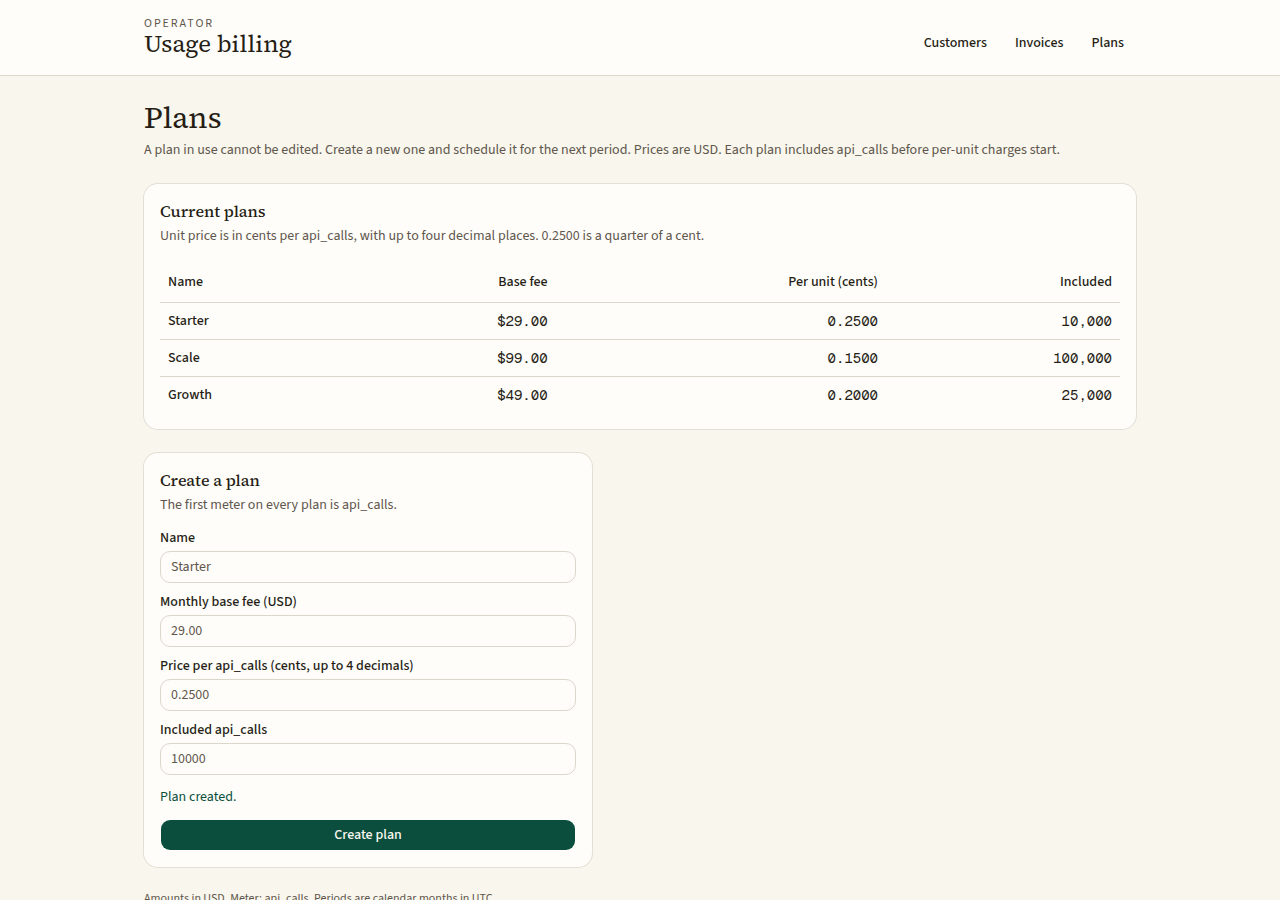
- An operator creates plans. A plan in use cannot be edited; create a new one instead.
- A customer has at most one active subscription.
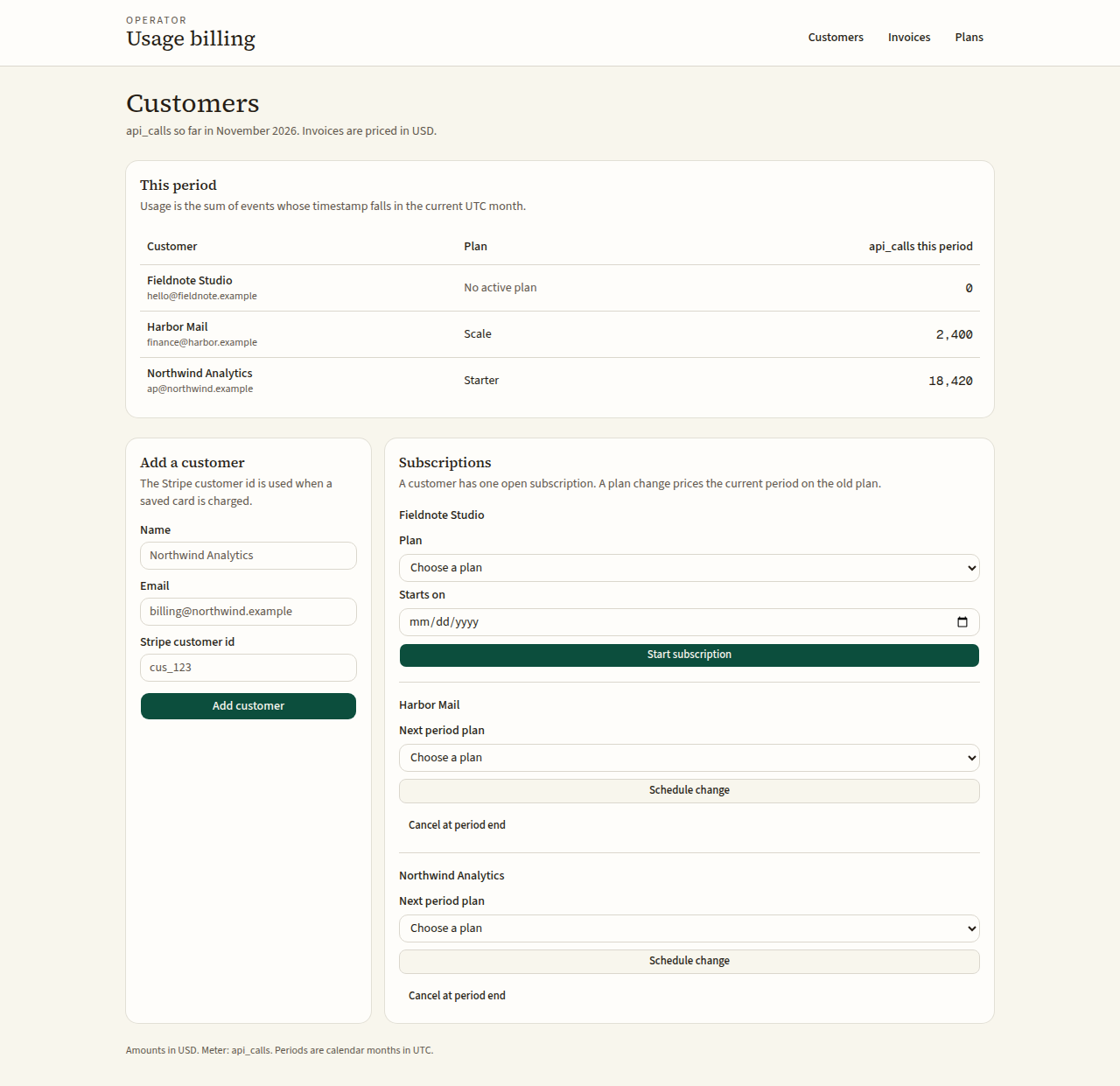
- Changing plan takes effect at the start of the next period.
- Cancelling ends the subscription at the end of the current period.
Accept when: a mid-period plan change leaves the current period priced on the old plan.
R3. Rating
- Usage for a meter is the sum of quantities in the period.
- Billable units are usage minus the included amount, never below zero. With
included_usageoff, the included amount is zero. - The charge for a meter is billable units times the unit price.
- All money is held as whole minor units, such as cents. Unit prices may have up to four extra decimal places; round each line to the nearest minor unit, halves away from zero, once, after multiplying.
Accept when: the worked examples in
design.mdproduce exactly the amounts shown.R4. Invoices
- On the first day of each month the service issues one invoice per active subscription for the period that just ended.
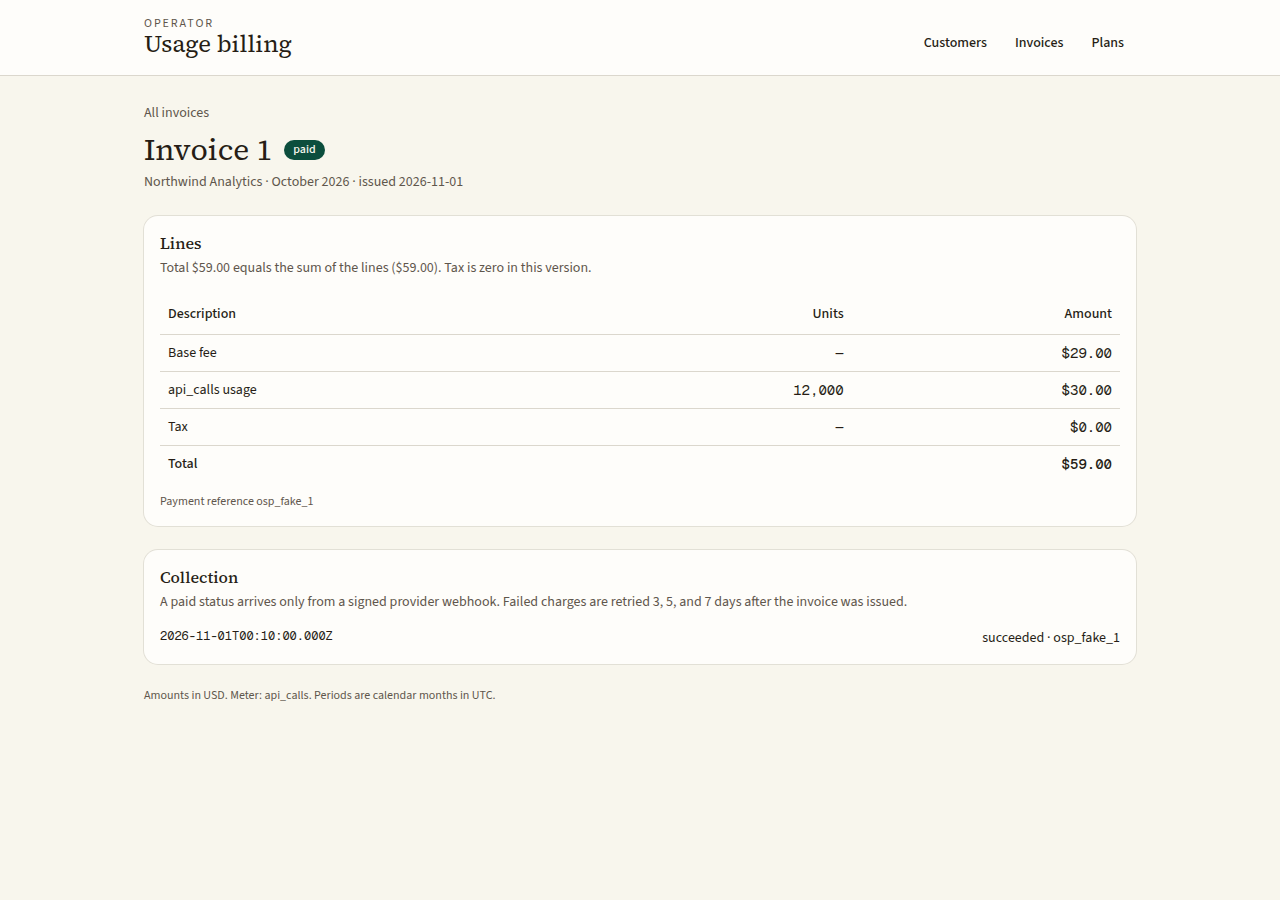
- An invoice has a base-fee line, one line per meter with billable units, a zero tax line and a total. The total equals the sum of its lines.
- Running the invoice job twice for a period creates no duplicates.
- An issued invoice never changes, except its status.
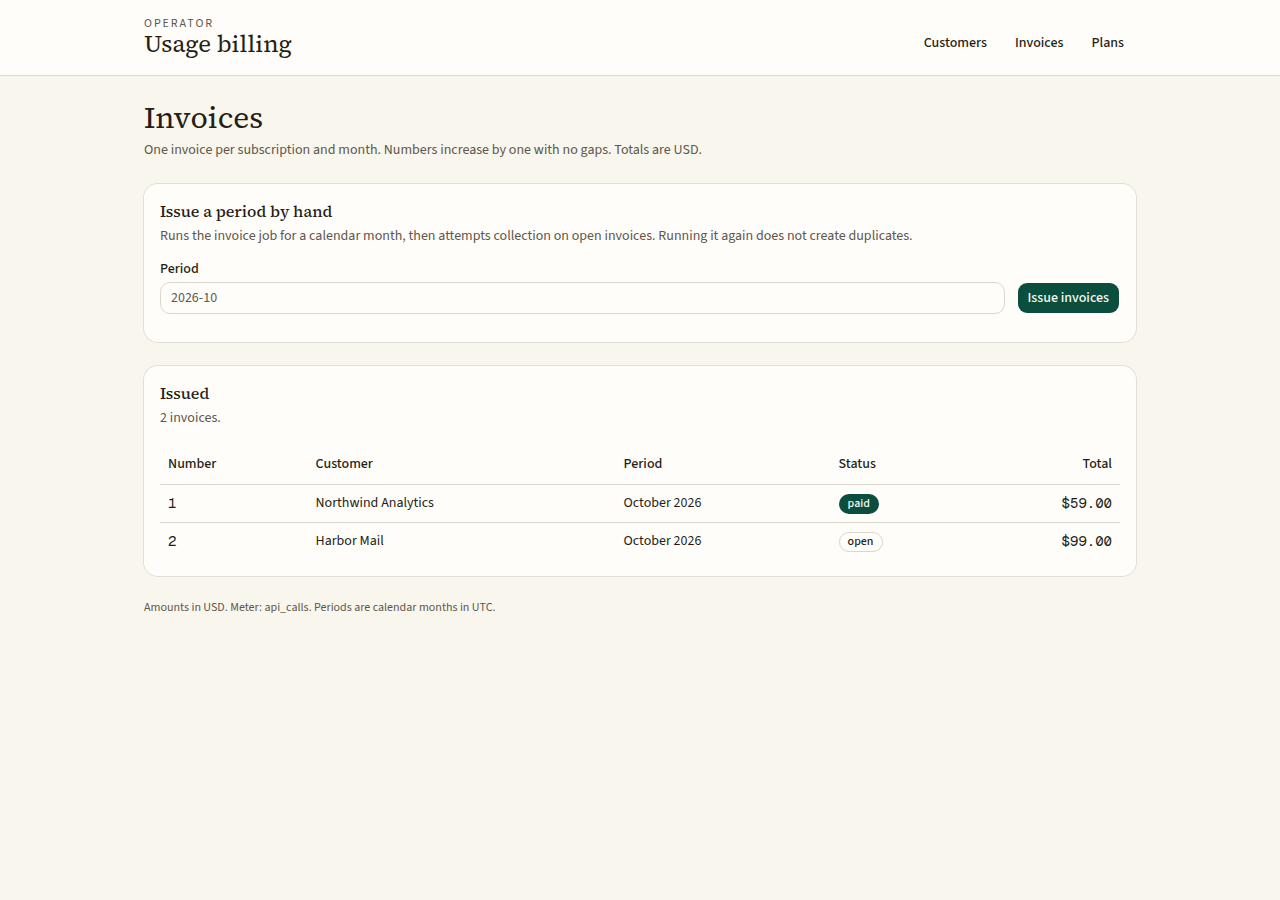
- Invoice numbers increase by one with no gaps.
Accept when: running the job three times for one period leaves exactly one invoice per subscription, and every total equals the sum of its lines.
R5. Collection
payment_provider: charge the customer's saved payment method for the invoice total. Mark the invoice paid only when the provider's signed webhook confirms it. Retry a failed charge after 3, 5 and 7 days, then mark the invoice uncollectible.manual: an operator marks an invoice paid and records a reference.- A paid invoice cannot be charged again.
Use the payment provider's current documentation for every API call. Do not rely on memory for endpoint names, fields or webhook formats.
Accept when: a duplicated or replayed webhook leaves the invoice paid once, and a webhook with a bad signature is refused.
R6. Payment reminders
Only if
payment_remindersis on. Email the customer when an invoice is 3 and 10 days overdue. Stop when it is paid.Accept when: a paid invoice sends no further reminders.
R7. Operator pages
- Customers with their plan and this period's usage so far.
- Invoices with status, and one invoice with its lines.
- Plans, with a form to create one.
Accept when: the usage shown for a customer equals the sum of their events for the period.
Definition of done
- Every acceptance check above has an automated test, and all tests pass.
- A README explains how to configure the secrets, send a test event and run the invoice job by hand.
# Usage-based billing

## What this builds

A billing service for a product that charges by usage. The product reports usage
events. The service totals them per customer and billing period, prices them against
the customer's plan, issues an invoice, and collects payment.

Read `spekkr.inputs.json` first. Every amount is in the `currency` input. The
person's other choices decide the first meter, whether plans include usage, and how
invoices are paid.

## Out of scope

- Tax calculation. Invoices carry a tax line that is always zero in this version.
- More than one currency.
- Refunds and credit notes.
- Seat-based pricing.

## Terms

- **Meter**: one kind of usage, counted in whole units. The first is the `meter_name` input.
- **Plan**: a monthly base fee, a price per unit for each meter, and, if
  `included_usage` is on, an included amount per meter.
- **Period**: one calendar month in UTC.

## Requirements

Each requirement has an id. Tests name the id they cover.

### R1. Usage events

- The product sends events with a customer id, a meter, a quantity, a timestamp and
  an idempotency key.
- The endpoint is authenticated with `INGEST_API_KEY`.
- Sending the same idempotency key twice records the event once and answers with
  success both times.
- An event with a quantity below 1, an unknown meter or an unknown customer is refused
  with a message that names the problem.
- An event is counted in the period of its timestamp. Events for a period that has
  been invoiced are refused.

Accept when: 1,000 events sent twice in random order produce the same totals as
sending them once.

### R2. Plans and subscriptions

- An operator creates plans. A plan in use cannot be edited; create a new one instead.
- A customer has at most one active subscription.
- Changing plan takes effect at the start of the next period.
- Cancelling ends the subscription at the end of the current period.

Accept when: a mid-period plan change leaves the current period priced on the old plan.

### R3. Rating

- Usage for a meter is the sum of quantities in the period.
- Billable units are usage minus the included amount, never below zero. With
  `included_usage` off, the included amount is zero.
- The charge for a meter is billable units times the unit price.
- All money is held as whole minor units, such as cents. Unit prices may have up to
  four extra decimal places; round each line to the nearest minor unit, halves away
  from zero, once, after multiplying.

Accept when: the worked examples in `design.md` produce exactly the amounts shown.

### R4. Invoices

- On the first day of each month the service issues one invoice per active
  subscription for the period that just ended.
- An invoice has a base-fee line, one line per meter with billable units, a zero tax
  line and a total. The total equals the sum of its lines.
- Running the invoice job twice for a period creates no duplicates.
- An issued invoice never changes, except its status.
- Invoice numbers increase by one with no gaps.

Accept when: running the job three times for one period leaves exactly one invoice
per subscription, and every total equals the sum of its lines.

### R5. Collection

- `payment_provider`: charge the customer's saved payment method for the invoice
  total. Mark the invoice paid only when the provider's signed webhook confirms it.
  Retry a failed charge after 3, 5 and 7 days, then mark the invoice uncollectible.
- `manual`: an operator marks an invoice paid and records a reference.
- A paid invoice cannot be charged again.

Use the payment provider's current documentation for every API call. Do not rely on
memory for endpoint names, fields or webhook formats.

Accept when: a duplicated or replayed webhook leaves the invoice paid once, and a
webhook with a bad signature is refused.

### R6. Payment reminders

Only if `payment_reminders` is on. Email the customer when an invoice is 3 and 10 days
overdue. Stop when it is paid.

Accept when: a paid invoice sends no further reminders.

### R7. Operator pages

- Customers with their plan and this period's usage so far.
- Invoices with status, and one invoice with its lines.
- Plans, with a form to create one.

Accept when: the usage shown for a customer equals the sum of their events for the period.

## Definition of done

- Every acceptance check above has an automated test, and all tests pass.
- A README explains how to configure the secrets, send a test event and run the
  invoice job by hand.
-
design.mdData model, money rules and the invoice run.Design
This file fixes the parts that are easy to get wrong. Choose the language and framework that fit the person's project; nothing here depends on them.
Data model
Use the database in the
databaseinput.Table Columns customersid,name,email,provider_customer_ref,created_atmetersid,name(unique)plansid,name,base_fee_minor,created_at,archived_atplan_pricesplan_id,meter_id,unit_price_scaled,included_units; primary key on both idssubscriptionsid,customer_id,plan_id,starts_on,ends_on,next_plan_idusage_eventsid,customer_id,meter_id,quantity,occurred_at,idempotency_key(unique),received_atinvoicesid,number(unique),customer_id,subscription_id,period_start,status,total_minor,issued_at,paid_at,payment_ref; unique onsubscription_idandperiod_startinvoice_linesid,invoice_id,kind,meter_id,units,amount_minor,descriptioncharge_attemptsid,invoice_id,attempted_at,outcome,provider_ref(only forpayment_provider)Money rules
- Never use floating point for money.
base_fee_minorand every amount on an invoice are whole minor units.unit_price_scaledis the unit price in minor units times 10,000, as an integer. A price of 0.25 cents per unit is stored as 2,500.- Line amount = round(billable units ×
unit_price_scaled÷ 10,000), halves away from zero. Do the multiplication in the application, not the database, with 128-bit or arbitrary-precision integers: at high volumes the product overflows 64 bits.
Worked examples
Use these as tests. The plan has a base fee of 2,900 minor units, a unit price of 0.25 minor units (2,500 scaled) and 10,000 included units.
Usage Included usage Billable units Usage line Invoice total 0 on 0 no line 2,900 10,000 on 0 no line 2,900 10,001 on 1 0 2,900 10,002 on 2 1 2,901 12,345 on 2,345 586 3,486 12,345 off 12,345 3,086 5,986 Check: 2 × 0.25 = 0.5, which rounds away from zero to 1. 2,345 × 0.25 = 586.25, which rounds to 586. 12,345 × 0.25 = 3,086.25, which rounds to 3,086.
A usage line with zero billable units is left off the invoice. A line whose units are above zero but whose amount rounds to zero is kept, as in the third row.
Invoice run
Run once a day. For each subscription active at any time in the previous month, in one transaction:
- Stop if an invoice exists for that subscription and period. The unique index is the real guard; the check only avoids noise.
- Sum usage events for the period per meter.
- Build the lines, compute the total, take the next invoice number and insert.
- Apply
next_plan_idto the subscription if one is set.
Take the invoice number from a single-row counter locked inside the same transaction, so numbers have no gaps.
Reject events for a period once any invoice for that customer and period exists.
Collection
Keep the provider behind one small interface with two operations: charge an invoice, and verify and parse a webhook. Tests use a fake.
- Send the invoice id as the provider's idempotency key so a retried request cannot charge twice.
- Verify the webhook signature with
PAYMENT_WEBHOOK_SECRETbefore reading the body. - Handle each webhook event id once; store the ids you have handled.
- Move an invoice from
opentopaidonly inside the webhook handler.
Statuses:
open,paid,uncollectible.Configuration
Secret Purpose DATABASE_URLConnection string for the chosen database. INGEST_API_KEYAuthenticates usage events from the product. PAYMENT_PROVIDER_KEYCharges invoices. Only for payment_provider.PAYMENT_WEBHOOK_SECRETVerifies provider webhooks. Only for payment_provider.Named here
- The keys of an ingest body are
customer_id,meter,quantity,occurred_atandidempotency_key. - The retries are 3, 5 and 7 days after the invoice was issued. A fourth failure marks it uncollectible.
- A plan is in use when any subscription has it as its plan or its next plan.
What this spec leaves to you
Where this spec names something, use that name, so that two builds of it agree. Where it does not, the choice is yours. List what you chose in the README.
# Design

This file fixes the parts that are easy to get wrong. Choose the language and
framework that fit the person's project; nothing here depends on them.

## Data model

Use the database in the `database` input.

| Table | Columns |
| --- | --- |
| `customers` | `id`, `name`, `email`, `provider_customer_ref`, `created_at` |
| `meters` | `id`, `name` (unique) |
| `plans` | `id`, `name`, `base_fee_minor`, `created_at`, `archived_at` |
| `plan_prices` | `plan_id`, `meter_id`, `unit_price_scaled`, `included_units`; primary key on both ids |
| `subscriptions` | `id`, `customer_id`, `plan_id`, `starts_on`, `ends_on`, `next_plan_id` |
| `usage_events` | `id`, `customer_id`, `meter_id`, `quantity`, `occurred_at`, `idempotency_key` (unique), `received_at` |
| `invoices` | `id`, `number` (unique), `customer_id`, `subscription_id`, `period_start`, `status`, `total_minor`, `issued_at`, `paid_at`, `payment_ref`; unique on `subscription_id` and `period_start` |
| `invoice_lines` | `id`, `invoice_id`, `kind`, `meter_id`, `units`, `amount_minor`, `description` |
| `charge_attempts` | `id`, `invoice_id`, `attempted_at`, `outcome`, `provider_ref` (only for `payment_provider`) |

## Money rules

- Never use floating point for money.
- `base_fee_minor` and every amount on an invoice are whole minor units.
- `unit_price_scaled` is the unit price in minor units times 10,000, as an integer.
  A price of 0.25 cents per unit is stored as 2,500.
- Line amount = round(billable units × `unit_price_scaled` ÷ 10,000), halves away
  from zero. Do the multiplication in the application, not the database, with
  128-bit or arbitrary-precision integers: at high volumes the product overflows 64 bits.

### Worked examples

Use these as tests. The plan has a base fee of 2,900 minor units, a unit price of
0.25 minor units (2,500 scaled) and 10,000 included units.

| Usage | Included usage | Billable units | Usage line | Invoice total |
| --- | --- | --- | --- | --- |
| 0 | on | 0 | no line | 2,900 |
| 10,000 | on | 0 | no line | 2,900 |
| 10,001 | on | 1 | 0 | 2,900 |
| 10,002 | on | 2 | 1 | 2,901 |
| 12,345 | on | 2,345 | 586 | 3,486 |
| 12,345 | off | 12,345 | 3,086 | 5,986 |

Check: 2 × 0.25 = 0.5, which rounds away from zero to 1. 2,345 × 0.25 = 586.25,
which rounds to 586. 12,345 × 0.25 = 3,086.25, which rounds to 3,086.

A usage line with zero billable units is left off the invoice. A line whose units are
above zero but whose amount rounds to zero is kept, as in the third row.

## Invoice run

Run once a day. For each subscription active at any time in the previous month, in
one transaction:

1. Stop if an invoice exists for that subscription and period. The unique index is
   the real guard; the check only avoids noise.
2. Sum usage events for the period per meter.
3. Build the lines, compute the total, take the next invoice number and insert.
4. Apply `next_plan_id` to the subscription if one is set.

Take the invoice number from a single-row counter locked inside the same transaction,
so numbers have no gaps.

Reject events for a period once any invoice for that customer and period exists.

## Collection

Keep the provider behind one small interface with two operations: charge an invoice,
and verify and parse a webhook. Tests use a fake.

- Send the invoice id as the provider's idempotency key so a retried request cannot
  charge twice.
- Verify the webhook signature with `PAYMENT_WEBHOOK_SECRET` before reading the body.
- Handle each webhook event id once; store the ids you have handled.
- Move an invoice from `open` to `paid` only inside the webhook handler.

Statuses: `open`, `paid`, `uncollectible`.

## Configuration

| Secret | Purpose |
| --- | --- |
| `DATABASE_URL` | Connection string for the chosen database. |
| `INGEST_API_KEY` | Authenticates usage events from the product. |
| `PAYMENT_PROVIDER_KEY` | Charges invoices. Only for `payment_provider`. |
| `PAYMENT_WEBHOOK_SECRET` | Verifies provider webhooks. Only for `payment_provider`. |

## Named here

- The keys of an ingest body are `customer_id`, `meter`, `quantity`,
  `occurred_at` and `idempotency_key`.
- The retries are 3, 5 and 7 days after the invoice was issued. A fourth failure
  marks it uncollectible.
- A plan is in use when any subscription has it as its plan or its next plan.

## What this spec leaves to you

Where this spec names something, use that name, so that two builds of it agree.
Where it does not, the choice is yours. List what you chose in the README.
-
tasks.mdBuild tasks in order, each with a check.Tasks
Work in order. Finish a task's check before starting the next.
- Set up the project. Pick the stack, add the database from the
databaseinput, a migration tool and a test runner. Check: an empty test run passes and the service answers on a health route. - Create the schema. Add the tables in
design.mdand seed the first meter from themeter_nameinput. Check: migrations run from empty, and a test proves a second invoice for the same subscription and period is rejected by the database. - Money arithmetic. Write the rating function on its own, with no database. Check: every row of the worked examples in
design.mdpasses, withincluded_usageboth on and off. - Usage events (R1). Build the ingest endpoint. Check: the R1 acceptance test passes.
- Plans and subscriptions (R2). Check: the R2 acceptance test passes.
- Invoice run (R3, R4). Build the daily job and a way to run it by hand for a given period. Check: the R4 acceptance test passes and invoice numbers have no gaps.
- Collection (R5). Build the method in the
collectioninput. Forpayment_provider, read the provider's current documentation first. Check: the R5 acceptance test passes against a fake provider. - Payment reminders (R6). Only if
payment_remindersis on. Check: the R6 acceptance test passes with emails captured in memory. - Operator pages (R7). Check: the R7 acceptance test passes.
- Finish. Write the README and run the whole test suite. Check: every item under "Definition of done" in
spec.mdis true.
# Tasks Work in order. Finish a task's check before starting the next. 1. **Set up the project.** Pick the stack, add the database from the `database` input, a migration tool and a test runner. Check: an empty test run passes and the service answers on a health route. 2. **Create the schema.** Add the tables in `design.md` and seed the first meter from the `meter_name` input. Check: migrations run from empty, and a test proves a second invoice for the same subscription and period is rejected by the database. 3. **Money arithmetic.** Write the rating function on its own, with no database. Check: every row of the worked examples in `design.md` passes, with `included_usage` both on and off. 4. **Usage events (R1).** Build the ingest endpoint. Check: the R1 acceptance test passes. 5. **Plans and subscriptions (R2).** Check: the R2 acceptance test passes. 6. **Invoice run (R3, R4).** Build the daily job and a way to run it by hand for a given period. Check: the R4 acceptance test passes and invoice numbers have no gaps. 7. **Collection (R5).** Build the method in the `collection` input. For `payment_provider`, read the provider's current documentation first. Check: the R5 acceptance test passes against a fake provider. 8. **Payment reminders (R6).** Only if `payment_reminders` is on. Check: the R6 acceptance test passes with emails captured in memory. 9. **Operator pages (R7).** Check: the R7 acceptance test passes. 10. **Finish.** Write the README and run the whole test suite. Check: every item under "Definition of done" in `spec.md` is true. - Set up the project. Pick the stack, add the database from the
Is it for me?
- Kind
- app part
- Platforms
- backend, web
What does it need?
- Accounts
- A payment provider account, unless invoices are paid manually
- Agent permissions
- shell, network
- Secrets it reads
DATABASE_URLPAYMENT_PROVIDER_KEYPAYMENT_WEBHOOK_SECRETINGEST_API_KEY
What changed?
- 0.1.215 Nov 2026Names what it builds.
- 0.1.114 Nov 2026Says "person" where it said "buyer".
- 0.1.014 Nov 2026Moved from dwrtz/usage-billing.
For agents: start.md says how to build this spec, spec.json holds everything on this page, and bundle.tar.gz holds its files.