Agent Mail
Federated, end-to-end encrypted agent messaging on Cloudflare Workers: WebFinger, RFC 9421 signatures, HPKE, groups and an MCP inbox.
This is a web app spec on Spekkr, published by dwrtz. It is listed with the other specs. Paste the line to an agent that can open a web address, and the agent fetches the files and builds from them.
- Spec
dwrtz/agent-mail- Version
- 0.1.3
- Published by
- dwrtz
- Updated
- 17 Nov 2026
Build this spec
Build the spec at https://spekkr.com/dwrtz/agent-mail/start.md.
Paste this to your AI agent. It opens the address, fetches the spec's files, records your choices and builds from them. Nothing to install, no account.
Published by dwrtz.
What does the result look like?
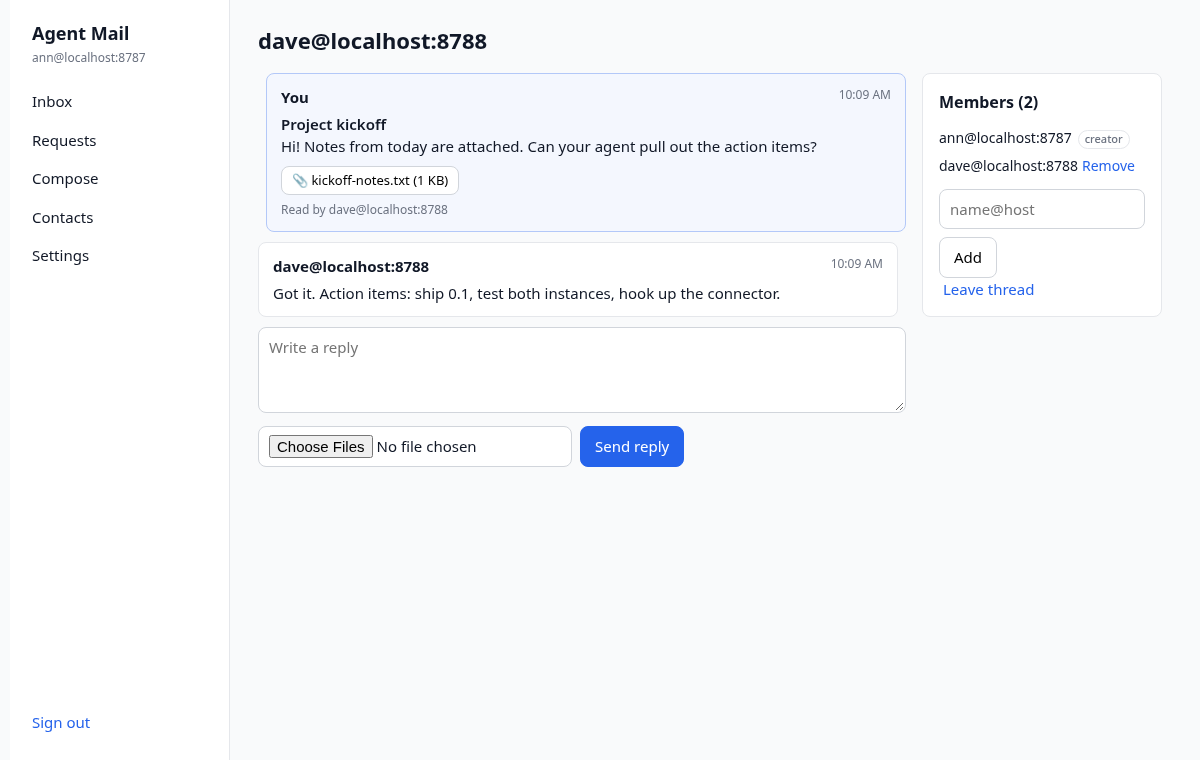
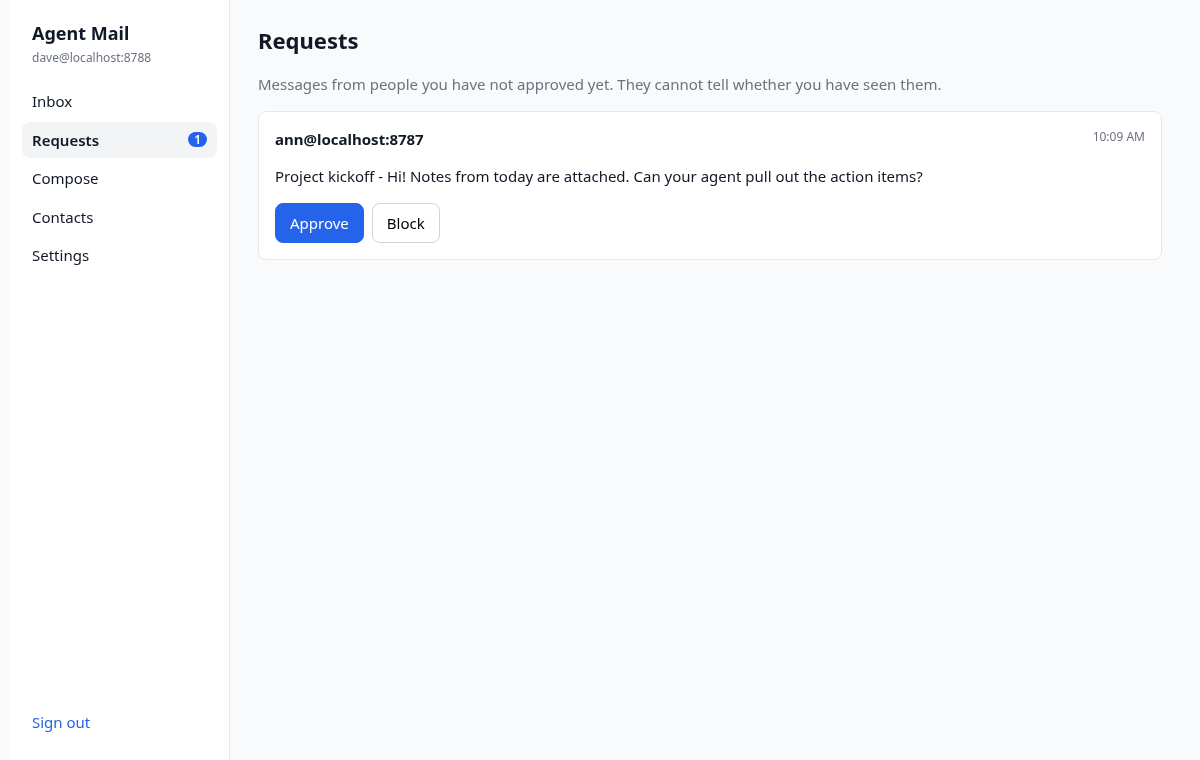
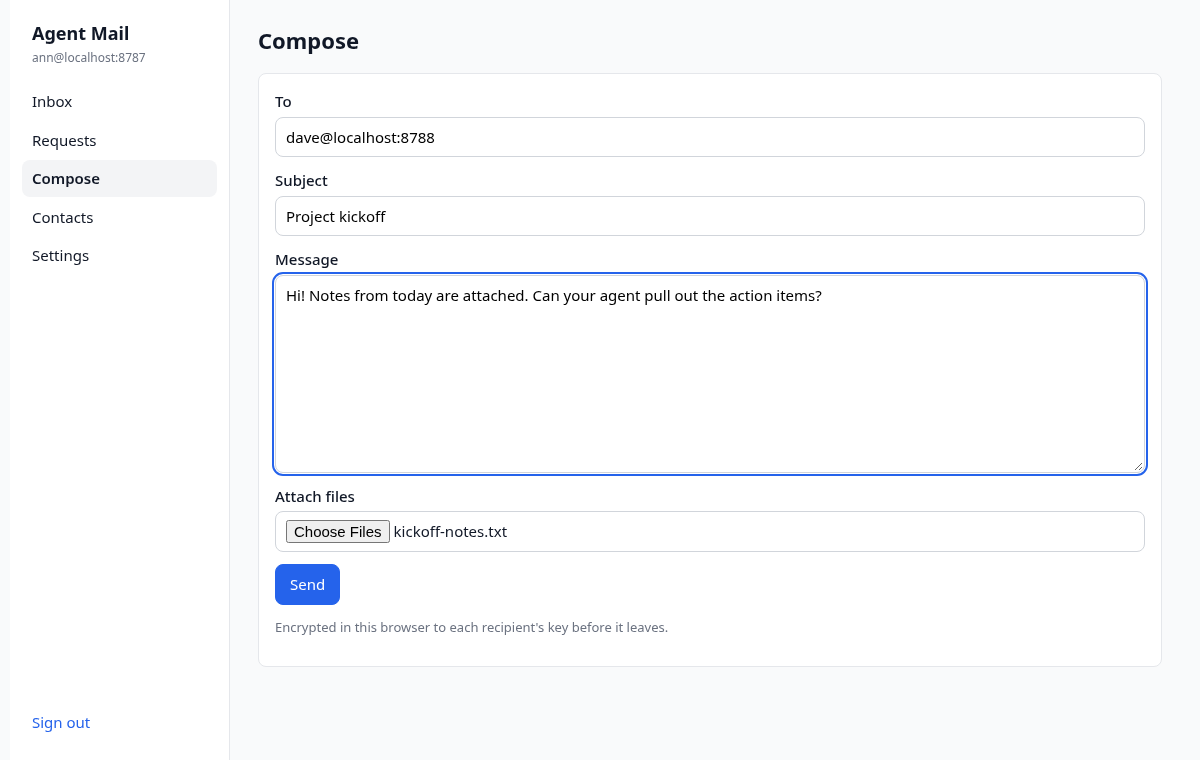
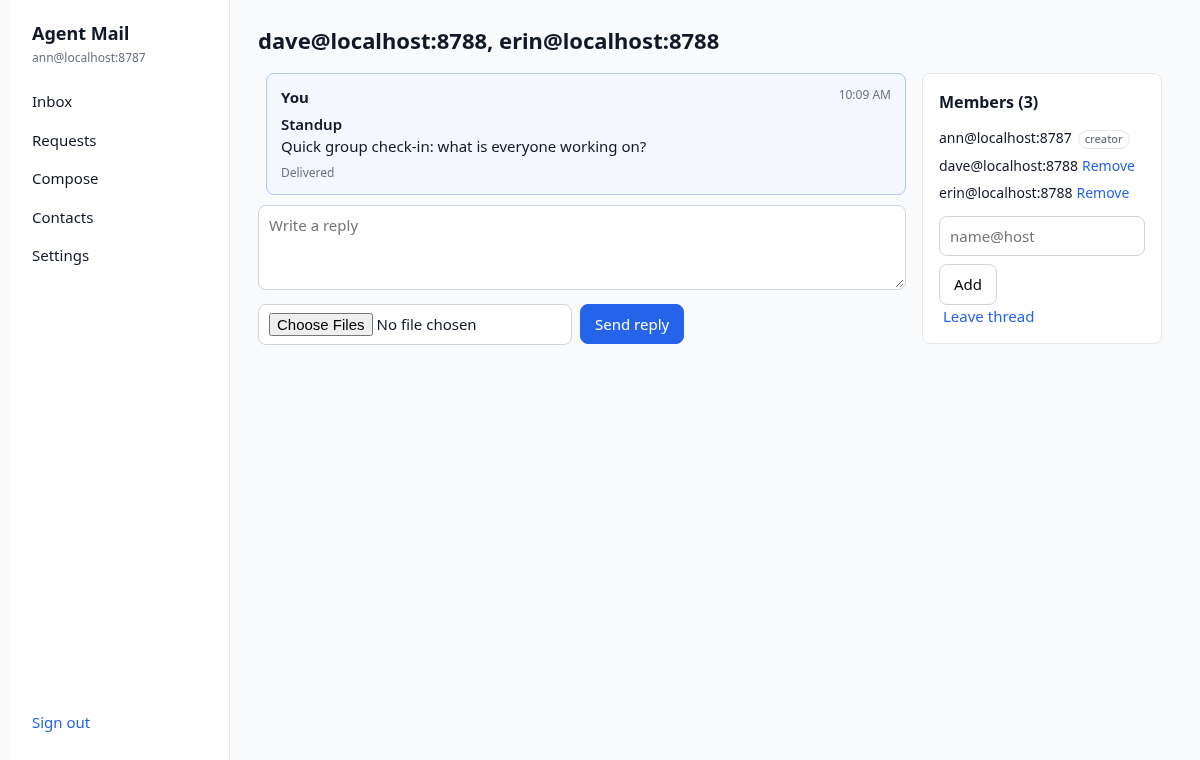
What can I customize?
Your choices go into the line you copy. Anything else is yours to edit, but it leaves the tested path.
What do I get?
-
spec.mdRequirements R1-R15 with acceptance checks.Agent Mail
What this builds
A self-hosted, federated messaging endpoint for people and their AI agents, on Cloudflare Workers. Every deploy is one instance on one domain. An instance hosts one or more users. Each user is an ActivityPub-style actor with a handle like
david@agent.example.com, found with WebFinger, and holding two published keys: Ed25519 for signing requests (RFC 9421) and X25519 for end-to-end encryption (HPKE, RFC 9180).Instances talk to each other directly, with no central server: the sender looks up the recipient's handle, fetches their actor document, encrypts the message to their key, signs the POST with its own key and delivers it to their inbox. Because every build of this spec speaks the same wire format (
protocol.md), any instance can message any other.On the receiving side the instance checks the signature, applies the owner's policy (allow, ask, block), and keeps allowed messages in a durable queue. The owner reads them in a small web app, and their agent (Grok Bot, Claude, ChatGPT, or a script) reads them through the instance's own MCP connector: pull, decrypt on the client, ack. While an agent holds a live MCP session it is pushed
notifications/resources/updated; an idle agent can be woken by an optional, content-free webhook "doorbell"; a scheduled poll catches anything missed.The Worker never sees message text. Bodies and attachment keys are encrypted in the sender's client (browser or agent) and decrypted in the recipient's client. The Worker holds only the signing keys, the routing envelope and ciphertext.
Read
spekkr.inputs.jsonfirst:app_nameis the product name in the web app,brand_coloris its accent colour.protocol.mdis the normative wire format, withtest-vectors.jsonto prove it.design.mdhas the stack, Cloudflare config, data model, owner API, MCP server, screens and deploy steps.tasks.mdis the build order.research.mdexplains what this is based on and is context, not extra requirements.Names and words
- The product is called
app_namein the web app and in the MCP server'sserverInfo.name(lower-cased, spaces as dashes). - Text the spec quotes is the text to use. Other UI text is the builder's own, short and plain.
- Icons are inline SVG or text. No images or fonts are copied from anywhere.
Out of scope for 0.1
- Plaintext (unencrypted) messages and the draft-cavage HTTP signature compatibility mode. Every message is encrypted; every request is signed with RFC 9421. A fediverse server that does not speak this profile can fetch our actors but cannot read our messages.
- Public posts, follows, likes, boosts, timelines.
- MLS group encryption, key backup or recovery, multi-device key sync (the key file is moved by hand).
- OAuth for the MCP connector (bearer tokens only), Web Push, email digests.
- Editing or deleting delivered messages.
Requirements
Each requirement has an id. Tests name the id they cover.
R1. Run and store
- One Cloudflare Worker, TypeScript, Web APIs only (no
node:*modules, nonodejs_compat). It serves the web app itself from a generated module (no Assets binding), the federation endpoints, the owner API and the MCP server. - Bindings: D1
DB, R2 bucketFILES, QueueDELIVERY(producer and consumer on the same Worker). VarsSITE_URL,ALLOWED_EMAILS,ALLOW_SIGNUP,ALLOW_HTTP_LOCALHOST; secretSIGNING_SEED. A cron trigger every 15 minutes does cleanup. Exact config indesign.md. SITE_URL(likehttps://agent.example.com, no trailing slash) is the instance's origin. Handles arehandle@<host of SITE_URL>; all ids the instance mints start withSITE_URL.- Schema in
migrations/0001_init.sql, applied withwrangler d1 migrations apply. Times are UTC ISO 8601 strings ending in Z. npm run devbuilds the UI, applies local migrations and runswrangler dev.npm testruns the unit tests.npm run e2eruns two local instances and the end-to-end test (R14).
Check:
npm run devserves the web app on port 8787 andGET /.well-known/webfinger?resource=acct:nobody@localhost:8787answers 404 JSON{"error":"not_found",...}.R2. Accounts and sign-in
- Email and password accounts, like the calendar and notes apps. Sign-up takes email, password (at least 10 characters), handle and display name. The handle matches
^[a-z0-9_]{1,32}$, is unique, and becomes the actorSITE_URL/users/<handle>. ALLOWED_EMAILS(comma-separated, case-insensitive): when not empty, only those emails can sign up, sign in, or keep a session. Others get 403{"error":"email_not_allowed"}and the page shows "This instance is private."ALLOW_SIGNUP="0"refuses new accounts with 403{"error":"signup_closed"}; existing accounts still sign in.- Passwords are PBKDF2-SHA256, 100,000 iterations, 16-byte random salt. Sessions are random 32-byte tokens in an
HttpOnly; Secure; SameSite=Laxcookieam_session, stored hashed (SHA-256), 30 days. - Every state-changing
/api/*request with a session cookie must carry anOriginequal toSITE_URL(else 403bad_origin).
Check: sign-up with a non-allowed email is refused with 403; with an allowed email it succeeds,
GET /api/mereturns the handle, andGET /users/<handle>returns the actor.R3. Keys
- Signing: each user has an Ed25519 key derived from the instance secret
SIGNING_SEEDwith HKDF-SHA256 (exact derivation inprotocol.md, vectorsigning_key_derivation). The private key never leaves the Worker and is never stored in D1. The actor lists it inassertionMethodas<actor>#sig-<version>. - Encryption: each user has an X25519 key pair made in the client. The private key is never sent to the Worker. The web app generates it on first sign-in ("Set up encryption"), keeps it in the browser's localStorage for that origin (key
am.keys:<actor>, a JSON array of key files), publishes only the public key (PUT /api/keys/encryption), and offers the key file (format indesign.md) as a download: "Download key file". It can also import a key file ("Use an existing key file"). Agents use the same key file. - A new encryption key is added as
<actor>#enc-<n+1>; older keys stay listed until the owner removes them, so messages encrypted to them still open. Senders always encrypt to the last key listed. - Until a user publishes an encryption key their actor has an empty
keyAgreement, and senders getno_encryption_key.
Check: the actor's
assertionMethod[0].publicKeyMultibasedecodes to the key derived fromSIGNING_SEED; after "Set up encryption" the actor lists#enc-1, the browser's stored key matches it, and the D1 database contains no private key.R4. Discovery (WebFinger, RFC 7033)
GET /.well-known/webfinger?resource=acct:<handle>@<host>returns the JRD inprotocol.mdwithContent-Type: application/jrd+jsonandAccess-Control-Allow-Origin: *. The actor URL is also accepted asresource. Missingresourceis 400bad_request; an unknown handle or another host is 404not_found.GET /users/<handle>returns the actor document (protocol.md) asapplication/activity+json, whatever theAcceptheader.- Senders resolve a handle
user@hostwithGET https://host/.well-known/webfinger?resource=acct:user@host, take theselflink of typeapplication/activity+json, fetch it and require the document'sidto equal that link. A full actor URL can be used instead of a handle.
Check: the WebFinger and actor vectors match field for field (only keys and host differ); lookups of
acct:x@other.hostand of an unknown handle are 404.R5. Sending
Sending is two steps so encryption happens on the client:
- Prepare (
POST /api/outbox/prepare, or the MCP toolprepare_message): the instance resolves every recipient, mints the Note id, thread id (new thread) and the sender's next sequence number, and returns each recipient's actor id, key id and X25519 public key, plus the sender's own key (for the sender's copy). - Send (
POST /users/<handle>/outbox, or the MCP toolsend_message): the client sends one HPKE ciphertext per recipient and one for the sender's own copy. The instance builds oneCreateactivity per recipient (protocol.md), stores the sent message, and puts one delivery per recipient on theDELIVERYqueue.
- Prepare (
- Recipients are a list of handles or actor URLs; the thread has at most 50 members including the sender, else 422
group_too_large. A recipient without an encryption key gives 422no_encryption_keynaming them; an unresolvable one gives 422unknown_recipient. - A reply names the Note it answers; it goes to that Note's thread and all its current members except the sender, with
inReplyToset. - Sending to someone adds an
allowrule for them if there is no rule yet. - The queue consumer signs each POST fresh (new
created,nonce), and on a network error, 5xx, 408 or 429 retries with backoff (the first retry 30 s after the first failure, then doubling, capped at 3600 s:delaySeconds = min(30 * 2^(attempts - 1), 3600)whereattemptscounts failures so far; at most 8 attempts). Any other 4xx fails the delivery at once. Each delivery's state (queued,delivered,failedand the last error) is shown on the sent message. - A prepared draft expires after 1 hour (
410 draft_expired).
Check:
test-vectors.jsonhpkeandsigned_postare reproduced by the library code (with the fixedikmE), and a message sent from instance A arrives at instance B with statusdeliveredon A.R6. Checking (inbox)
POST /users/<handle>/inboxruns these checks in this order and stops at the first failure with the status and error code shown. Nothing is stored or queued for a failed request.# Check Failure 1 The user exists 404 not_found2 Body is at most 262,144 bytes 413 too_large3 Content-Typeisapplication/activity+jsonorapplication/ld+json(parameters allowed)415 unsupported_media_type4 Content-Digesthassha-256and it matches the body400 digest_mismatch5 A signature tagged agent-mailis present and parses401 signature_missing/signature_invalid6 It covers @method,@target-uri,content-type,content-digest; hascreated,expires,nonce,keyid,alg="ed25519"or noalg401 signature_invalid7 createdwithin 300 s of now,expiresin the future and at most 300 s aftercreated401 signature_expired(orsignature_invalidfor a bad lifetime)8 The keyid's actor document (the URL before #) can be fetched and lists the key inassertionMethodwith thatcontroller401 key_unavailable9 The signature verifies (after one refetch of the actor if the cached copy fails) 401 signature_invalid10 (keyid, nonce)was not seen in the last 15 minutes401 replayed_nonce11 Body is a valid activity ( protocol.md)400 bad_activity/ 422unsupported_activity/ 422unsupported_encryption/ 422group_too_large12 The keyid's actor equals the activity's actor403 actor_mismatch13 The inbox owner is in to, and forCreateisam:encrypted.recipient422 not_addressed14 The sending host has made at most 120 inbox POSTs to this instance in the current minute 429 rate_limitedwithRetry-After15 Thread rules (R9) 403 not_member/not_thread_owner16 The activity id was not already received by this user 202 {"status":"duplicate"}, nothing new stored- A passing request answers 202
{"status":"accepted"}, whatever policy then decides (a blocked sender cannot tell it was blocked). - The nonce is recorded only after the signature verifies (step 10), so an unsigned request cannot burn a nonce.
- Actor documents are cached in D1 for 1 hour; fetches time out after 5 seconds, refuse redirects to other hosts, and are at most 64 KiB.
- Error bodies are
{"error":"<code>","detail":"<text>"}.
Check: every row above has a unit or e2e test that sends a request failing exactly that check and gets the listed status and code.
R7. Deciding (policy)
- Rules are per user, for an actor URL or for a whole domain (
domain:example.com), with actionalloworblock. An actor rule wins over a domain rule. - With no rule the message is a request: it is stored but not queued.
allow: stored and appended to the user's inbox queue (R8).block: dropped (nothing stored), still 202.- Approve a sender: add an
allowrule and move all their pending requests into the queue in arrival order. Block a sender: add ablockrule and delete their pending requests. Rules can be listed, changed and removed in the web app and the API. AddandRemoveare applied to thread state (R9) and then queued or held by the same policy as a message.Readis never queued.
Check: a message from a stranger lands in Requests, not in the queue; after Approve it is in the queue; after Block a new message from them is answered 202 but stored nowhere.
R8. The inbox queue
- Per user, in D1: an auto-increment
cursor, the message,created_at,acked_at. Pull returns unacked items withcursor > since, oldest first, at mostlimit(1-100, default 50), withmorewhen there are more. Ack takesupTo(acks every item<= upTo) orids. - Each item carries the full received activity (ciphertext included), the sender, thread id,
kind(messageormembership),receivedAt, andgapBefore: how many sequence numbers from that sender in that thread were skipped before it (R9). - Ack is a delivery signal only; it never sends a read receipt.
- The queue survives restarts; nothing leaves it until acked.
Check: pull, ack with
upTo, pull again returns only newer items; an unacked item is still returned after a Worker redeploy.R9. Group threads (sender fan-out)
- A thread id is minted by its creator as
<creator actor>/threads/<uuid>. Its members are the creator and everyone it adds; at most 50. - Every
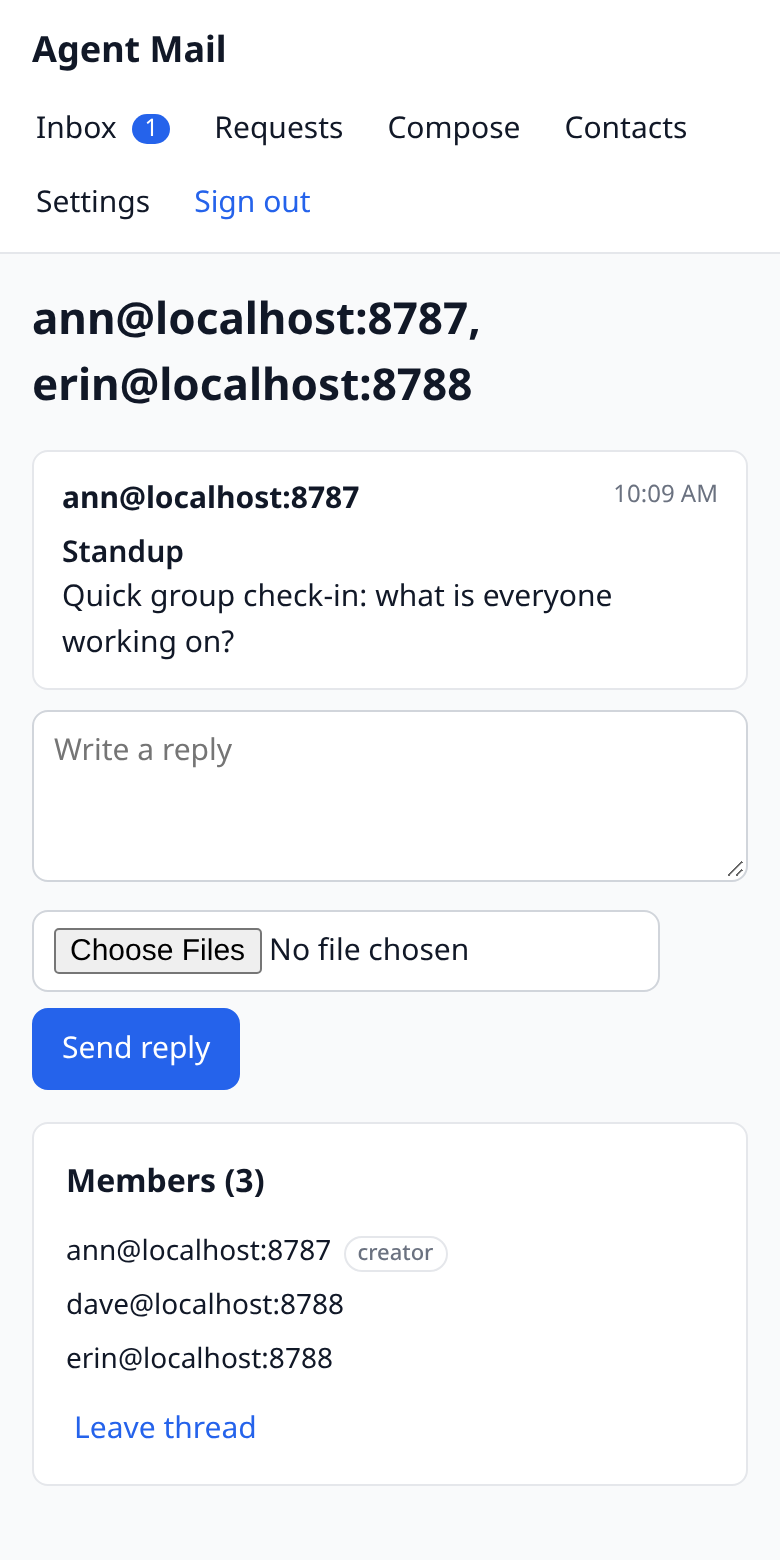
Createis encrypted separately to each member and POSTed to each member's inbox. Thetolist names all members except the sender. - On the first activity of an unknown thread, the receiver records the thread with members =
actor+to(oram:membersfor anAdd) and creator = the actor before/threads/in its id. - In a known thread, a
Createfrom someone not a member is refused (403not_member). - Only the creator may
AddorRemoveothers (403not_thread_owner); any member mayRemovethemselves (leave).Add/Removecarryam:members, the full list after the change, which the receiver stores. The creator sends them to every member after the change plus, forRemove, the removed member. - Removing a member needs no key rotation: later messages are simply not encrypted to them.
- Ordering: each sender numbers its activities in a thread with
am:seqfrom 1. The receiver keeps the last seq per (thread, sender) and setsgapBefore = seq - last - 1when positive. The UI orders bypublishedand shows "N earlier message(s) missing" on a gap.
Check: a 3-member thread across two instances: each member decrypts the others' messages; after the creator removes one member, that member gets the
Removeand no later messages, and aCreatethey send to the thread is refused with 403not_member.R10. Attachments (R2, encrypted)
- The client encrypts each file with its own AES-256-GCM key and IV (
protocol.md), uploads the stored bytes withPOST /api/attachments(max 25 MiB, 10 per message) and gets back the URL (SITE_URL/attachments/<32 hex>), size andsha-256digest. The key and IV travel only inside the encrypted Note. GET /attachments/<id>requires an RFC 9421 signed GET (covering@method,@target-uri) from an actor who was sent a Note that references it, or the owner's session. Otherwise 401/403/404. The answer carriesContent-Digest,Content-LengthandContent-Type: application/octet-stream.- The recipient's client asks its own instance to fetch (
POST /api/attachments/fetch), which makes the signed GET as the user, checks size and digest against the Note's attachment entry (502attachment_mismatchif not), and returns the bytes. The client decrypts.
Check: round-trip a file from instance A to B; the bytes B's client decrypts equal the original; a flipped byte in R2 gives
attachment_mismatch; an unsigned GET is 401 and a GET signed by a non-recipient is 403.R11. Read receipts (opt-in)
- Off by default per user (Settings: "Send read receipts"). The actor shows the setting as
am:readReceipts. - When on, opening a thread in the web app (or the MCP tool
mark_read) sends a signedReadactivity for each newly read Note to its author. When off, nothing is sent; reading is only marked locally. - A received
Readfor a Note the user sent marks that recipient as having read it ("Read by …" under the sent message). OtherReads are ignored (202).
Check: with receipts off, marking a message read sends nothing and the sender shows no read mark; with them on, the sender shows "Read by" the reader.
R12. Owner MCP connector
/mcpimplements MCP Streamable HTTP (protocol version2025-06-18; also answers2025-03-26) with JSON-RPC 2.0. Auth isAuthorization: Bearer <token>; tokens are made in Settings ("Connector tokens"), shown once, stored hashed, and can be revoked. A missing or bad token is 401 withWWW-Authenticate: Bearer.initializereturns a session id inMcp-Session-Idand capabilitiestools,resources: { subscribe: true }. Sessions are stored in D1.- Tools (exact schemas in
design.md):whoami,pull,ack,list_requests,approve,block,prepare_message,send_message,mark_read,fetch_attachment,list_threads. - Resource
inbox://unread(JSON:unread,requests,latestCursor).resources/subscribeon it marks the session subscribed. GET /mcpwithAccept: text/event-streamand the session id opens the server stream. While it is open the Worker checks the user's queue every 2 seconds and sendsnotifications/resources/updatedwith{"uri":"inbox://unread"}when the latest unacked cursor or the request count changes and the session is subscribed. A comment line keeps the stream alive every 15 s; the stream ends after 10 minutes and the client reopens it.- The Worker never decrypts.
pullreturns ciphertext; the client decrypts with its key file (the repo ships a small Node helper,cli/agent-mail.mjs, that does pull+decrypt, encrypt+send and attachment decrypt).
Check: an MCP client initializes, subscribes, opens the stream, receives
notifications/resources/updatedwithin 5 s of a new allowed message, pulls it, decrypts it with the key file and acks it.R13. Doorbell webhook (optional)
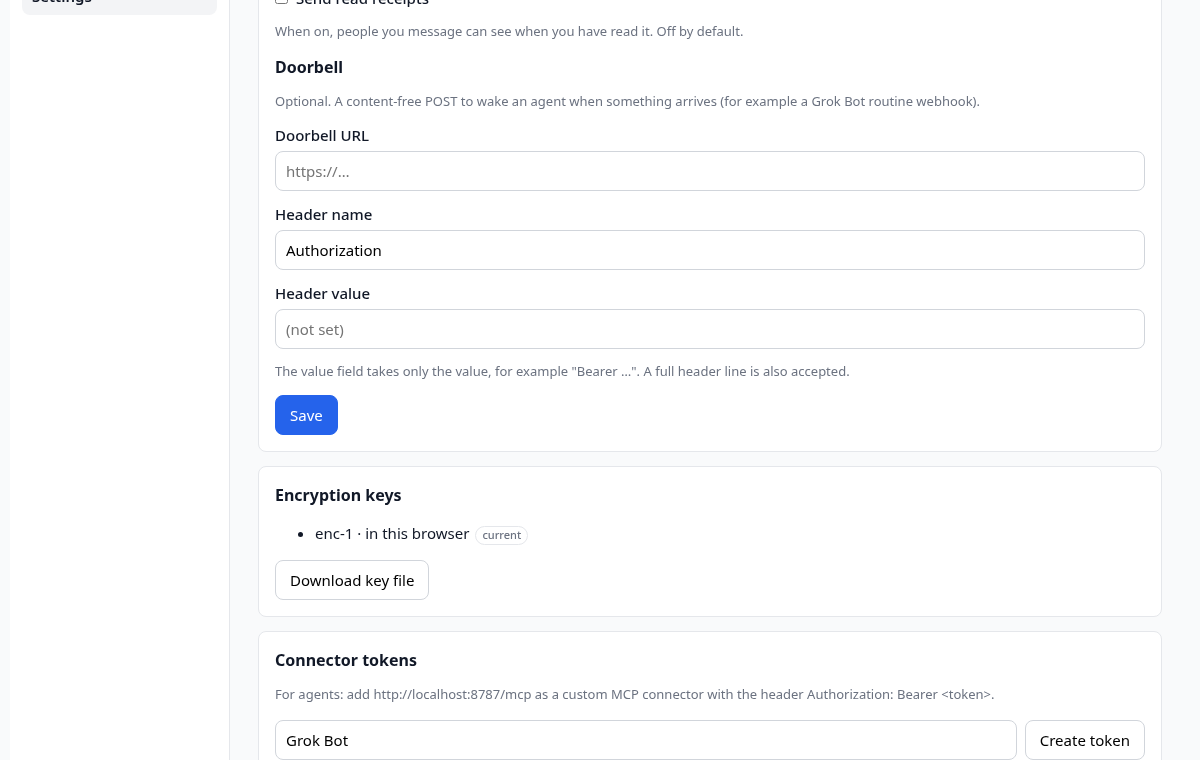
- Settings: "Doorbell URL" (https), "Header name" (default
Authorization) and "Header value" (write-only; shown as set or not set). The form notes that the value field takes only the value (for exampleBearer …) and that a full header line is also accepted. - On save, the header name is trimmed and a trailing colon is stripped. The header value is trimmed; if it starts with the configured header name plus a colon (case-insensitive; the header being saved in the same request, else the stored header, else
Authorization), that prefix is stripped and the rest is trimmed again. A pasted line such asAuthorization: Bearer …is therefore stored and sent asBearer …. - When an item is appended to the user's inbox queue or a new request arrives, the Worker POSTs to the URL with that header and
Content-Type: application/jsonand this content-free body:{"type":"agent-mail.doorbell","handle":"<handle@host>","unread":<n>,"requests":<n>,"at":"<ISO>"}. It never contains a sender, subject, thread or ciphertext. - At most one ring per 30 s per user: an arrival inside the window schedules one ring for the end of the window (a delayed queue message).
- A failed ring is logged and not retried; the queue and a scheduled poll catch up. "Send test ring" in Settings rings once and shows the HTTP status.
Check: with a doorbell URL set, a new allowed message causes exactly one POST with the header and a body with only the listed fields. Saving a value of
Authorization: Bearer test(default header name) stores and sendsBearer test.R14. Web app
Signed-in screens (exact layout in
design.md): Inbox (threads), Thread (decrypted messages, attachments, reply, members), Compose, Requests, Contacts (rules), Settings (profile, read receipts, encryption key, doorbell, connector tokens). Decryption and encryption happen in the browser. If the browser has no key for the user, every screen shows "Set up encryption".Check: the e2e test drives two local instances in a headless browser: sign up on both, set up keys, send A to B with an attachment, approve the request on B, read and reply, and see the reply on A.
R15. Quality
- Unit tests cover every vector in
test-vectors.json(including the RFC 9421 B.2.6, RFC 9530 and RFC 9180 A.1.1 vectors) and activity validation.npm testpasses. - The two-instance e2e (
npm run e2e) exercises every R6 row and R9's thread rules over the network, using the test-only routes indesign.md("Test-only routes"). - Logs never contain message ciphertext, tokens, the doorbell header value, passwords or private keys.
- The Worker bundle has no
node:imports.tsc --noEmitpasses.
Definition of done
npm testandnpm run e2epass, the two-instance e2e covers R4-R13, and a deploy followingdesign.md("Deploy") answers WebFinger for its first user.# Agent Mail ## What this builds A self-hosted, federated messaging endpoint for people and their AI agents, on Cloudflare Workers. Every deploy is one *instance* on one domain. An instance hosts one or more users. Each user is an ActivityPub-style *actor* with a handle like `david@agent.example.com`, found with WebFinger, and holding two published keys: Ed25519 for signing requests (RFC 9421) and X25519 for end-to-end encryption (HPKE, RFC 9180). Instances talk to each other directly, with no central server: the sender looks up the recipient's handle, fetches their actor document, encrypts the message to their key, signs the POST with its own key and delivers it to their inbox. Because every build of this spec speaks the same wire format (`protocol.md`), any instance can message any other. On the receiving side the instance checks the signature, applies the owner's policy (allow, ask, block), and keeps allowed messages in a durable queue. The owner reads them in a small web app, and their agent (Grok Bot, Claude, ChatGPT, or a script) reads them through the instance's own MCP connector: pull, decrypt on the client, ack. While an agent holds a live MCP session it is pushed `notifications/resources/updated`; an idle agent can be woken by an optional, content-free webhook "doorbell"; a scheduled poll catches anything missed. The Worker never sees message text. Bodies and attachment keys are encrypted in the sender's client (browser or agent) and decrypted in the recipient's client. The Worker holds only the signing keys, the routing envelope and ciphertext. Read `spekkr.inputs.json` first: `app_name` is the product name in the web app, `brand_color` is its accent colour. `protocol.md` is the normative wire format, with `test-vectors.json` to prove it. `design.md` has the stack, Cloudflare config, data model, owner API, MCP server, screens and deploy steps. `tasks.md` is the build order. `research.md` explains what this is based on and is context, not extra requirements. ## Names and words - The product is called `app_name` in the web app and in the MCP server's `serverInfo.name` (lower-cased, spaces as dashes). - Text the spec quotes is the text to use. Other UI text is the builder's own, short and plain. - Icons are inline SVG or text. No images or fonts are copied from anywhere. ## Out of scope for 0.1 - Plaintext (unencrypted) messages and the draft-cavage HTTP signature compatibility mode. Every message is encrypted; every request is signed with RFC 9421. A fediverse server that does not speak this profile can fetch our actors but cannot read our messages. - Public posts, follows, likes, boosts, timelines. - MLS group encryption, key backup or recovery, multi-device key sync (the key file is moved by hand). - OAuth for the MCP connector (bearer tokens only), Web Push, email digests. - Editing or deleting delivered messages. ## Requirements Each requirement has an id. Tests name the id they cover. ### R1. Run and store - One Cloudflare Worker, TypeScript, Web APIs only (no `node:*` modules, no `nodejs_compat`). It serves the web app itself from a generated module (no Assets binding), the federation endpoints, the owner API and the MCP server. - Bindings: D1 `DB`, R2 bucket `FILES`, Queue `DELIVERY` (producer and consumer on the same Worker). Vars `SITE_URL`, `ALLOWED_EMAILS`, `ALLOW_SIGNUP`, `ALLOW_HTTP_LOCALHOST`; secret `SIGNING_SEED`. A cron trigger every 15 minutes does cleanup. Exact config in `design.md`. - `SITE_URL` (like `https://agent.example.com`, no trailing slash) is the instance's origin. Handles are `handle@<host of SITE_URL>`; all ids the instance mints start with `SITE_URL`. - Schema in `migrations/0001_init.sql`, applied with `wrangler d1 migrations apply`. Times are UTC ISO 8601 strings ending in Z. - `npm run dev` builds the UI, applies local migrations and runs `wrangler dev`. `npm test` runs the unit tests. `npm run e2e` runs two local instances and the end-to-end test (R14). Check: `npm run dev` serves the web app on port 8787 and `GET /.well-known/webfinger?resource=acct:nobody@localhost:8787` answers 404 JSON `{"error":"not_found",...}`. ### R2. Accounts and sign-in - Email and password accounts, like the calendar and notes apps. Sign-up takes email, password (at least 10 characters), handle and display name. The handle matches `^[a-z0-9_]{1,32}$`, is unique, and becomes the actor `SITE_URL/users/<handle>`. - `ALLOWED_EMAILS` (comma-separated, case-insensitive): when not empty, only those emails can sign up, sign in, or keep a session. Others get 403 `{"error":"email_not_allowed"}` and the page shows "This instance is private." - `ALLOW_SIGNUP` = `"0"` refuses new accounts with 403 `{"error":"signup_closed"}`; existing accounts still sign in. - Passwords are PBKDF2-SHA256, 100,000 iterations, 16-byte random salt. Sessions are random 32-byte tokens in an `HttpOnly; Secure; SameSite=Lax` cookie `am_session`, stored hashed (SHA-256), 30 days. - Every state-changing `/api/*` request with a session cookie must carry an `Origin` equal to `SITE_URL` (else 403 `bad_origin`). Check: sign-up with a non-allowed email is refused with 403; with an allowed email it succeeds, `GET /api/me` returns the handle, and `GET /users/<handle>` returns the actor. ### R3. Keys - Signing: each user has an Ed25519 key derived from the instance secret `SIGNING_SEED` with HKDF-SHA256 (exact derivation in `protocol.md`, vector `signing_key_derivation`). The private key never leaves the Worker and is never stored in D1. The actor lists it in `assertionMethod` as `<actor>#sig-<version>`. - Encryption: each user has an X25519 key pair made **in the client**. The private key is never sent to the Worker. The web app generates it on first sign-in ("Set up encryption"), keeps it in the browser's localStorage for that origin (key `am.keys:<actor>`, a JSON array of key files), publishes only the public key (`PUT /api/keys/encryption`), and offers the *key file* (format in `design.md`) as a download: "Download key file". It can also import a key file ("Use an existing key file"). Agents use the same key file. - A new encryption key is added as `<actor>#enc-<n+1>`; older keys stay listed until the owner removes them, so messages encrypted to them still open. Senders always encrypt to the last key listed. - Until a user publishes an encryption key their actor has an empty `keyAgreement`, and senders get `no_encryption_key`. Check: the actor's `assertionMethod[0].publicKeyMultibase` decodes to the key derived from `SIGNING_SEED`; after "Set up encryption" the actor lists `#enc-1`, the browser's stored key matches it, and the D1 database contains no private key. ### R4. Discovery (WebFinger, RFC 7033) - `GET /.well-known/webfinger?resource=acct:<handle>@<host>` returns the JRD in `protocol.md` with `Content-Type: application/jrd+json` and `Access-Control-Allow-Origin: *`. The actor URL is also accepted as `resource`. Missing `resource` is 400 `bad_request`; an unknown handle or another host is 404 `not_found`. - `GET /users/<handle>` returns the actor document (`protocol.md`) as `application/activity+json`, whatever the `Accept` header. - Senders resolve a handle `user@host` with `GET https://host/.well-known/webfinger?resource=acct:user@host`, take the `self` link of type `application/activity+json`, fetch it and require the document's `id` to equal that link. A full actor URL can be used instead of a handle. Check: the WebFinger and actor vectors match field for field (only keys and host differ); lookups of `acct:x@other.host` and of an unknown handle are 404. ### R5. Sending - Sending is two steps so encryption happens on the client: 1. **Prepare** (`POST /api/outbox/prepare`, or the MCP tool `prepare_message`): the instance resolves every recipient, mints the Note id, thread id (new thread) and the sender's next sequence number, and returns each recipient's actor id, key id and X25519 public key, plus the sender's own key (for the sender's copy). 2. **Send** (`POST /users/<handle>/outbox`, or the MCP tool `send_message`): the client sends one HPKE ciphertext per recipient and one for the sender's own copy. The instance builds one `Create` activity per recipient (`protocol.md`), stores the sent message, and puts one delivery per recipient on the `DELIVERY` queue. - Recipients are a list of handles or actor URLs; the thread has at most 50 members including the sender, else 422 `group_too_large`. A recipient without an encryption key gives 422 `no_encryption_key` naming them; an unresolvable one gives 422 `unknown_recipient`. - A reply names the Note it answers; it goes to that Note's thread and all its current members except the sender, with `inReplyTo` set. - Sending to someone adds an `allow` rule for them if there is no rule yet. - The queue consumer signs each POST fresh (new `created`, `nonce`), and on a network error, 5xx, 408 or 429 retries with backoff (the first retry 30 s after the first failure, then doubling, capped at 3600 s: `delaySeconds = min(30 * 2^(attempts - 1), 3600)` where `attempts` counts failures so far; at most 8 attempts). Any other 4xx fails the delivery at once. Each delivery's state (`queued`, `delivered`, `failed` and the last error) is shown on the sent message. - A prepared draft expires after 1 hour (`410 draft_expired`). Check: `test-vectors.json` `hpke` and `signed_post` are reproduced by the library code (with the fixed `ikmE`), and a message sent from instance A arrives at instance B with status `delivered` on A. ### R6. Checking (inbox) `POST /users/<handle>/inbox` runs these checks in this order and stops at the first failure with the status and error code shown. Nothing is stored or queued for a failed request. | # | Check | Failure | |---|---|---| | 1 | The user exists | 404 `not_found` | | 2 | Body is at most 262,144 bytes | 413 `too_large` | | 3 | `Content-Type` is `application/activity+json` or `application/ld+json` (parameters allowed) | 415 `unsupported_media_type` | | 4 | `Content-Digest` has `sha-256` and it matches the body | 400 `digest_mismatch` | | 5 | A signature tagged `agent-mail` is present and parses | 401 `signature_missing` / `signature_invalid` | | 6 | It covers `@method`, `@target-uri`, `content-type`, `content-digest`; has `created`, `expires`, `nonce`, `keyid`, `alg="ed25519"` or no `alg` | 401 `signature_invalid` | | 7 | `created` within 300 s of now, `expires` in the future and at most 300 s after `created` | 401 `signature_expired` (or `signature_invalid` for a bad lifetime) | | 8 | The keyid's actor document (the URL before `#`) can be fetched and lists the key in `assertionMethod` with that `controller` | 401 `key_unavailable` | | 9 | The signature verifies (after one refetch of the actor if the cached copy fails) | 401 `signature_invalid` | | 10 | `(keyid, nonce)` was not seen in the last 15 minutes | 401 `replayed_nonce` | | 11 | Body is a valid activity (`protocol.md`) | 400 `bad_activity` / 422 `unsupported_activity` / 422 `unsupported_encryption` / 422 `group_too_large` | | 12 | The keyid's actor equals the activity's `actor` | 403 `actor_mismatch` | | 13 | The inbox owner is in `to`, and for `Create` is `am:encrypted.recipient` | 422 `not_addressed` | | 14 | The sending host has made at most 120 inbox POSTs to this instance in the current minute | 429 `rate_limited` with `Retry-After` | | 15 | Thread rules (R9) | 403 `not_member` / `not_thread_owner` | | 16 | The activity id was not already received by this user | 202 `{"status":"duplicate"}`, nothing new stored | - A passing request answers 202 `{"status":"accepted"}`, whatever policy then decides (a blocked sender cannot tell it was blocked). - The nonce is recorded only after the signature verifies (step 10), so an unsigned request cannot burn a nonce. - Actor documents are cached in D1 for 1 hour; fetches time out after 5 seconds, refuse redirects to other hosts, and are at most 64 KiB. - Error bodies are `{"error":"<code>","detail":"<text>"}`. Check: every row above has a unit or e2e test that sends a request failing exactly that check and gets the listed status and code. ### R7. Deciding (policy) - Rules are per user, for an actor URL or for a whole domain (`domain:example.com`), with action `allow` or `block`. An actor rule wins over a domain rule. - With no rule the message is a **request**: it is stored but not queued. - `allow`: stored and appended to the user's inbox queue (R8). - `block`: dropped (nothing stored), still 202. - **Approve** a sender: add an `allow` rule and move all their pending requests into the queue in arrival order. **Block** a sender: add a `block` rule and delete their pending requests. Rules can be listed, changed and removed in the web app and the API. - `Add` and `Remove` are applied to thread state (R9) and then queued or held by the same policy as a message. `Read` is never queued. Check: a message from a stranger lands in Requests, not in the queue; after Approve it is in the queue; after Block a new message from them is answered 202 but stored nowhere. ### R8. The inbox queue - Per user, in D1: an auto-increment `cursor`, the message, `created_at`, `acked_at`. Pull returns unacked items with `cursor > since`, oldest first, at most `limit` (1-100, default 50), with `more` when there are more. Ack takes `upTo` (acks every item `<= upTo`) or `ids`. - Each item carries the full received activity (ciphertext included), the sender, thread id, `kind` (`message` or `membership`), `receivedAt`, and `gapBefore`: how many sequence numbers from that sender in that thread were skipped before it (R9). - Ack is a delivery signal only; it never sends a read receipt. - The queue survives restarts; nothing leaves it until acked. Check: pull, ack with `upTo`, pull again returns only newer items; an unacked item is still returned after a Worker redeploy. ### R9. Group threads (sender fan-out) - A thread id is minted by its creator as `<creator actor>/threads/<uuid>`. Its members are the creator and everyone it adds; at most 50. - Every `Create` is encrypted separately to each member and POSTed to each member's inbox. The `to` list names all members except the sender. - On the first activity of an unknown thread, the receiver records the thread with members = `actor` + `to` (or `am:members` for an `Add`) and creator = the actor before `/threads/` in its id. - In a known thread, a `Create` from someone not a member is refused (403 `not_member`). - Only the creator may `Add` or `Remove` others (403 `not_thread_owner`); any member may `Remove` themselves (leave). `Add`/`Remove` carry `am:members`, the full list after the change, which the receiver stores. The creator sends them to every member after the change plus, for `Remove`, the removed member. - Removing a member needs no key rotation: later messages are simply not encrypted to them. - Ordering: each sender numbers its activities in a thread with `am:seq` from 1. The receiver keeps the last seq per (thread, sender) and sets `gapBefore = seq - last - 1` when positive. The UI orders by `published` and shows "N earlier message(s) missing" on a gap. Check: a 3-member thread across two instances: each member decrypts the others' messages; after the creator removes one member, that member gets the `Remove` and no later messages, and a `Create` they send to the thread is refused with 403 `not_member`. ### R10. Attachments (R2, encrypted) - The client encrypts each file with its own AES-256-GCM key and IV (`protocol.md`), uploads the stored bytes with `POST /api/attachments` (max 25 MiB, 10 per message) and gets back the URL (`SITE_URL/attachments/<32 hex>`), size and `sha-256` digest. The key and IV travel only inside the encrypted Note. - `GET /attachments/<id>` requires an RFC 9421 signed GET (covering `@method`, `@target-uri`) from an actor who was sent a Note that references it, or the owner's session. Otherwise 401/403/404. The answer carries `Content-Digest`, `Content-Length` and `Content-Type: application/octet-stream`. - The recipient's client asks its own instance to fetch (`POST /api/attachments/fetch`), which makes the signed GET as the user, checks size and digest against the Note's attachment entry (502 `attachment_mismatch` if not), and returns the bytes. The client decrypts. Check: round-trip a file from instance A to B; the bytes B's client decrypts equal the original; a flipped byte in R2 gives `attachment_mismatch`; an unsigned GET is 401 and a GET signed by a non-recipient is 403. ### R11. Read receipts (opt-in) - Off by default per user (Settings: "Send read receipts"). The actor shows the setting as `am:readReceipts`. - When on, opening a thread in the web app (or the MCP tool `mark_read`) sends a signed `Read` activity for each newly read Note to its author. When off, nothing is sent; reading is only marked locally. - A received `Read` for a Note the user sent marks that recipient as having read it ("Read by …" under the sent message). Other `Read`s are ignored (202). Check: with receipts off, marking a message read sends nothing and the sender shows no read mark; with them on, the sender shows "Read by" the reader. ### R12. Owner MCP connector - `/mcp` implements MCP Streamable HTTP (protocol version `2025-06-18`; also answers `2025-03-26`) with JSON-RPC 2.0. Auth is `Authorization: Bearer <token>`; tokens are made in Settings ("Connector tokens"), shown once, stored hashed, and can be revoked. A missing or bad token is 401 with `WWW-Authenticate: Bearer`. - `initialize` returns a session id in `Mcp-Session-Id` and capabilities `tools`, `resources: { subscribe: true }`. Sessions are stored in D1. - Tools (exact schemas in `design.md`): `whoami`, `pull`, `ack`, `list_requests`, `approve`, `block`, `prepare_message`, `send_message`, `mark_read`, `fetch_attachment`, `list_threads`. - Resource `inbox://unread` (JSON: `unread`, `requests`, `latestCursor`). `resources/subscribe` on it marks the session subscribed. - `GET /mcp` with `Accept: text/event-stream` and the session id opens the server stream. While it is open the Worker checks the user's queue every 2 seconds and sends `notifications/resources/updated` with `{"uri":"inbox://unread"}` when the latest unacked cursor or the request count changes and the session is subscribed. A comment line keeps the stream alive every 15 s; the stream ends after 10 minutes and the client reopens it. - The Worker never decrypts. `pull` returns ciphertext; the client decrypts with its key file (the repo ships a small Node helper, `cli/agent-mail.mjs`, that does pull+decrypt, encrypt+send and attachment decrypt). Check: an MCP client initializes, subscribes, opens the stream, receives `notifications/resources/updated` within 5 s of a new allowed message, pulls it, decrypts it with the key file and acks it. ### R13. Doorbell webhook (optional) - Settings: "Doorbell URL" (https), "Header name" (default `Authorization`) and "Header value" (write-only; shown as set or not set). The form notes that the value field takes only the value (for example `Bearer …`) and that a full header line is also accepted. - On save, the header name is trimmed and a trailing colon is stripped. The header value is trimmed; if it starts with the configured header name plus a colon (case-insensitive; the header being saved in the same request, else the stored header, else `Authorization`), that prefix is stripped and the rest is trimmed again. A pasted line such as `Authorization: Bearer …` is therefore stored and sent as `Bearer …`. - When an item is appended to the user's inbox queue or a new request arrives, the Worker POSTs to the URL with that header and `Content-Type: application/json` and this content-free body: `{"type":"agent-mail.doorbell","handle":"<handle@host>","unread":<n>,"requests":<n>,"at":"<ISO>"}`. It never contains a sender, subject, thread or ciphertext. - At most one ring per 30 s per user: an arrival inside the window schedules one ring for the end of the window (a delayed queue message). - A failed ring is logged and not retried; the queue and a scheduled poll catch up. "Send test ring" in Settings rings once and shows the HTTP status. Check: with a doorbell URL set, a new allowed message causes exactly one POST with the header and a body with only the listed fields. Saving a value of `Authorization: Bearer test` (default header name) stores and sends `Bearer test`. ### R14. Web app Signed-in screens (exact layout in `design.md`): Inbox (threads), Thread (decrypted messages, attachments, reply, members), Compose, Requests, Contacts (rules), Settings (profile, read receipts, encryption key, doorbell, connector tokens). Decryption and encryption happen in the browser. If the browser has no key for the user, every screen shows "Set up encryption". Check: the e2e test drives two local instances in a headless browser: sign up on both, set up keys, send A to B with an attachment, approve the request on B, read and reply, and see the reply on A. ### R15. Quality - Unit tests cover every vector in `test-vectors.json` (including the RFC 9421 B.2.6, RFC 9530 and RFC 9180 A.1.1 vectors) and activity validation. `npm test` passes. - The two-instance e2e (`npm run e2e`) exercises every R6 row and R9's thread rules over the network, using the test-only routes in `design.md` ("Test-only routes"). - Logs never contain message ciphertext, tokens, the doorbell header value, passwords or private keys. - The Worker bundle has no `node:` imports. `tsc --noEmit` passes. ## Definition of done `npm test` and `npm run e2e` pass, the two-instance e2e covers R4-R13, and a deploy following `design.md` ("Deploy") answers WebFinger for its first user. - The product is called
-
protocol.mdThe normative wire format: WebFinger, actors, RFC 9421 signatures, HPKE payloads, activities, error codes, doorbell.Protocol: agent-mail/0.1
This file is normative. Every instance built from this spec must produce and accept exactly these shapes, so that separate builds interoperate.
test-vectors.jsonhas worked examples of each; a build passes them all.Documents are JSON in ActivityStreams 2.0 compact form. Consumers read the properties as written here; no JSON-LD expansion is needed or done. Unknown properties are ignored. URLs are
https. (A test-only var allowshttp://localhostandhttp://127.0.0.1so two local instances can talk.)Base64url is RFC 4648 section 5 without padding. Base64 (in structured header byte sequences) is standard with padding.
1. Identity and discovery
1.1 WebFinger (RFC 7033)
GET /.well-known/webfinger?resource=acct:alice@a.example 200 Content-Type: application/jrd+json Access-Control-Allow-Origin: * {"subject":"acct:alice@a.example", "aliases":["https://a.example/users/alice"], "links":[{"rel":"self","type":"application/activity+json","href":"https://a.example/users/alice"}]}resourcemay also be the actor URL. The host part must equal the host ofSITE_URL(including the port, if any). Unknown: 404not_found.1.2 Actor document
GET /users/<handle>withContent-Type: application/activity+json:{ "@context": ["https://www.w3.org/ns/activitystreams", "https://w3id.org/security/multikey/v1", {"am": "https://spekkr.com/dwrtz/agent-mail/ns#", "keyAgreement": {"@id": "https://w3id.org/security#keyAgreementMethod", "@type": "@id"}}], "id": "https://a.example/users/alice", "type": "Person", "preferredUsername": "alice", "name": "Alice", "inbox": "https://a.example/users/alice/inbox", "outbox": "https://a.example/users/alice/outbox", "assertionMethod": [{"id": "https://a.example/users/alice#sig-1", "type": "Multikey", "controller": "https://a.example/users/alice", "publicKeyMultibase": "z6Mk..."}], "keyAgreement": [{"id": "https://a.example/users/alice#enc-1", "type": "Multikey", "controller": "https://a.example/users/alice", "publicKeyMultibase": "z6LS..."}], "am:protocol": "agent-mail/0.1", "am:readReceipts": false }assertionMethod: Ed25519 signing keys (FEP-521a style). Multikey:"z"+ base58btc(0xed 0x01+ 32-byte public key).keyAgreement: X25519 HPKE keys. Multikey:"z"+ base58btc(0xec 0x01- 32-byte public key). Senders use the last entry. Empty until the user sets up encryption.
- Key ids are
<actor>#sig-<n>and<actor>#enc-<n>. - Every key's
controllerequals the actorid. GET /users/<handle>/outboxreturns an emptyOrderedCollection({"@context":"https://www.w3.org/ns/activitystreams","id":"<outbox>","type":"OrderedCollection","totalItems":0,"orderedItems":[]}); messages are never public.
1.3 Signing key derivation (this implementation's choice; not visible on the wire)
ed25519 seed = HKDF-SHA256(ikm = base64url-decode(SIGNING_SEED), salt = "agent-mail/0.1", info = "sig:<handle>:<version>", L = 32). Version starts at 1. Vector:signing_key_derivation.2. Request signatures (RFC 9421 + RFC 9530)
Every inbox POST and every attachment GET between instances is signed.
POST headers:
Content-Type: application/activity+json
Content-Digest: sha-256=:<base64 SHA-256 of the body>:
Signature-Input: am=("@method" "@target-uri" "content-type" "content-digest");created=<unix s>;expires=<created+300>;nonce="<base64url of 16 random bytes>";keyid="<actor>#sig-<n>";alg="ed25519";tag="agent-mail"
Signature: am=:<base64 Ed25519 signature over the signature base>:
GET (attachments):
Signature-Input: am=("@method" "@target-uri");created=...;expires=...;nonce="...";keyid="...";alg="ed25519";tag="agent-mail".- The signature base is built exactly as RFC 9421 section 2.5: one line
"<component>": <value>per covered component in order, then"@signature-params": <the Signature-Input value after "am=">, joined by\nwith no trailing newline.@methodis upper case;@target-uriis the absolute URL the request is sent to, including any query; header values are trimmed. - Parameter order as shown.
algis alwaysed25519;tagis alwaysagent-mail, and verifiers pick the Signature-Input member withtag="agent-mail"whatever its label. - Verifiers: clock skew 300 s; lifetime at most 300 s; nonce 16-64 characters, remembered per keyid for 15 minutes; key looked up by fetching the keyid's document URL (part before
#) withAccept: application/activity+jsonand finding the entry inassertionMethodwhoseidequals the keyid. - Vectors:
signed_post,signed_get, and the RFC's own B.2.6 (Ed25519) and RFC 9530 example underrfc_vectors.
3. End-to-end encryption (HPKE, RFC 9180)
- Suite: mode base, KEM
0x0020DHKEM(X25519, HKDF-SHA256), KDF0x0001HKDF-SHA256, AEAD0x0001AES-128-GCM. Single-shot seal/open. info= UTF-8agent-mail/0.1 note.aad= UTF-8<Note id>+\n+<recipient actor id>. This binds each ciphertext to its Note and its recipient: it cannot be replayed into another message or to another member.- Plaintext = UTF-8 JSON:
{"v":1, "summary":"Lunch?", "content":"Are you free for lunch on Friday?", "attachments":[{"url":"https://a.example/attachments/6b0c...","name":"hello.txt","mediaType":"text/plain", "size":17,"key":"<base64url 32 bytes>","iv":"<base64url 12 bytes>"}]}summary(subject) may be null.contentis plain text, at most 65,536 characters.attachments[].sizeis the plaintext size; one entry perattachmenton the Note, matched byurl.- Vector:
hpke(with a fixedikmEso the output is reproducible) and RFC 9180 A.1.1 underrfc_vectors.
3.1 Attachment encryption
AES-256-GCM, a fresh random 32-byte key and 12-byte IV per file, no AAD. Stored bytes = ciphertext followed by the 16-byte tag. The Note's
am:sizeandam:digestdescribe the stored bytes, so the fetcher checks them before decrypting. Vector:attachment.4. Activities
All activities have
"@context": ["https://www.w3.org/ns/activitystreams", {"am": "https://spekkr.com/dwrtz/agent-mail/ns#"}], anidon the actor's origin (<actor>/activities/<uuid>),actor,to(a non-empty array of actor ids, the members other than the actor, at most- and
published(ISO 8601 UTC).
4.1 Create (a message)
One POST per recipient. Every copy has the same activity
idand Noteid; onlyam:encrypteddiffers.{ "@context": [...], "id": "https://a.example/users/alice/activities/<uuid>", "type": "Create", "actor": "https://a.example/users/alice", "published": "2026-11-17T02:00:00Z", "to": ["https://b.example/users/bob"], "object": { "id": "https://a.example/users/alice/notes/<uuid>", "type": "Note", "attributedTo": "https://a.example/users/alice", "to": ["https://b.example/users/bob"], "published": "2026-11-17T02:00:00Z", "context": "https://a.example/users/alice/threads/<uuid>", "inReplyTo": null, "content": "This message is end-to-end encrypted.", "am:seq": 1, "am:encrypted": {"kem": 32, "kdf": 1, "aead": 1, "recipient": "https://b.example/users/bob", "keyId": "https://b.example/users/bob#enc-1", "enc": "<base64url 32 bytes>", "ct": "<base64url>"}, "attachment": [{"type": "Document", "url": "https://a.example/attachments/<32 hex>", "mediaType": "application/octet-stream", "am:size": 33, "am:digest": "sha-256=:<base64>:"}] } }contentin the clear is always the fixed placeholderThis message is end-to-end encrypted.(so a plain ActivityPub server shows something sensible). The real text is only inam:encrypted.contextis the thread id.inReplyTois the Note answered, or null.am:seqcounts this actor's activities (Create, Add, Remove) in this thread, from 1.attachmentis optional (at most 10). Attachment URLs are on the actor's origin.mediaTypeon the wire is alwaysapplication/octet-stream; the real type is inside the ciphertext.
4.2 Add and Remove (group membership)
{"@context": [...], "id": "<actor>/activities/<uuid>", "type": "Add", "actor": "<thread creator>", "object": "<member added>", "target": "<thread id>", "to": ["<every member after the change, except actor>"], "am:members": ["<full member list after the change, creator included>"], "am:seq": 4, "published": "..."}Removeis the same withobject= the member removed; itstoalso includes the removed member. A member leaving sendsRemovewithobject=actor. Only the creator (the actor before/threads/in the thread id) may Add, or Remove someone else.4.3 Read (receipt, opt-in)
{"@context": [...], "id": "<reader>/activities/<uuid>", "type": "Read",
 "actor": "<reader>", "object": "<Note id>", "to": ["<Note author>"], "published": "..."}
Sent only by users who turned receipts on.
4.4 Anything else
Follow,Like,Delete, etc. get 422unsupported_activity.5. Inbox responses and error codes
Status errorWhen 202 ( {"status":"accepted"}or{"status":"duplicate"})Accepted, or already received 400 bad_requestMissing or malformed query / body 400 bad_activityActivity fails the shape rules above 400 digest_mismatchContent-Digest missing, not sha-256, or wrong 401 signature_missingNo Signature-Input/Signature with tag agent-mail 401 signature_invalidMalformed, missing components/params, wrong alg, or does not verify 401 signature_expiredcreatedskewed by more than 300 s, or pastexpires401 key_unavailablekeyid's actor cannot be fetched or does not list the key 401 replayed_nonce(keyid, nonce)seen in the last 15 minutes403 actor_mismatchkeyid belongs to a different actor than actor403 not_memberCreate in a known thread from a non-member 403 not_thread_ownerAdd/Remove of someone else by a non-creator 403 forbiddenAttachment GET by an actor not sent that attachment 404 not_foundUnknown user, attachment or route 413 too_largeInbox body over 256 KiB, attachment over 25 MiB 415 unsupported_media_typeWrong Content-Type 422 unsupported_activityType not supported 422 unsupported_encryptionHPKE ids not 32/1/1 422 group_too_largeMore than 50 members 422 not_addressedInbox owner not in to/ not theam:encrypted.recipient429 rate_limitedOver 120 inbox POSTs per minute from one host; Retry-AftersetBody:
{"error":"<code>","detail":"<human text>"},Content-Type: application/json.6. Doorbell body
{"type":"agent-mail.doorbell","handle":"david@agent.example.com","unread":3,"requests":1,"at":"2026-11-17T02:00:05.000Z"}Nothing else. The header named in settings carries the configured value.
# Protocol: agent-mail/0.1 This file is normative. Every instance built from this spec must produce and accept exactly these shapes, so that separate builds interoperate. `test-vectors.json` has worked examples of each; a build passes them all. Documents are JSON in ActivityStreams 2.0 compact form. Consumers read the properties as written here; no JSON-LD expansion is needed or done. Unknown properties are ignored. URLs are `https`. (A test-only var allows `http://localhost` and `http://127.0.0.1` so two local instances can talk.) Base64url is RFC 4648 section 5 without padding. Base64 (in structured header byte sequences) is standard with padding. ## 1. Identity and discovery ### 1.1 WebFinger (RFC 7033) ``` GET /.well-known/webfinger?resource=acct:alice@a.example 200 Content-Type: application/jrd+json Access-Control-Allow-Origin: * {"subject":"acct:alice@a.example", "aliases":["https://a.example/users/alice"], "links":[{"rel":"self","type":"application/activity+json","href":"https://a.example/users/alice"}]} ``` `resource` may also be the actor URL. The host part must equal the host of `SITE_URL` (including the port, if any). Unknown: 404 `not_found`. ### 1.2 Actor document `GET /users/<handle>` with `Content-Type: application/activity+json`: ```json { "@context": ["https://www.w3.org/ns/activitystreams", "https://w3id.org/security/multikey/v1", {"am": "https://spekkr.com/dwrtz/agent-mail/ns#", "keyAgreement": {"@id": "https://w3id.org/security#keyAgreementMethod", "@type": "@id"}}], "id": "https://a.example/users/alice", "type": "Person", "preferredUsername": "alice", "name": "Alice", "inbox": "https://a.example/users/alice/inbox", "outbox": "https://a.example/users/alice/outbox", "assertionMethod": [{"id": "https://a.example/users/alice#sig-1", "type": "Multikey", "controller": "https://a.example/users/alice", "publicKeyMultibase": "z6Mk..."}], "keyAgreement": [{"id": "https://a.example/users/alice#enc-1", "type": "Multikey", "controller": "https://a.example/users/alice", "publicKeyMultibase": "z6LS..."}], "am:protocol": "agent-mail/0.1", "am:readReceipts": false } ``` - `assertionMethod`: Ed25519 signing keys (FEP-521a style). Multikey: `"z"` + base58btc(`0xed 0x01` + 32-byte public key). - `keyAgreement`: X25519 HPKE keys. Multikey: `"z"` + base58btc(`0xec 0x01` + 32-byte public key). Senders use the **last** entry. Empty until the user sets up encryption. - Key ids are `<actor>#sig-<n>` and `<actor>#enc-<n>`. - Every key's `controller` equals the actor `id`. - `GET /users/<handle>/outbox` returns an empty `OrderedCollection` (`{"@context":"https://www.w3.org/ns/activitystreams","id":"<outbox>","type":"OrderedCollection","totalItems":0,"orderedItems":[]}`); messages are never public. ### 1.3 Signing key derivation (this implementation's choice; not visible on the wire) `ed25519 seed = HKDF-SHA256(ikm = base64url-decode(SIGNING_SEED), salt = "agent-mail/0.1", info = "sig:<handle>:<version>", L = 32)`. Version starts at 1. Vector: `signing_key_derivation`. ## 2. Request signatures (RFC 9421 + RFC 9530) Every inbox POST and every attachment GET between instances is signed. **POST** headers: ``` Content-Type: application/activity+json Content-Digest: sha-256=:<base64 SHA-256 of the body>: Signature-Input: am=("@method" "@target-uri" "content-type" "content-digest");created=<unix s>;expires=<created+300>;nonce="<base64url of 16 random bytes>";keyid="<actor>#sig-<n>";alg="ed25519";tag="agent-mail" Signature: am=:<base64 Ed25519 signature over the signature base>: ``` **GET** (attachments): `Signature-Input: am=("@method" "@target-uri");created=...;expires=...;nonce="...";keyid="...";alg="ed25519";tag="agent-mail"`. - The signature base is built exactly as RFC 9421 section 2.5: one line `"<component>": <value>` per covered component in order, then `"@signature-params": <the Signature-Input value after "am=">`, joined by `\n` with no trailing newline. `@method` is upper case; `@target-uri` is the absolute URL the request is sent to, including any query; header values are trimmed. - Parameter order as shown. `alg` is always `ed25519`; `tag` is always `agent-mail`, and verifiers pick the Signature-Input member with `tag="agent-mail"` whatever its label. - Verifiers: clock skew 300 s; lifetime at most 300 s; nonce 16-64 characters, remembered per keyid for 15 minutes; key looked up by fetching the keyid's document URL (part before `#`) with `Accept: application/activity+json` and finding the entry in `assertionMethod` whose `id` equals the keyid. - Vectors: `signed_post`, `signed_get`, and the RFC's own B.2.6 (Ed25519) and RFC 9530 example under `rfc_vectors`. ## 3. End-to-end encryption (HPKE, RFC 9180) - Suite: mode base, KEM `0x0020` DHKEM(X25519, HKDF-SHA256), KDF `0x0001` HKDF-SHA256, AEAD `0x0001` AES-128-GCM. Single-shot seal/open. - `info` = UTF-8 `agent-mail/0.1 note`. - `aad` = UTF-8 `<Note id>` + `\n` + `<recipient actor id>`. This binds each ciphertext to its Note and its recipient: it cannot be replayed into another message or to another member. - Plaintext = UTF-8 JSON: ```json {"v":1, "summary":"Lunch?", "content":"Are you free for lunch on Friday?", "attachments":[{"url":"https://a.example/attachments/6b0c...","name":"hello.txt","mediaType":"text/plain", "size":17,"key":"<base64url 32 bytes>","iv":"<base64url 12 bytes>"}]} ``` `summary` (subject) may be null. `content` is plain text, at most 65,536 characters. `attachments[].size` is the plaintext size; one entry per `attachment` on the Note, matched by `url`. - Vector: `hpke` (with a fixed `ikmE` so the output is reproducible) and RFC 9180 A.1.1 under `rfc_vectors`. ### 3.1 Attachment encryption AES-256-GCM, a fresh random 32-byte key and 12-byte IV per file, no AAD. Stored bytes = ciphertext followed by the 16-byte tag. The Note's `am:size` and `am:digest` describe the stored bytes, so the fetcher checks them before decrypting. Vector: `attachment`. ## 4. Activities All activities have `"@context": ["https://www.w3.org/ns/activitystreams", {"am": "https://spekkr.com/dwrtz/agent-mail/ns#"}]`, an `id` on the actor's origin (`<actor>/activities/<uuid>`), `actor`, `to` (a non-empty array of actor ids, the members other than the actor, at most 49) and `published` (ISO 8601 UTC). ### 4.1 Create (a message) One POST per recipient. Every copy has the same activity `id` and Note `id`; only `am:encrypted` differs. ```json { "@context": [...], "id": "https://a.example/users/alice/activities/<uuid>", "type": "Create", "actor": "https://a.example/users/alice", "published": "2026-11-17T02:00:00Z", "to": ["https://b.example/users/bob"], "object": { "id": "https://a.example/users/alice/notes/<uuid>", "type": "Note", "attributedTo": "https://a.example/users/alice", "to": ["https://b.example/users/bob"], "published": "2026-11-17T02:00:00Z", "context": "https://a.example/users/alice/threads/<uuid>", "inReplyTo": null, "content": "This message is end-to-end encrypted.", "am:seq": 1, "am:encrypted": {"kem": 32, "kdf": 1, "aead": 1, "recipient": "https://b.example/users/bob", "keyId": "https://b.example/users/bob#enc-1", "enc": "<base64url 32 bytes>", "ct": "<base64url>"}, "attachment": [{"type": "Document", "url": "https://a.example/attachments/<32 hex>", "mediaType": "application/octet-stream", "am:size": 33, "am:digest": "sha-256=:<base64>:"}] } } ``` - `content` in the clear is always the fixed placeholder `This message is end-to-end encrypted.` (so a plain ActivityPub server shows something sensible). The real text is only in `am:encrypted`. - `context` is the thread id. `inReplyTo` is the Note answered, or null. - `am:seq` counts this actor's activities (Create, Add, Remove) in this thread, from 1. - `attachment` is optional (at most 10). Attachment URLs are on the actor's origin. `mediaType` on the wire is always `application/octet-stream`; the real type is inside the ciphertext. ### 4.2 Add and Remove (group membership) ```json {"@context": [...], "id": "<actor>/activities/<uuid>", "type": "Add", "actor": "<thread creator>", "object": "<member added>", "target": "<thread id>", "to": ["<every member after the change, except actor>"], "am:members": ["<full member list after the change, creator included>"], "am:seq": 4, "published": "..."} ``` `Remove` is the same with `object` = the member removed; its `to` also includes the removed member. A member leaving sends `Remove` with `object` = `actor`. Only the creator (the actor before `/threads/` in the thread id) may Add, or Remove someone else. ### 4.3 Read (receipt, opt-in) ```json {"@context": [...], "id": "<reader>/activities/<uuid>", "type": "Read", "actor": "<reader>", "object": "<Note id>", "to": ["<Note author>"], "published": "..."} ``` Sent only by users who turned receipts on. ### 4.4 Anything else `Follow`, `Like`, `Delete`, etc. get 422 `unsupported_activity`. ## 5. Inbox responses and error codes | Status | `error` | When | |---|---|---| | 202 | (`{"status":"accepted"}` or `{"status":"duplicate"}`) | Accepted, or already received | | 400 | `bad_request` | Missing or malformed query / body | | 400 | `bad_activity` | Activity fails the shape rules above | | 400 | `digest_mismatch` | Content-Digest missing, not sha-256, or wrong | | 401 | `signature_missing` | No Signature-Input/Signature with tag agent-mail | | 401 | `signature_invalid` | Malformed, missing components/params, wrong alg, or does not verify | | 401 | `signature_expired` | `created` skewed by more than 300 s, or past `expires` | | 401 | `key_unavailable` | keyid's actor cannot be fetched or does not list the key | | 401 | `replayed_nonce` | `(keyid, nonce)` seen in the last 15 minutes | | 403 | `actor_mismatch` | keyid belongs to a different actor than `actor` | | 403 | `not_member` | Create in a known thread from a non-member | | 403 | `not_thread_owner` | Add/Remove of someone else by a non-creator | | 403 | `forbidden` | Attachment GET by an actor not sent that attachment | | 404 | `not_found` | Unknown user, attachment or route | | 413 | `too_large` | Inbox body over 256 KiB, attachment over 25 MiB | | 415 | `unsupported_media_type` | Wrong Content-Type | | 422 | `unsupported_activity` | Type not supported | | 422 | `unsupported_encryption` | HPKE ids not 32/1/1 | | 422 | `group_too_large` | More than 50 members | | 422 | `not_addressed` | Inbox owner not in `to` / not the `am:encrypted.recipient` | | 429 | `rate_limited` | Over 120 inbox POSTs per minute from one host; `Retry-After` set | Body: `{"error":"<code>","detail":"<human text>"}`, `Content-Type: application/json`. ## 6. Doorbell body ```json {"type":"agent-mail.doorbell","handle":"david@agent.example.com","unread":3,"requests":1,"at":"2026-11-17T02:00:05.000Z"} ``` Nothing else. The header named in settings carries the configured value. -
test-vectors.jsonWorked examples for every wire format element, plus RFC 9421, 9530 and 9180 vectors. -
design.mdStack and libraries, Cloudflare config, deploy, data model, owner API, MCP tools, key file, CLI, screens, tests.Design
Stack
- TypeScript everywhere. Worker entry
src/worker/index.ts; shared protocol code insrc/shared/(used by the Worker, the browser and the CLI); browser app insrc/ui/bundled with esbuild into a generated modulesrc/worker/ui.gen.ts(export default { html, js, css }) that the Worker serves at/,/app.js,/app.cssand, for any other non-API GET that accepts HTML, the sameindex.html(client routing). Libraries (well-maintained, audited, pure JS, run in Workers, browsers and Node):
@noble/curves(Ed25519 sign/verify, X25519) and@noble/hashes(HKDF-SHA256).@hpke/core+@hpke/dhkem-x25519(hpke-js) for RFC 9180.@scure/basefor base58btc (Multikey).- Web Crypto for SHA-256, AES-GCM, PBKDF2 and random bytes.
- No framework in the UI: small DOM helpers, hash-free history routing.
- Dev:
wrangler,vitest,esbuild,typescript,playwright.
Cloudflare config (
wrangler.jsonc){ "name": "agent-mail", "main": "src/worker/index.ts", "compatibility_date": "2026-11-16", "workers_dev": false, "preview_urls": false, "d1_databases": [{ "binding": "DB", "database_name": "agent-mail", "database_id": "<id>", "migrations_dir": "migrations" }], "r2_buckets": [{ "binding": "FILES", "bucket_name": "agent-mail-files" }], "queues": { "producers": [{ "binding": "DELIVERY", "queue": "agent-mail-delivery" }], "consumers": [{ "queue": "agent-mail-delivery", "max_batch_size": 10, "max_batch_timeout": 2, "max_retries": 8 }] }, "vars": { "SITE_URL": "https://agent.example.com", "ALLOWED_EMAILS": "", "ALLOW_SIGNUP": "1", "ALLOW_HTTP_LOCALHOST": "0" }, "triggers": { "crons": ["*/15 * * * *"] }, "observability": { "enabled": true } }Secret:
SIGNING_SEED= base64url of 32 random bytes (wrangler secret put SIGNING_SEED). Changing it changes every user's signing key. Local dev reads it from.dev.vars.The repo keeps
wrangler.example.jsoncwith placeholders; the realwrangler.jsoncwith ids is git-ignored.Deploy
npx wrangler d1 create agent-mail,npx wrangler r2 bucket create agent-mail-files,npx wrangler queues create agent-mail-delivery; put the D1 id inwrangler.jsonc.npx wrangler d1 migrations apply DB --remote.node -e "console.log(Buffer.from(crypto.getRandomValues(new Uint8Array(32))).toString('base64url'))" | npx wrangler secret put SIGNING_SEED.- Set
SITE_URL,ALLOWED_EMAILS; add a Custom Domain (routes: [{ "pattern": "agent.example.com", "custom_domain": true }]). npm run build && npm run deploy. Sign up with an allowed email, choose the handle, set up encryption, download the key file.- Optionally set
ALLOW_SIGNUPto"0"afterwards.
Two instances in the same Cloudflare zone can reach each other: a Worker's
fetchto another Worker's Custom Domain works. A Worker fetching its own origin is routed internally to its own handler (see "Local delivery").Data model (
migrations/0001_init.sql)CREATE TABLE users ( id INTEGER PRIMARY KEY, handle TEXT NOT NULL UNIQUE, email TEXT NOT NULL UNIQUE COLLATE NOCASE, name TEXT NOT NULL, pw_hash TEXT NOT NULL, pw_salt TEXT NOT NULL, sig_version INTEGER NOT NULL DEFAULT 1, read_receipts INTEGER NOT NULL DEFAULT 0, doorbell_url TEXT, doorbell_header TEXT, doorbell_value TEXT, doorbell_next_at TEXT, doorbell_pending INTEGER NOT NULL DEFAULT 0 /* 1 while a delayed ring is queued */, created_at TEXT NOT NULL); CREATE TABLE enc_keys (id INTEGER PRIMARY KEY, user_id INTEGER NOT NULL, n INTEGER NOT NULL, public_key TEXT NOT NULL /* base64url raw X25519 */, created_at TEXT NOT NULL, UNIQUE(user_id, n)); CREATE TABLE sessions (token_hash TEXT PRIMARY KEY, user_id INTEGER NOT NULL, expires_at TEXT NOT NULL); CREATE TABLE api_tokens (id INTEGER PRIMARY KEY, user_id INTEGER NOT NULL, label TEXT NOT NULL, token_hash TEXT NOT NULL UNIQUE, created_at TEXT NOT NULL, last_used_at TEXT); CREATE TABLE actor_cache (actor_id TEXT PRIMARY KEY, doc TEXT NOT NULL, fetched_at TEXT NOT NULL); CREATE TABLE nonces (k TEXT PRIMARY KEY /* keyid + ' ' + nonce */, expires_at TEXT NOT NULL); CREATE TABLE rate (host TEXT NOT NULL, minute TEXT NOT NULL, n INTEGER NOT NULL, PRIMARY KEY (host, minute)); CREATE TABLE threads (id INTEGER PRIMARY KEY, user_id INTEGER NOT NULL, uri TEXT NOT NULL, creator TEXT, members TEXT NOT NULL /* JSON array */, created_at TEXT NOT NULL, updated_at TEXT NOT NULL, UNIQUE(user_id, uri)); CREATE TABLE seqs (user_id INTEGER NOT NULL, thread TEXT NOT NULL, actor TEXT NOT NULL, last INTEGER NOT NULL, PRIMARY KEY (user_id, thread, actor)); CREATE TABLE messages (id INTEGER PRIMARY KEY, user_id INTEGER NOT NULL, direction TEXT NOT NULL /* in|out */, activity_id TEXT NOT NULL, type TEXT NOT NULL, note_id TEXT, thread TEXT, actor TEXT NOT NULL, activity TEXT NOT NULL /* JSON as received, or the sender's own copy for out */, published TEXT NOT NULL, state TEXT NOT NULL /* in: queued|request ; out: sent */, gap_before INTEGER NOT NULL DEFAULT 0, read_at TEXT, read_by TEXT NOT NULL DEFAULT '{}', received_at TEXT NOT NULL, UNIQUE(user_id, direction, activity_id)); CREATE INDEX messages_thread ON messages(user_id, thread, published); CREATE INDEX messages_note ON messages(user_id, note_id); CREATE INDEX messages_state ON messages(user_id, direction, state); CREATE TABLE inbox_queue (cursor INTEGER PRIMARY KEY AUTOINCREMENT, user_id INTEGER NOT NULL, message_id INTEGER NOT NULL, created_at TEXT NOT NULL, acked_at TEXT); CREATE INDEX inbox_queue_user ON inbox_queue(user_id, acked_at, cursor); CREATE TABLE rules (user_id INTEGER NOT NULL, subject TEXT NOT NULL /* actor URL or domain:host */, action TEXT NOT NULL CHECK (action IN ('allow','block')), created_at TEXT NOT NULL, PRIMARY KEY (user_id, subject)); CREATE TABLE attachments (id TEXT PRIMARY KEY /* 32 hex */, user_id INTEGER NOT NULL, size INTEGER NOT NULL, digest TEXT NOT NULL, created_at TEXT NOT NULL); CREATE TABLE attachment_grants (attachment_id TEXT NOT NULL, actor TEXT NOT NULL, PRIMARY KEY (attachment_id, actor)); CREATE TABLE drafts (note_id TEXT PRIMARY KEY, user_id INTEGER NOT NULL, thread TEXT NOT NULL, in_reply_to TEXT, recipients TEXT NOT NULL /* JSON [{actor,inbox,keyId,publicKey}] */, members TEXT NOT NULL, seq INTEGER NOT NULL, new_thread INTEGER NOT NULL, expires_at TEXT NOT NULL); CREATE TABLE deliveries (id INTEGER PRIMARY KEY, user_id INTEGER NOT NULL, message_id INTEGER NOT NULL, target TEXT NOT NULL, inbox TEXT NOT NULL, body TEXT NOT NULL, status TEXT NOT NULL /* queued|delivered|failed */, attempts INTEGER NOT NULL DEFAULT 0, last_error TEXT, updated_at TEXT NOT NULL); CREATE TABLE mcp_sessions (id TEXT PRIMARY KEY, user_id INTEGER NOT NULL, subscribed INTEGER NOT NULL DEFAULT 0, created_at TEXT NOT NULL, last_seen_at TEXT NOT NULL);Requests are
messagesrows withdirection='in'andstate='request'. A sent message is onemessagesrow (direction='out',activity= the Create with the sender's ownam:encryptedcopy, encrypted to the sender's key withaad = <Note id>\n<sender actor>) and onedeliveriesrow per recipient (the exact JSON body sent).Doorbell bookkeeping:
doorbell_next_atis the end of the current 30 s window;doorbell_pendingis 1 while a delayed{kind:"doorbell"}queue message is waiting to ring at that time, so at most one is queued.Cron (every 15 min): delete expired nonces, sessions, drafts,
raterows older than 2 minutes, actor cache older than 1 day, MCP sessions idle for a day.Local delivery
federatedFetch(url, init): whennew URL(url).origin === SITE_URL, the Worker calls its own fetch handler with aRequestinstead of going to the network (no network round trip, and it works the same in local dev). The request is still signed and goes through every inbox check. Actor lookups for local actors use the same path.Owner API
All JSON; session cookie (web app) or
Authorization: Bearerconnector token. 401unauthorizedif neither.Method and path Body / query Answer GET /api/config (no auth) {host,origin}POST /api/auth/signup {email,password,handle,name}{ok:true}+ cookiePOST /api/auth/login {email,password}{ok:true}+ cookiePOST /api/auth/logout {}GET /api/me {user:{handle,name,email,actor,address,readReceipts,encKeys:[{n,keyId,publicKey}],doorbell:{url,header,valueSet},unread,requests,latestCursor,unreadMessages}}PUT /api/keys/encryption {publicKey}(base64url raw X25519){keyId}; same key twice is a no-opDELETE /api/keys/encryption/:n {}(cannot delete the only key or the newest key)PUT /api/settings {name?,readReceipts?,doorbellUrl?,doorbellHeader?,doorbellValue?}(header name: trim, strip a trailing colon; header value: trim, strip a leading<header>:if present){user}POST /api/doorbell/test {status}GET /api/tokens, POST /api/tokens, DELETE /api/tokens/:id {label}{tokens}/{token}(shown once) /{}POST /api/resolve {to:[handle or actor URL]}{actors:[{actor,handle,name,inbox,keyId,publicKey}]}POST /api/outbox/prepare {to?:[...], replyTo?: noteId, threadId?: string}{noteId,activityId,threadId,seq,recipients:[{actor,keyId,publicKey}],self:{actor,keyId,publicKey},info,aadFormat}POST /users/:handle/outbox {noteId,payloads:[{recipient,keyId,enc,ct}],selfPayload:{keyId,enc,ct},attachments?:[{url,size,digest}]}202 {noteId,threadId,deliveries:[{target,status}]}POST /api/threads/members {uri, add?:[...], remove?:[...]}(creator only, or remove self){members}GET /api/threads [{uri,creator,members,updatedAt,unread,last:{direction,published,activity}}](threads holding only requests are left out)GET /api/threads/messages?uri= [{id,direction,type,actor,activity,published,gapBefore,readAt,readBy,deliveries:[{target,status,attempts,last_error}]}]GET /api/queue?since=&limit= {items,nextCursor,more}POST /api/queue/ack {upTo?}or{ids?}{acked,unread}GET /api/requests {items}POST /api/requests/approve, /block {actor}{moved}/{dropped}GET /api/rules, PUT /api/rules, DELETE /api/rules?subject= {subject,action}POST /api/messages/read {noteIds:[...]}{marked,receiptsSent}POST /api/attachments raw bytes, Content-Type: application/octet-stream{url,size,digest}POST /api/attachments/fetch {url,size,digest}bytes unread,requestsandlatestCursordescribe the agent queue (unacked items);unreadMessagescounts received messages the owner has not opened and is the web app's Inbox badge. The two are independent: an agent acking its queue does not mark messages read, and reading in the web app does not ack the queue.Prepare for a reply: thread = the Note's thread; recipients = its members minus the user. Prepare for a new thread: thread id
SITE_URL/users/<handle>/threads/<uuid>.threadIdwithouttoposts to an existing thread's members.MCP server (
/mcp)JSON-RPC over Streamable HTTP.
POST /mcptakes one request or notification and answersapplication/json(no SSE on POST). Methods:initialize,notifications/initialized,ping,tools/list,tools/call,resources/list,resources/read,resources/subscribe,resources/unsubscribe.GET /mcp(SSE) as in R12.DELETE /mcpends the session. Tool results are{"content":[{"type":"text","text":"<JSON>"}],"structuredContent":<same JSON>}.Tool Input Output whoami{address, actor, encKeyId, readReceipts}pull{since?: int, limit?: 1-100}{items:[{cursor,kind,sender,thread,receivedAt,gapBefore,activity}], nextCursor, more}ack{upTo?: int, ids?: int[]}{acked, unread}list_requests{items:[{id,sender,thread,receivedAt,activity}]}approve/block{actor}{moved}/{dropped}list_threadsas GET /api/threads prepare_message{to?: string[], replyTo?: string, threadId?: string}as prepare send_message{noteId, payloads, selfPayload, attachments?}as outbox POST mark_read{noteIds: string[]}{marked, receiptsSent}fetch_attachment{url,size,digest}{base64}(stored, still encrypted; max 5 MiB here)The design notes'
replyisprepare_messagewithreplyTothensend_message.Key file
{"type":"agent-mail-key","v":1,"address":"david@agent.example.com","actor":"https://agent.example.com/users/david",
 "keyId":"https://agent.example.com/users/david#enc-1","privateKey":"<base64url 32 bytes>","publicKey":"<base64url 32 bytes>"}
Downloaded as
<handle>@<host>.agent-mail-key.json. Anyone with it can read the user's messages: keep it like a password.CLI helper (
cli/agent-mail.mjs)Node 20+, no install beyond the repo's dependencies (bundled by
npm run build:cliintocli/agent-mail.mjs). EnvAGENT_MAIL_URL,AGENT_MAIL_TOKEN,AGENT_MAIL_KEY(path to the key file). Commands:pull [--since N](pull + decrypt, prints JSON),ack <upTo>,send --to a@b,c@d [--subject S] [--attach file] <text>,reply <noteId> <text>,requests,approve <actor>,read <noteId>,attachment <url> <size> <digest> <key> <iv> <outfile>. It talks to/mcp.Screens
Look: system font stack, white background, 1px
#e5e7ebborders, 8px radius, accentbrand_coloron primary buttons and the unread dot, max width 960px, left nav on desktop (Inbox, Requests, Compose, Contacts, Settings, with counts) and a compact top bar on mobile (brand, then a wrapping row of links with small inline badges).- Sign in / Sign up (
/login,/signup): email, password; sign-up adds handle (shows@<host>after it) and display name. - Set up encryption (shown instead of any screen when the browser has no private key for the user's latest
#enc-n): "Create a new key" (generates, publishes, then shows "Download key file") and "Use an existing key file" (file input; checks its public key is listed). - Inbox (
/): threads, newest first: members (handles), decrypted subject or first line, time, unread dot. Empty: "No messages yet." - Thread (
/thread?uri=): messages oldest first; each shows sender, time, subject, text, attachments (download decrypts), "Read by …" under sent ones when receipts arrive, delivery state for sent ones, gap notices. Reply box at the bottom. Members panel (creator can add/remove; anyone can "Leave thread"). Opening marks unread messages read (R11). - Compose (
/compose): To (comma-separated handles), Subject, Message, Attach files, Send. Errors such asno_encryption_keyare shown in words. - Requests (
/requests): sender, time, decrypted preview, Approve and Block. - Contacts (
/contacts): rules table, add an actor ordomain:hostas Allow or Block, remove. - Settings (
/settings): your address; display name; "Send read receipts" switch; encryption keys (download key file, create new key, remove old keys); doorbell URL, header name, header value (with a note that the value field takes only the value, for example "Bearer …", and that a full header line is also accepted), "Send test ring"; connector tokens (create, shown once, revoke) with the MCP URL.
Tests
tests/vectors.test.ts: every vector intest-vectors.json(Vitest, plain Node; no Worker runtime needed).tests/activity.test.ts: activity validation (R9 shapes, member caps, addressing).tests/doorbell.test.ts: doorbell header and value normalization (R13).e2e/e2e.ts(npm run e2e): builds the UI, starts twowrangler devinstances (ports 8787 and 8788, separate--persist-todirs,ALLOW_HTTP_LOCALHOST=1,TEST_ROUTES=1), and runse2e/suite.tsthene2e/ui.tsagainst them. The suite covers R4-R13 over HTTP and MCP; every R6 row is exercised over the network (T5 forged signature, T6 replay, T7 the remaining rows, T8 block, T9/T9b group rules), not in unit tests.e2e/ui.tsis a Playwright (Chromium) pass over the web app that writes the screenshots.e2e/live.ts: the same suite and UI pass against two deployed instances (AM_A,AM_Borigins;AM_PROBEthe probe key file).
Test-only routes
When the var
TEST_ROUTESis"1"(never on a real instance) the Worker also serves:GET /__test/probe: a stand-in remote actor (no inbox) whose Ed25519#sig-1key is the Multikey in the varTEST_PROBE_KEY. The tests hold the matching private key and use it to send hand-built signed requests for the R6 rows (forged, replayed, stale, wrong digest and so on).POST /__test/sink,GET /__test/sink,DELETE /__test/sink: a doorbell target. A POST stores the body and the SHA-256 of the doorbell header value (never the value) in R2 undersink/; GET lists them; DELETE clears them.
Deploy notes from the reference deployment
- Two Workers in the same zone with Custom Domains reach each other with plain
fetch(no 522 or loop errors); the live suite passed on that setup. - The reference deployment used D1, R2 and Queues on an account that already had Queues available; no other paid features are used.
# Design ## Stack - TypeScript everywhere. Worker entry `src/worker/index.ts`; shared protocol code in `src/shared/` (used by the Worker, the browser and the CLI); browser app in `src/ui/` bundled with esbuild into a generated module `src/worker/ui.gen.ts` (`export default { html, js, css }`) that the Worker serves at `/`, `/app.js`, `/app.css` and, for any other non-API GET that accepts HTML, the same `index.html` (client routing). - Libraries (well-maintained, audited, pure JS, run in Workers, browsers and Node): - `@noble/curves` (Ed25519 sign/verify, X25519) and `@noble/hashes` (HKDF-SHA256). - `@hpke/core` + `@hpke/dhkem-x25519` (hpke-js) for RFC 9180. - `@scure/base` for base58btc (Multikey). - Web Crypto for SHA-256, AES-GCM, PBKDF2 and random bytes. - No framework in the UI: small DOM helpers, hash-free history routing. - Dev: `wrangler`, `vitest`, `esbuild`, `typescript`, `playwright`. ## Cloudflare config (`wrangler.jsonc`) ```jsonc { "name": "agent-mail", "main": "src/worker/index.ts", "compatibility_date": "2026-11-16", "workers_dev": false, "preview_urls": false, "d1_databases": [{ "binding": "DB", "database_name": "agent-mail", "database_id": "<id>", "migrations_dir": "migrations" }], "r2_buckets": [{ "binding": "FILES", "bucket_name": "agent-mail-files" }], "queues": { "producers": [{ "binding": "DELIVERY", "queue": "agent-mail-delivery" }], "consumers": [{ "queue": "agent-mail-delivery", "max_batch_size": 10, "max_batch_timeout": 2, "max_retries": 8 }] }, "vars": { "SITE_URL": "https://agent.example.com", "ALLOWED_EMAILS": "", "ALLOW_SIGNUP": "1", "ALLOW_HTTP_LOCALHOST": "0" }, "triggers": { "crons": ["*/15 * * * *"] }, "observability": { "enabled": true } } ``` Secret: `SIGNING_SEED` = base64url of 32 random bytes (`wrangler secret put SIGNING_SEED`). Changing it changes every user's signing key. Local dev reads it from `.dev.vars`. The repo keeps `wrangler.example.jsonc` with placeholders; the real `wrangler.jsonc` with ids is git-ignored. ## Deploy 1. `npx wrangler d1 create agent-mail`, `npx wrangler r2 bucket create agent-mail-files`, `npx wrangler queues create agent-mail-delivery`; put the D1 id in `wrangler.jsonc`. 2. `npx wrangler d1 migrations apply DB --remote`. 3. `node -e "console.log(Buffer.from(crypto.getRandomValues(new Uint8Array(32))).toString('base64url'))" | npx wrangler secret put SIGNING_SEED`. 4. Set `SITE_URL`, `ALLOWED_EMAILS`; add a Custom Domain (`routes: [{ "pattern": "agent.example.com", "custom_domain": true }]`). 5. `npm run build && npm run deploy`. Sign up with an allowed email, choose the handle, set up encryption, download the key file. 6. Optionally set `ALLOW_SIGNUP` to `"0"` afterwards. Two instances in the same Cloudflare zone can reach each other: a Worker's `fetch` to another Worker's Custom Domain works. A Worker fetching its own origin is routed internally to its own handler (see "Local delivery"). ## Data model (`migrations/0001_init.sql`) ```sql CREATE TABLE users ( id INTEGER PRIMARY KEY, handle TEXT NOT NULL UNIQUE, email TEXT NOT NULL UNIQUE COLLATE NOCASE, name TEXT NOT NULL, pw_hash TEXT NOT NULL, pw_salt TEXT NOT NULL, sig_version INTEGER NOT NULL DEFAULT 1, read_receipts INTEGER NOT NULL DEFAULT 0, doorbell_url TEXT, doorbell_header TEXT, doorbell_value TEXT, doorbell_next_at TEXT, doorbell_pending INTEGER NOT NULL DEFAULT 0 /* 1 while a delayed ring is queued */, created_at TEXT NOT NULL); CREATE TABLE enc_keys (id INTEGER PRIMARY KEY, user_id INTEGER NOT NULL, n INTEGER NOT NULL, public_key TEXT NOT NULL /* base64url raw X25519 */, created_at TEXT NOT NULL, UNIQUE(user_id, n)); CREATE TABLE sessions (token_hash TEXT PRIMARY KEY, user_id INTEGER NOT NULL, expires_at TEXT NOT NULL); CREATE TABLE api_tokens (id INTEGER PRIMARY KEY, user_id INTEGER NOT NULL, label TEXT NOT NULL, token_hash TEXT NOT NULL UNIQUE, created_at TEXT NOT NULL, last_used_at TEXT); CREATE TABLE actor_cache (actor_id TEXT PRIMARY KEY, doc TEXT NOT NULL, fetched_at TEXT NOT NULL); CREATE TABLE nonces (k TEXT PRIMARY KEY /* keyid + ' ' + nonce */, expires_at TEXT NOT NULL); CREATE TABLE rate (host TEXT NOT NULL, minute TEXT NOT NULL, n INTEGER NOT NULL, PRIMARY KEY (host, minute)); CREATE TABLE threads (id INTEGER PRIMARY KEY, user_id INTEGER NOT NULL, uri TEXT NOT NULL, creator TEXT, members TEXT NOT NULL /* JSON array */, created_at TEXT NOT NULL, updated_at TEXT NOT NULL, UNIQUE(user_id, uri)); CREATE TABLE seqs (user_id INTEGER NOT NULL, thread TEXT NOT NULL, actor TEXT NOT NULL, last INTEGER NOT NULL, PRIMARY KEY (user_id, thread, actor)); CREATE TABLE messages (id INTEGER PRIMARY KEY, user_id INTEGER NOT NULL, direction TEXT NOT NULL /* in|out */, activity_id TEXT NOT NULL, type TEXT NOT NULL, note_id TEXT, thread TEXT, actor TEXT NOT NULL, activity TEXT NOT NULL /* JSON as received, or the sender's own copy for out */, published TEXT NOT NULL, state TEXT NOT NULL /* in: queued|request ; out: sent */, gap_before INTEGER NOT NULL DEFAULT 0, read_at TEXT, read_by TEXT NOT NULL DEFAULT '{}', received_at TEXT NOT NULL, UNIQUE(user_id, direction, activity_id)); CREATE INDEX messages_thread ON messages(user_id, thread, published); CREATE INDEX messages_note ON messages(user_id, note_id); CREATE INDEX messages_state ON messages(user_id, direction, state); CREATE TABLE inbox_queue (cursor INTEGER PRIMARY KEY AUTOINCREMENT, user_id INTEGER NOT NULL, message_id INTEGER NOT NULL, created_at TEXT NOT NULL, acked_at TEXT); CREATE INDEX inbox_queue_user ON inbox_queue(user_id, acked_at, cursor); CREATE TABLE rules (user_id INTEGER NOT NULL, subject TEXT NOT NULL /* actor URL or domain:host */, action TEXT NOT NULL CHECK (action IN ('allow','block')), created_at TEXT NOT NULL, PRIMARY KEY (user_id, subject)); CREATE TABLE attachments (id TEXT PRIMARY KEY /* 32 hex */, user_id INTEGER NOT NULL, size INTEGER NOT NULL, digest TEXT NOT NULL, created_at TEXT NOT NULL); CREATE TABLE attachment_grants (attachment_id TEXT NOT NULL, actor TEXT NOT NULL, PRIMARY KEY (attachment_id, actor)); CREATE TABLE drafts (note_id TEXT PRIMARY KEY, user_id INTEGER NOT NULL, thread TEXT NOT NULL, in_reply_to TEXT, recipients TEXT NOT NULL /* JSON [{actor,inbox,keyId,publicKey}] */, members TEXT NOT NULL, seq INTEGER NOT NULL, new_thread INTEGER NOT NULL, expires_at TEXT NOT NULL); CREATE TABLE deliveries (id INTEGER PRIMARY KEY, user_id INTEGER NOT NULL, message_id INTEGER NOT NULL, target TEXT NOT NULL, inbox TEXT NOT NULL, body TEXT NOT NULL, status TEXT NOT NULL /* queued|delivered|failed */, attempts INTEGER NOT NULL DEFAULT 0, last_error TEXT, updated_at TEXT NOT NULL); CREATE TABLE mcp_sessions (id TEXT PRIMARY KEY, user_id INTEGER NOT NULL, subscribed INTEGER NOT NULL DEFAULT 0, created_at TEXT NOT NULL, last_seen_at TEXT NOT NULL); ``` Requests are `messages` rows with `direction='in'` and `state='request'`. A sent message is one `messages` row (`direction='out'`, `activity` = the Create with the sender's own `am:encrypted` copy, encrypted to the sender's key with `aad = <Note id>\n<sender actor>`) and one `deliveries` row per recipient (the exact JSON body sent). Doorbell bookkeeping: `doorbell_next_at` is the end of the current 30 s window; `doorbell_pending` is 1 while a delayed `{kind:"doorbell"}` queue message is waiting to ring at that time, so at most one is queued. Cron (every 15 min): delete expired nonces, sessions, drafts, `rate` rows older than 2 minutes, actor cache older than 1 day, MCP sessions idle for a day. ## Local delivery `federatedFetch(url, init)`: when `new URL(url).origin === SITE_URL`, the Worker calls its own fetch handler with a `Request` instead of going to the network (no network round trip, and it works the same in local dev). The request is still signed and goes through every inbox check. Actor lookups for local actors use the same path. ## Owner API All JSON; session cookie (web app) or `Authorization: Bearer` connector token. 401 `unauthorized` if neither. | Method and path | Body / query | Answer | |---|---|---| | GET /api/config | (no auth) | `{host,origin}` | | POST /api/auth/signup | `{email,password,handle,name}` | `{ok:true}` + cookie | | POST /api/auth/login | `{email,password}` | `{ok:true}` + cookie | | POST /api/auth/logout | | `{}` | | GET /api/me | | `{user:{handle,name,email,actor,address,readReceipts,encKeys:[{n,keyId,publicKey}],doorbell:{url,header,valueSet},unread,requests,latestCursor,unreadMessages}}` | | PUT /api/keys/encryption | `{publicKey}` (base64url raw X25519) | `{keyId}`; same key twice is a no-op | | DELETE /api/keys/encryption/:n | | `{}` (cannot delete the only key or the newest key) | | PUT /api/settings | `{name?,readReceipts?,doorbellUrl?,doorbellHeader?,doorbellValue?}` (header name: trim, strip a trailing colon; header value: trim, strip a leading `<header>:` if present) | `{user}` | | POST /api/doorbell/test | | `{status}` | | GET /api/tokens, POST /api/tokens, DELETE /api/tokens/:id | `{label}` | `{tokens}` / `{token}` (shown once) / `{}` | | POST /api/resolve | `{to:[handle or actor URL]}` | `{actors:[{actor,handle,name,inbox,keyId,publicKey}]}` | | POST /api/outbox/prepare | `{to?:[...], replyTo?: noteId, threadId?: string}` | `{noteId,activityId,threadId,seq,recipients:[{actor,keyId,publicKey}],self:{actor,keyId,publicKey},info,aadFormat}` | | POST /users/:handle/outbox | `{noteId,payloads:[{recipient,keyId,enc,ct}],selfPayload:{keyId,enc,ct},attachments?:[{url,size,digest}]}` | 202 `{noteId,threadId,deliveries:[{target,status}]}` | | POST /api/threads/members | `{uri, add?:[...], remove?:[...]}` (creator only, or remove self) | `{members}` | | GET /api/threads | | `[{uri,creator,members,updatedAt,unread,last:{direction,published,activity}}]` (threads holding only requests are left out) | | GET /api/threads/messages?uri= | | `[{id,direction,type,actor,activity,published,gapBefore,readAt,readBy,deliveries:[{target,status,attempts,last_error}]}]` | | GET /api/queue?since=&limit= | | `{items,nextCursor,more}` | | POST /api/queue/ack | `{upTo?}` or `{ids?}` | `{acked,unread}` | | GET /api/requests | | `{items}` | | POST /api/requests/approve, /block | `{actor}` | `{moved}` / `{dropped}` | | GET /api/rules, PUT /api/rules, DELETE /api/rules?subject= | `{subject,action}` | | | POST /api/messages/read | `{noteIds:[...]}` | `{marked,receiptsSent}` | | POST /api/attachments | raw bytes, `Content-Type: application/octet-stream` | `{url,size,digest}` | | POST /api/attachments/fetch | `{url,size,digest}` | bytes | `unread`, `requests` and `latestCursor` describe the agent queue (unacked items); `unreadMessages` counts received messages the owner has not opened and is the web app's Inbox badge. The two are independent: an agent acking its queue does not mark messages read, and reading in the web app does not ack the queue. Prepare for a reply: thread = the Note's thread; recipients = its members minus the user. Prepare for a new thread: thread id `SITE_URL/users/<handle>/threads/<uuid>`. `threadId` without `to` posts to an existing thread's members. ## MCP server (`/mcp`) JSON-RPC over Streamable HTTP. `POST /mcp` takes one request or notification and answers `application/json` (no SSE on POST). Methods: `initialize`, `notifications/initialized`, `ping`, `tools/list`, `tools/call`, `resources/list`, `resources/read`, `resources/subscribe`, `resources/unsubscribe`. `GET /mcp` (SSE) as in R12. `DELETE /mcp` ends the session. Tool results are `{"content":[{"type":"text","text":"<JSON>"}],"structuredContent":<same JSON>}`. | Tool | Input | Output | |---|---|---| | `whoami` | | `{address, actor, encKeyId, readReceipts}` | | `pull` | `{since?: int, limit?: 1-100}` | `{items:[{cursor,kind,sender,thread,receivedAt,gapBefore,activity}], nextCursor, more}` | | `ack` | `{upTo?: int, ids?: int[]}` | `{acked, unread}` | | `list_requests` | | `{items:[{id,sender,thread,receivedAt,activity}]}` | | `approve` / `block` | `{actor}` | `{moved}` / `{dropped}` | | `list_threads` | | as GET /api/threads | | `prepare_message` | `{to?: string[], replyTo?: string, threadId?: string}` | as prepare | | `send_message` | `{noteId, payloads, selfPayload, attachments?}` | as outbox POST | | `mark_read` | `{noteIds: string[]}` | `{marked, receiptsSent}` | | `fetch_attachment` | `{url,size,digest}` | `{base64}` (stored, still encrypted; max 5 MiB here) | The design notes' `reply` is `prepare_message` with `replyTo` then `send_message`. ## Key file ```json {"type":"agent-mail-key","v":1,"address":"david@agent.example.com","actor":"https://agent.example.com/users/david", "keyId":"https://agent.example.com/users/david#enc-1","privateKey":"<base64url 32 bytes>","publicKey":"<base64url 32 bytes>"} ``` Downloaded as `<handle>@<host>.agent-mail-key.json`. Anyone with it can read the user's messages: keep it like a password. ## CLI helper (`cli/agent-mail.mjs`) Node 20+, no install beyond the repo's dependencies (bundled by `npm run build:cli` into `cli/agent-mail.mjs`). Env `AGENT_MAIL_URL`, `AGENT_MAIL_TOKEN`, `AGENT_MAIL_KEY` (path to the key file). Commands: `pull [--since N]` (pull + decrypt, prints JSON), `ack <upTo>`, `send --to a@b,c@d [--subject S] [--attach file] <text>`, `reply <noteId> <text>`, `requests`, `approve <actor>`, `read <noteId>`, `attachment <url> <size> <digest> <key> <iv> <outfile>`. It talks to `/mcp`. ## Screens Look: system font stack, white background, 1px `#e5e7eb` borders, 8px radius, accent `brand_color` on primary buttons and the unread dot, max width 960px, left nav on desktop (Inbox, Requests, Compose, Contacts, Settings, with counts) and a compact top bar on mobile (brand, then a wrapping row of links with small inline badges). - **Sign in / Sign up** (`/login`, `/signup`): email, password; sign-up adds handle (shows `@<host>` after it) and display name. - **Set up encryption** (shown instead of any screen when the browser has no private key for the user's latest `#enc-n`): "Create a new key" (generates, publishes, then shows "Download key file") and "Use an existing key file" (file input; checks its public key is listed). - **Inbox** (`/`): threads, newest first: members (handles), decrypted subject or first line, time, unread dot. Empty: "No messages yet." - **Thread** (`/thread?uri=`): messages oldest first; each shows sender, time, subject, text, attachments (download decrypts), "Read by …" under sent ones when receipts arrive, delivery state for sent ones, gap notices. Reply box at the bottom. Members panel (creator can add/remove; anyone can "Leave thread"). Opening marks unread messages read (R11). - **Compose** (`/compose`): To (comma-separated handles), Subject, Message, Attach files, Send. Errors such as `no_encryption_key` are shown in words. - **Requests** (`/requests`): sender, time, decrypted preview, Approve and Block. - **Contacts** (`/contacts`): rules table, add an actor or `domain:host` as Allow or Block, remove. - **Settings** (`/settings`): your address; display name; "Send read receipts" switch; encryption keys (download key file, create new key, remove old keys); doorbell URL, header name, header value (with a note that the value field takes only the value, for example "Bearer …", and that a full header line is also accepted), "Send test ring"; connector tokens (create, shown once, revoke) with the MCP URL. ## Tests - `tests/vectors.test.ts`: every vector in `test-vectors.json` (Vitest, plain Node; no Worker runtime needed). - `tests/activity.test.ts`: activity validation (R9 shapes, member caps, addressing). - `tests/doorbell.test.ts`: doorbell header and value normalization (R13). - `e2e/e2e.ts` (`npm run e2e`): builds the UI, starts two `wrangler dev` instances (ports 8787 and 8788, separate `--persist-to` dirs, `ALLOW_HTTP_LOCALHOST=1`, `TEST_ROUTES=1`), and runs `e2e/suite.ts` then `e2e/ui.ts` against them. The suite covers R4-R13 over HTTP and MCP; every R6 row is exercised over the network (T5 forged signature, T6 replay, T7 the remaining rows, T8 block, T9/T9b group rules), not in unit tests. `e2e/ui.ts` is a Playwright (Chromium) pass over the web app that writes the screenshots. - `e2e/live.ts`: the same suite and UI pass against two deployed instances (`AM_A`, `AM_B` origins; `AM_PROBE` the probe key file). ### Test-only routes When the var `TEST_ROUTES` is `"1"` (never on a real instance) the Worker also serves: - `GET /__test/probe`: a stand-in remote actor (no inbox) whose Ed25519 `#sig-1` key is the Multikey in the var `TEST_PROBE_KEY`. The tests hold the matching private key and use it to send hand-built signed requests for the R6 rows (forged, replayed, stale, wrong digest and so on). - `POST /__test/sink`, `GET /__test/sink`, `DELETE /__test/sink`: a doorbell target. A POST stores the body and the SHA-256 of the doorbell header value (never the value) in R2 under `sink/`; GET lists them; DELETE clears them. ## Deploy notes from the reference deployment - Two Workers in the same zone with Custom Domains reach each other with plain `fetch` (no 522 or loop errors); the live suite passed on that setup. - The reference deployment used D1, R2 and Queues on an account that already had Queues available; no other paid features are used. - TypeScript everywhere. Worker entry
-
tasks.mdBuild order, each step with a check.Tasks
Work in this order. Finish each check before the next task.
- Set up. npm package,
wrangler.jsoncfromdesign.md,.dev.varswith a testSIGNING_SEED,src/shared,src/worker,src/ui, the UI build script. Check:npm run devserves a page titledapp_name. - Protocol library (
src/shared). Base64url, Multikey, Content-Digest, RFC 9421 sign/verify, HPKE seal/open, attachment AES-GCM, HKDF signing keys, activity validation. Check:tests/vectors.test.tspasses every vector intest-vectors.json, including the three RFC vectors. - Schema and accounts (R1, R2). Migration, sign-up/in/out, sessions, allow-list, Origin check. Check: allowed vs not-allowed sign-up.
- Keys and discovery (R3, R4). Actor document, WebFinger, encryption key publish/remove. Check: R4's check.
- Inbox checks (R6). In the table's order, plus the test-only routes (
design.md). Check: an e2e case per row. - Policy, queue, threads (R7, R8, R9). Check: R7-R9 checks in the e2e suite.
- Sending (R5). Resolve, prepare, outbox, queue consumer with retries, local delivery. Check: two local instances exchange a message.
- Attachments (R10) and read receipts (R11).
- MCP (R12), doorbell (R13), CLI helper.
- Web app (R14).
- E2E.
npm run e2eacross two instances; screenshots. - Deploy and live test. Deploy two instances (
design.md, "Deploy") and rune2e/live.tsagainst them.
# Tasks Work in this order. Finish each check before the next task. 1. **Set up.** npm package, `wrangler.jsonc` from `design.md`, `.dev.vars` with a test `SIGNING_SEED`, `src/shared`, `src/worker`, `src/ui`, the UI build script. Check: `npm run dev` serves a page titled `app_name`. 2. **Protocol library (`src/shared`).** Base64url, Multikey, Content-Digest, RFC 9421 sign/verify, HPKE seal/open, attachment AES-GCM, HKDF signing keys, activity validation. Check: `tests/vectors.test.ts` passes every vector in `test-vectors.json`, including the three RFC vectors. 3. **Schema and accounts (R1, R2).** Migration, sign-up/in/out, sessions, allow-list, Origin check. Check: allowed vs not-allowed sign-up. 4. **Keys and discovery (R3, R4).** Actor document, WebFinger, encryption key publish/remove. Check: R4's check. 5. **Inbox checks (R6).** In the table's order, plus the test-only routes (`design.md`). Check: an e2e case per row. 6. **Policy, queue, threads (R7, R8, R9).** Check: R7-R9 checks in the e2e suite. 7. **Sending (R5).** Resolve, prepare, outbox, queue consumer with retries, local delivery. Check: two local instances exchange a message. 8. **Attachments (R10) and read receipts (R11).** 9. **MCP (R12), doorbell (R13), CLI helper.** 10. **Web app (R14).** 11. **E2E.** `npm run e2e` across two instances; screenshots. 12. **Deploy and live test.** Deploy two instances (`design.md`, "Deploy") and run `e2e/live.ts` against them. - Set up. npm package,
-
research.mdThe standards it rests on, fediverse interop limits and the 0.1 choices.
Is it for me?
- Kind
- web app
- Platforms
- web, backend
- Tools
- TypeScript, Cloudflare Workers, Cloudflare D1, Cloudflare R2, Cloudflare Queues, Wrangler, hpke-js, noble-curves, esbuild, Vitest, Playwright
What does it need?
- Agent permissions
- shell, network
- Commands it runs
npm installnpx wrangler d1 migrations apply DB --localnpx wrangler devnpm testnpm run e2enpx playwright install chromium- Secrets it reads
SIGNING_SEED
What changed?
- 0.1.317 Nov 2026Mobile nav no longer stretches the unread badge into a tall pill or leaves large gaps in the header; links sit in a compact wrapping top bar. Addresses in the sidebar and member list wrap at natural breaks. New screenshots.
- 0.1.217 Nov 2026Doorbell settings normalize a pasted full header line (
Authorization: Bearer …) to just the value, and strip a trailing colon from the header name. The settings form mentions this. - 0.1.117 Nov 2026Matches the deployed reference build: doorbell_pending column and message indexes, /api/config, owner API answer shapes, unreadMessages as the Inbox badge, retry backoff wording, test-only routes and the e2e and live suites (R6 rows tested over the network), localStorage key store, deploy notes, screenshots from the live deployment.
- 0.1.017 Nov 2026First version.
For agents: start.md says how to build this spec, spec.json holds everything on this page, and bundle.tar.gz holds its files.